Cultivar · genus Philodendron
Brasil
Philodendron hederaceum · ‘Brasil’
Guide
Written and kept by people who grow it. Every section carries its source.
A Brazilian Sport's Story
'Brasil' traces back to 1991, found by a grower in Holambra, Brazil, when one seedling out of many thousands of propagated heartleaf philodendrons threw a greenish-yellow stripe down its leaf center. The grower propagated it through several generations of cuttings to confirm the variegation held true before it was named for its homeland and patented in 2000. It remains one of the oldest stable Philodendron hederaceum cultivars still in circulation, and its own mutations have since given rise to newer sports such as 'Rio'.
Source: Epic Gardening
Light Keeps the Stripe
Because the pale, variegated part of each leaf carries less chlorophyll, 'Brasil' needs brighter indirect light than a plain-green heartleaf philodendron to keep photosynthesizing well and to hold its pattern. An east window with a little gentle morning sun suits it, while south or west light should be softened with a sheer curtain; north-facing spots and other low light tend to be too dim, and plants kept there gradually revert toward solid green.
Source: Epic Gardening
The Yellow-Green Stripe
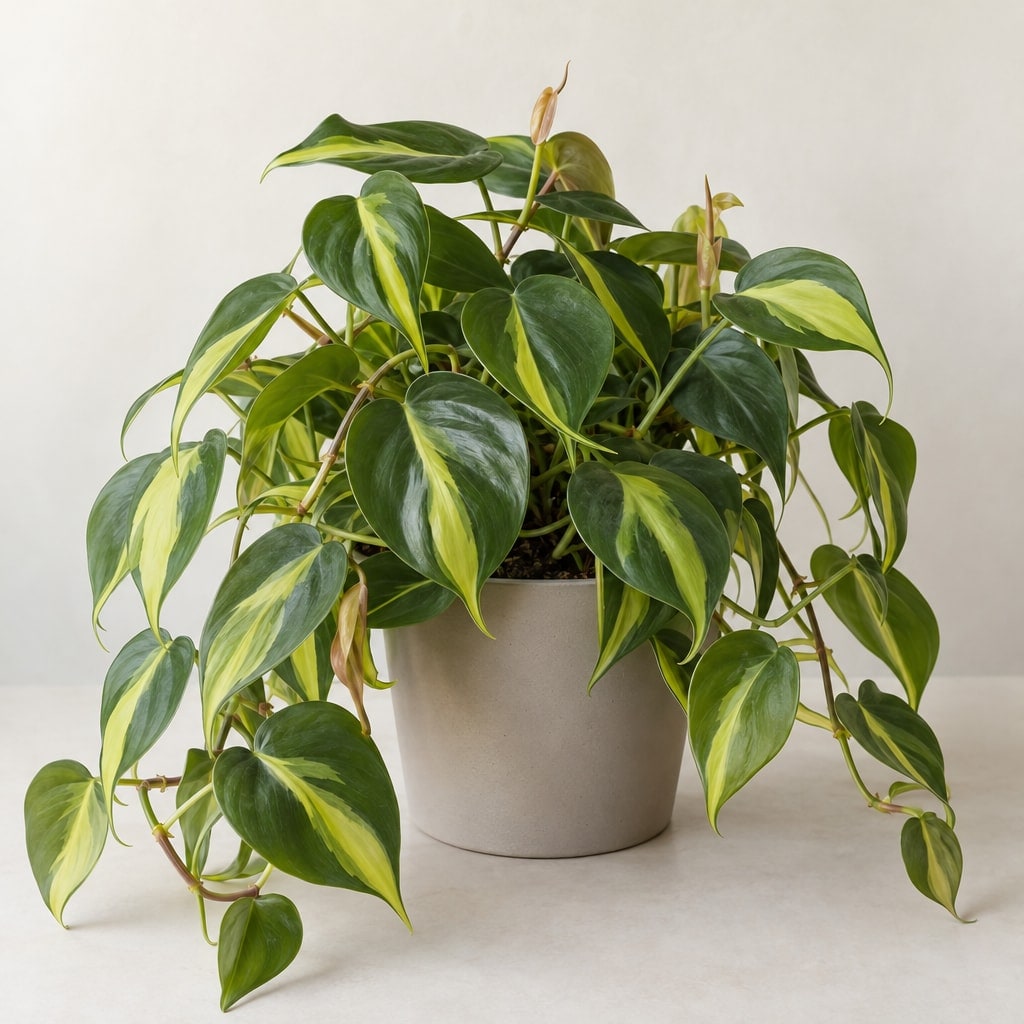
What sets 'Brasil' apart from the plain green species is a bold yellow-green stripe running down the center of each heart-shaped leaf, varying from a thin thread to a band that nearly fills the blade. Leaf tips also run a touch more elongated and pointed than other heartleaf forms, and new stems emerge reddish before fading to orange-brown. Because the patent describes it reaching only about six inches tall with a twenty-inch spread, its real presence comes from trailing stems that can run several feet, and growth tends to lag slightly behind solid-green philodendrons.
Source: Epic Gardening
Fading Back to Green
The quirk most particular to this cultivar is variegation loss: in low light the yellow-green striping recedes and leaves trend back toward plain green. Moving the plant into bright indirect light generally restores the pattern over time, and it may even expand.
Source: Epic Gardening
Care recipe
Each fact carries its confidence tier — and says whether it belongs to this cultivar or is inherited from the species.
Care notes reviewed by Horta
- Light
- ai:claude-sonnet-5
- Water
- ai:claude-sonnet-5
- Humidity
- ai:claude-sonnet-5
- Care
- ai:claude-sonnet-5
Bright, indirect
≈ every 7 days
High
18–29 °C
Light, well-draining aroid or peat-based mix
Node cuttings in water or sphagnum moss
Balanced liquid feed monthly in the growing season
Slow
Rarely flowers indoors
Toxic to cats & dogs & humans
Araceae contain insoluble calcium oxalate crystals that irritate the mouth and digestive tract if chewed. This is where toxicity lives: every cultivar inherits it and none can override it.
Reference images
Every image credited. Licenses link to their deeds.
PrimarySources: ai:claude-sonnet-5 · ai:claude-opus-4-8 (family inference)
Kept true by its growers
Every fact here carries its source. Grow ‘Brasil’ yourself? What you’ve observed — how it drinks, how it holds its color, a name that’s off — and a clear photo of your plant are exactly what keep this page honest. Contributions are reviewed before anything changes.
Sign in to add what you know →