Cultivar · genus Philodendron
Birkin
Philodendron erubescens · ‘Birkin’
Guide
Written and kept by people who grow it. Every section carries its source.
A Pinstriped Sport
Birkin is a cultivar that arose as a mutation, most likely from 'Rojo Congo,' rather than a plant you would ever encounter in the wild. It was introduced in 2010 and quickly became one of the more recognizable variegated philodendrons on the market.
Source: NC State Extension
A Chimeric Accident
Birkin traces back to a chimeric mutation on a Rojo Congo plant, where some cells lost the ability to make chlorophyll. Most such mutations fade after a generation or two, but this one held stable enough through repeated propagation to be named and brought to market. Because it descends from Rojo Congo, which is itself a cross of Imperial Red and Philodendron tatei, Birkin has no wild habitat of its own.
Source: Epic Gardening
No Two Leaves Alike
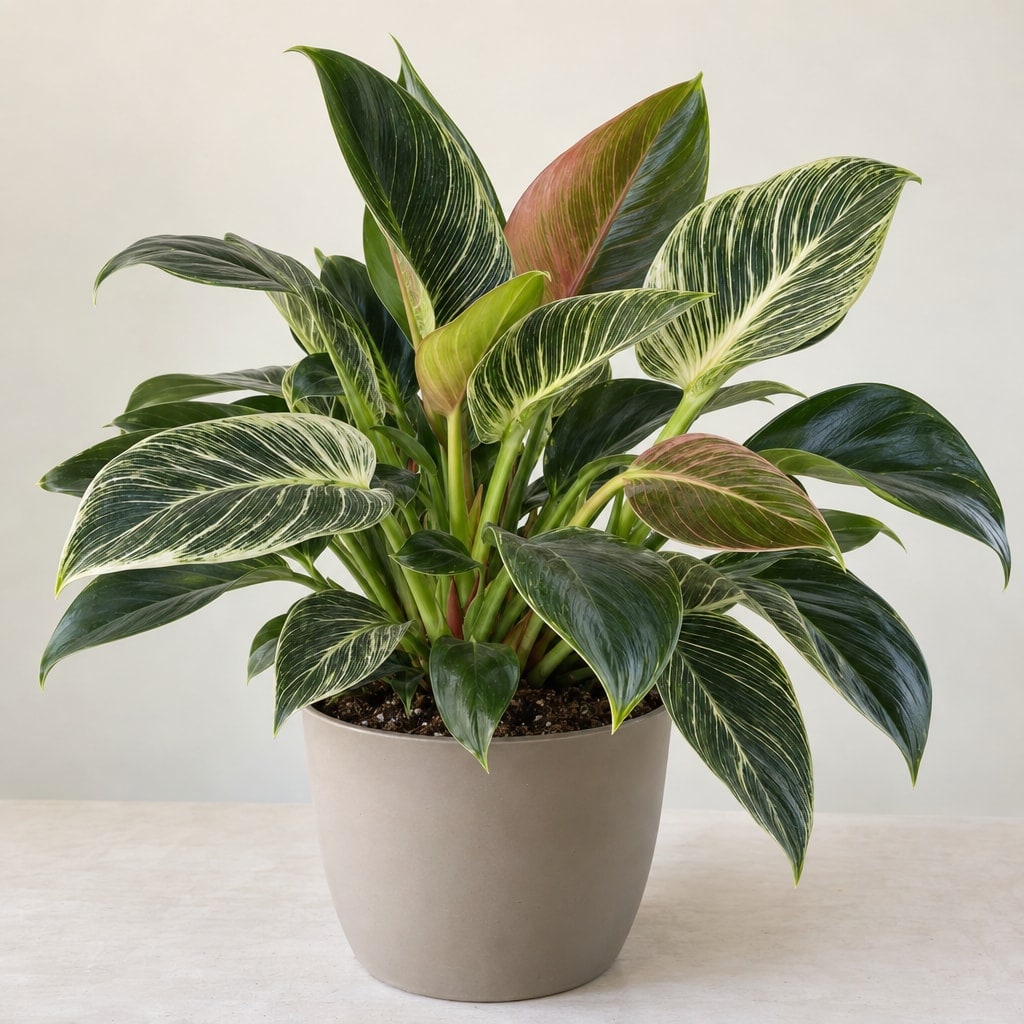
What sets Birkin apart is its pinstriping: fine creamy white, yellow, or light green lines running through glossy dark green leaves, with each leaf carrying its own unique pattern. The stripes grow more pronounced as a leaf matures, and young leaves can emerge nearly white before deepening in green. Unlike its climbing relatives, Birkin is self-heading, growing as a compact, upright clump rather than a vine, and it occasionally throws leaves with red patches or leaves that are entirely reddish-green, a nod to its Red Congo ancestry.
Source: Costa Farms
When the Stripes Fade
Because its variegation depends on patches of chlorophyll-free tissue, Birkin needs more light than a plain green philodendron to keep that patterning. In dim conditions the pinstripes can slowly green over and the plant can also revert toward the purplish hue of its Rojo Congo parent rather than simply going plain green. Moving a fading plant to brighter indirect light can bring the variegation back.
Source: Epic Gardening
Care recipe
Each fact carries its confidence tier — and says whether it belongs to this cultivar or is inherited from the species.
Care notes reviewed by Horta
- Water
- ai:claude-sonnet-5
Bright, indirect
≈ every 7 days
Medium
16–29 °C
Chunky, well-draining aroid mix with bark and perlite
Stem cuttings rooted in water or soil; also air layering.
Balanced liquid feed monthly in the growing season
Slow
Produces a greenish-white spathe and spadix but rarely flowers indoors.
Toxic to cats & dogs & humans
Araceae contain insoluble calcium oxalate crystals, which irritate the mouth and digestive tract if chewed. This is where toxicity lives: every cultivar inherits it and none can override it.
Reference images
Every image credited. Licenses link to their deeds.
PrimarySources: ai:claude-sonnet-5 · ai:claude-opus-4-8 (family inference)
Kept true by its growers
Every fact here carries its source. Grow ‘Birkin’ yourself? What you’ve observed — how it drinks, how it holds its color, a name that’s off — and a clear photo of your plant are exactly what keep this page honest. Contributions are reviewed before anything changes.
Sign in to add what you know →