Species · genus Gasteria · Asphodelaceae
Keeled Oxtongue
Gasteria carinata (Mill.) Duval
Cultivars of G. carinata
The named forms growers keep — each with its own page, each honest about how much we know.
No named cultivars catalogued under G. carinata yet. When growers document a stable, named form, it earns its own page here.
Guide
The species-level account. Cultivar pages build on this and say where they differ.
A Warty-Leaved Succulent
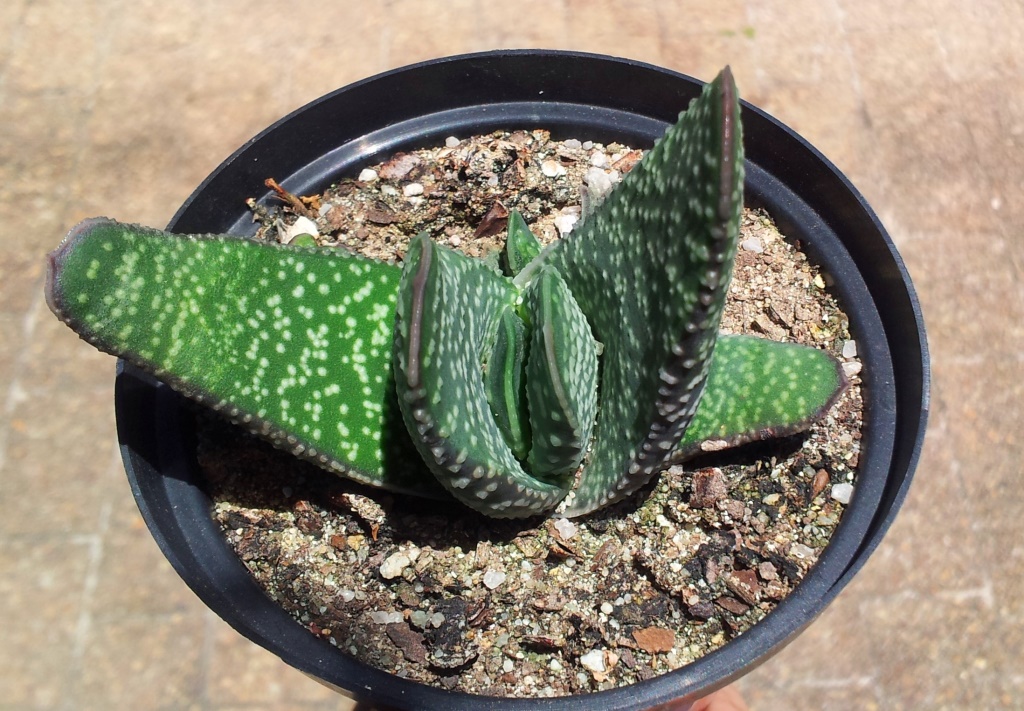
This is the warty keeled ox tongue, a clump-forming succulent that stays low, reaching only around 15cm tall. Its two-ranked, tough leaves are heavily speckled with raised white tubercles, giving the plant its common name.
Source: RHS
A South African Native
Gasteria carinata comes from the Cape Provinces of South Africa, where it grows as a succulent perennial in the subtropical biome. The species carries one accepted infraspecific variety among several recognised botanical forms, including the warty verrucosa and the retusa varieties.
Source: Kew
A Gritty, Sun-Loving Rhythm
Grown under glass, it wants a standard cactus compost and bright, filtered light, with full sun to partial shade suiting it outdoors in a sheltered, south- or west-facing spot. Water moderately through the growing season and feed with a low-nitrogen liquid fertiliser every four or five weeks, then let it run almost dry over winter. It sits happily in loam or sandy, well-drained soil across acid, alkaline, or neutral pH.
Source: RHS
Seed, Offsets, or Leaf Cuttings
This plant can be raised from seed, by separating the offsets it produces around its base, or through leaf cuttings.
Source: RHS
Tongue-Shaped Leaves, Tubular Flowers
The genus Gasteria is known for its stemless clumps of fleshy, often two-ranked rosettes, a form this plant follows closely. In late spring and summer it sends up slender flower spikes to 30cm high, carrying pendulous, tubular orange flowers tipped in green.
Source: RHS
Largely Trouble-Free
This gasteria is generally pest-free and generally disease-free as well.
Source: RHS
Little Fuss Required
No pruning is needed for this plant, and it suits low-maintenance houseplant or conservatory growing. Expect it to take roughly two to five years to reach full maturity.
Source: RHS
Care recipe
The species record — the baseline every cultivar inherits unless it says otherwise.
Care notes are early — not yet verified
- Light
- ai:claude-opus-4-8
- Water
- ai:claude-opus-4-8 (range 14-28d)
- Humidity
- ai:claude-opus-4-8
- Soil
- ai:claude-fable-5
- Care
- ai:claude-fable-5
Bright, indirect
≈ every 28 days
Low — average room
10–30 °C
Gritty, fast-draining cactus and succulent mix
Leaf cuttings or offsets
Dilute succulent feed once or twice in summer
Slow
Arching sprays of pink-red tubular flowers
Not yet documented
This is where toxicity lives — every cultivar of this species inherits it and none can override it.
Reference images
Every image credited. Licenses link to their deeds.
PrimarySources: ai:claude-opus-4-8 · ai:claude-opus-4-8 (range 14-28d) · ai:claude-fable-5
Kept true by its growers
Every fact here carries its source. Grow Keeled Oxtongue yourself? What you’ve observed — how it drinks, how it holds its color, a name that’s off — and a clear photo of your plant are exactly what keep this page honest. Contributions are reviewed before anything changes.
Sign in to add what you know →