Cultivar · genus Ficus
Tineke
Ficus elastica · ‘Tineke’
Guide
Written and kept by people who grow it. Every section carries its source.
A Variegated Classic
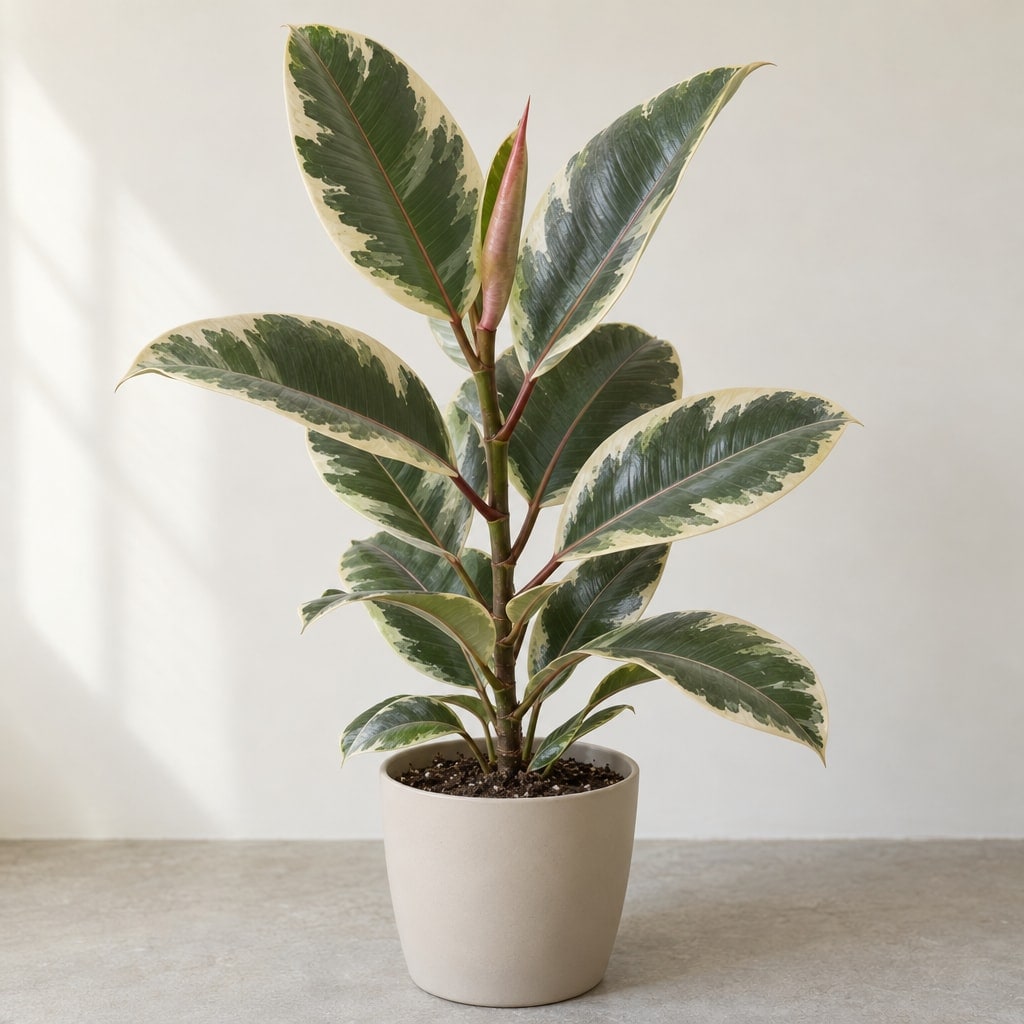
Tineke is a variegated selection of the rubber tree, one that has been in cultivation for decades yet recently found fresh popularity. What sets it apart from the plain-leaved species is its creamy-white marked foliage on an otherwise familiar, easy-care rubber tree frame.
Source: Costa Farms
More Forgiving Than It Looks
Despite its showy variegation, Tineke is described as more easy-going about light and water than its relative the Fiddleleaf Fig, which makes it a reasonable pick for someone who wants a similar bold look without the fuss. Indoors it does best in medium to bright light, ideally within 3 to 4 feet of an unobstructed east- or west-facing window, and can also grow under artificial light. Water once the top half of the potting mix has dried, and give it average household temperatures with average to above-average humidity.
Source: Costa Farms
Gray-Green and Cream
Tineke's leaves are broad, thick, and irregularly edged in creamy white against a gray-green base, a marbled look rather than a clean split. RHS describes the upper leaf surface as dark-green and cream with a lighter underside, and each leaf carries a reddish-brown midrib and leaf stalk. Grown well, it keeps a bushy, upright tree habit.
Source: RHS
Size Is Containable
Left outdoors in frost-free climates this variety can become a genuine tree, reportedly reaching 40 feet, but that is not the indoor reality. Lower indoor light and the restriction of a pot slow its growth considerably, so it stays a manageable size for a home. As a floor specimen it is also noted as a touch slower growing than some other rubber tree varieties.
Source: Costa Farms
Care recipe
Each fact carries its confidence tier — and says whether it belongs to this cultivar or is inherited from the species.
Care notes reviewed by Horta
- Water
- ai:claude-sonnet-5
- Humidity
- ai:claude-sonnet-5
- Soil
- ai:claude-sonnet-5
- Care
- ai:claude-sonnet-5
Bright, indirect
≈ every 7 days
Medium
16–30 °C
peat-free, loam-based compost with added bark chippings
semi-ripe cuttings or layering in spring or late summer
high nitrogen fertiliser every four weeks during growth; stop feeding and keep just moist over winter
Slow
In cultivation, yellow fruits can only appear on the largest plants
Toxic to cats & dogs
Fig / rubber plant — irritant latex (ficin); GI upset, dermatitis. This is where toxicity lives: every cultivar inherits it and none can override it.
Reference images
Every image credited. Licenses link to their deeds.
PrimarySources: ai:claude-sonnet-5 · ASPCA
Kept true by its growers
Every fact here carries its source. Grow ‘Tineke’ yourself? What you’ve observed — how it drinks, how it holds its color, a name that’s off — and a clear photo of your plant are exactly what keep this page honest. Contributions are reviewed before anything changes.
Sign in to add what you know →