Species · genus Cyclamen · Primulaceae
Florist's Cyclamen
Cyclamen persicum Mill.
Also known as: Common Cyclamen · Cyclamen · Persian Cyclamen · Tangara Rastrojera
Cultivars of C. persicum
The named forms growers keep — each with its own page, each honest about how much we know.
No named cultivars catalogued under C. persicum yet. When growers document a stable, named form, it earns its own page here.
Guide
The species-level account. Cultivar pages build on this and say where they differ.
A Winter-Blooming Tuber
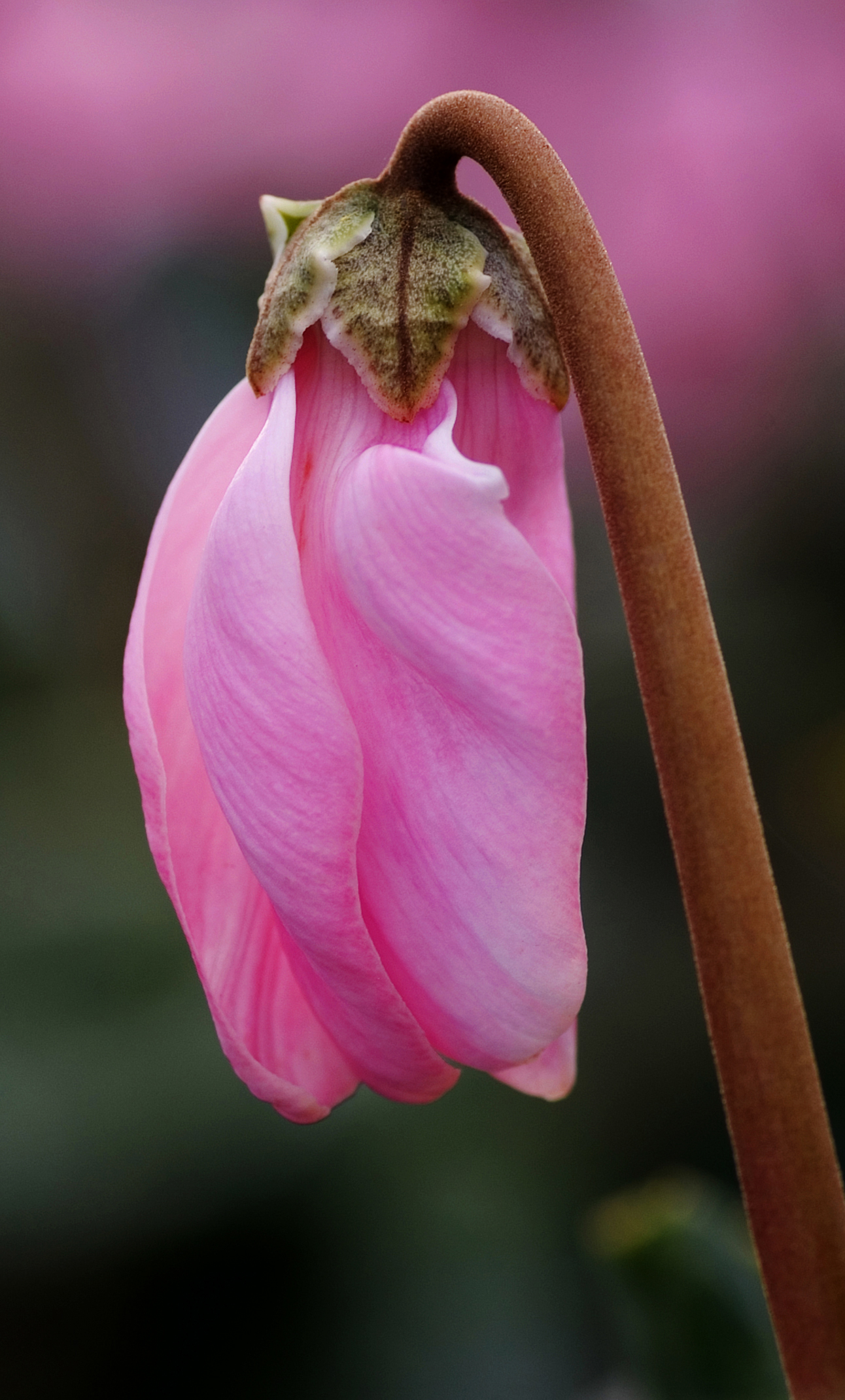
Persian cyclamen is a tuberous perennial grown indoors or under glass for its winter and spring flowers, held above heart-shaped, silver-marked foliage. The fragrant white or pink blooms have petals swept upwards with carmine mouths, and the whole plant stays compact, generally reaching only 10-20cm.
Source: RHS
Roots in the Mediterranean
This species comes from the eastern Mediterranean, where it grows tucked into the shade of rocky crevices through the mountains. Its native climate swings from cool, wet winters to hot, dry summers, and the plant's whole rhythm of growth and dormancy is a response to that pattern.
Source: Epic Gardening
A Cool, Steady Routine
Grow it in bright filtered light with moderate humidity, keeping winter temperatures between 13 and 16°C and avoiding draughts or hot, dry air. Water moderately while the plant is in growth, feeding fortnightly with a low-nitrogen liquid fertiliser, then taper off watering as flowering finishes and let the tuber rest dry through dormancy. Pot it in peat-free, loam-based compost with the top of the tuber sitting just above the soil surface.
Source: RHS
Starting From Seed
Propagation is by seed, sown in darkness as soon as it is ripe, at a temperature of 12 to 15°C. Soaking the seed for 10 hours before sowing can help.
Source: RHS
Marbled Leaves, Upswept Blooms
The heart-shaped leaves carry white or light green patterning with serrated edges, and their undersides are sometimes pale green or reddish. Flowers turn upward in white, pink, red, or purple with a slightly sweet scent, and each plant sits on a rounded tuber that can grow to about 6 inches wide in a pot. The name cyclamen traces back to the Greek word for circle, a nod to that tuber's shape.
Source: Epic Gardening
Watch for Common Invaders
Indoors, cyclamen are prone to the usual houseplant pests of aphids, mealybugs, scale, and thrips, along with two-spotted spider mites and cyclamen mites. Aphids and mites often show first on new growth or in webbing and folds of the tuber, while thrips can be checked for by tapping a flower over white paper. In containers grown outdoors or under glass, vine weevil, mice, and squirrels are also worth watching for.
Source: RHS
Rot, Mould, and Overwatering
The plant is susceptible to cyclamen grey mould and black root rot, and tuber rot from a soft-rot bacterium is a further risk, turning the tuber slimy and foul-smelling while leaves yellow and droop. Overwatering is the main contributing cause, so soil should stay moist without becoming soaked, and the top of the tuber should always be planted above the soil line to keep water from collecting in the crown.
Source: Epic Gardening
Rest Through Summer
No pruning is needed for this species. Once flowering ends, watering should be reduced and the tuber kept dry while dormant, resuming care as growth begins again the following season.
Source: RHS
Care recipe
The species record — the baseline every cultivar inherits unless it says otherwise.
Care notes are early — not yet verified
- Light
- ai:claude-opus-4-8
- Water
- ai:claude-opus-4-8 (range 5-10d)
- Humidity
- ai:claude-opus-4-8
- Soil
- ai:claude-fable-5
- Care
- ai:claude-fable-5
Bright, indirect
≈ every 10 days
Medium
10–18 °C
Airy, well-draining peat-based mix
Sown from seed; tubers rarely divided
Half-strength liquid feed every 2 weeks while in leaf
Moderate
Winter-blooming when kept cool; goes dormant in summer
Toxic to cats & dogs & humans
Primulaceae and Cyclamen tubers contain irritant triterpenoid saponins (cyclamin), concentrated in the tuber. This is where toxicity lives: every cultivar of this species inherits it and none can override it.
Reference images
Every image credited. Licenses link to their deeds.
Sources: ai:claude-opus-4-8 · ai:claude-opus-4-8 (range 5-10d) · ai:claude-fable-5 · ai:claude-opus-4-8 (family inference)
Kept true by its growers
Every fact here carries its source. Grow Florist's Cyclamen yourself? What you’ve observed — how it drinks, how it holds its color, a name that’s off — and a clear photo of your plant are exactly what keep this page honest. Contributions are reviewed before anything changes.
Sign in to add what you know →