Species · genus Cyclamen · Primulaceae
Eastern Sowbread
Cyclamen coum Mill.
Also known as: Eastern Cyclamen · Round-leaved Cyclamen
Cultivars of C. coum
The named forms growers keep — each with its own page, each honest about how much we know.
No named cultivars catalogued under C. coum yet. When growers document a stable, named form, it earns its own page here.
Guide
The species-level account. Cultivar pages build on this and say where they differ.
A Winter Woodland Tuber
Hardy cyclamen is a low tuberous perennial valued for flowering when little else in the garden bothers to, often through late winter and into early spring. Cyclamen coum in particular is a small, dainty species, reaching only about 10cm, that pairs well underplanted with snowdrops, hellebores and other early woodlanders.
Source: RHS
From Bulgaria to Israel
Cyclamen coum, also called eastern or round-leaved cyclamen, hails from a range stretching from Bulgaria through the Caucasus to Israel. Despite this southern origin it is rated fully hardy in the UK, tolerant of severe winter weather.
Source: RHS
Shade, Drainage, Restraint
Hardy cyclamen wants partial shade and a moderately fertile, humus-rich, well-drained soil, and it dislikes an overly dry or overly sunny spot as much as excessive summer moisture. Plant tubers shallow, only 3-5cm deep, since burying them too deeply can stop them flowering, and mulch annually with leafmould or bark chips as the leaves die back, with a deeper mulch in frost-prone areas. Borderline hardy species are better kept in a cool greenhouse with bright filtered light and a touch of humidity, and pot-grown plants do well in a peat-free John Innes No 2 mix with added grit and leafmould or fine composted bark.
Source: RHS
Seed, Ants, and Patience
Propagation is by seed, collected as the flower-stalk coils and draws the ripening capsule down toward the soil. Seed is best sown fresh after an overnight soak, in equal parts seed compost and sharp grit, covered only lightly since light can inhibit germination, then kept bagged at a minimum of 16°C in light shade until large enough to transplant. Left to their own devices, Cyclamen coum will self-sow readily, their sticky seed coats gathered up by ants and woodlice and carried off to germinate wherever those neighbours happen to drop them; starting with two plants improves the odds of successful cross-pollination since a single flower rarely self-pollinates.
Source: RHS
Marbled Leaves, Reflexed Blooms
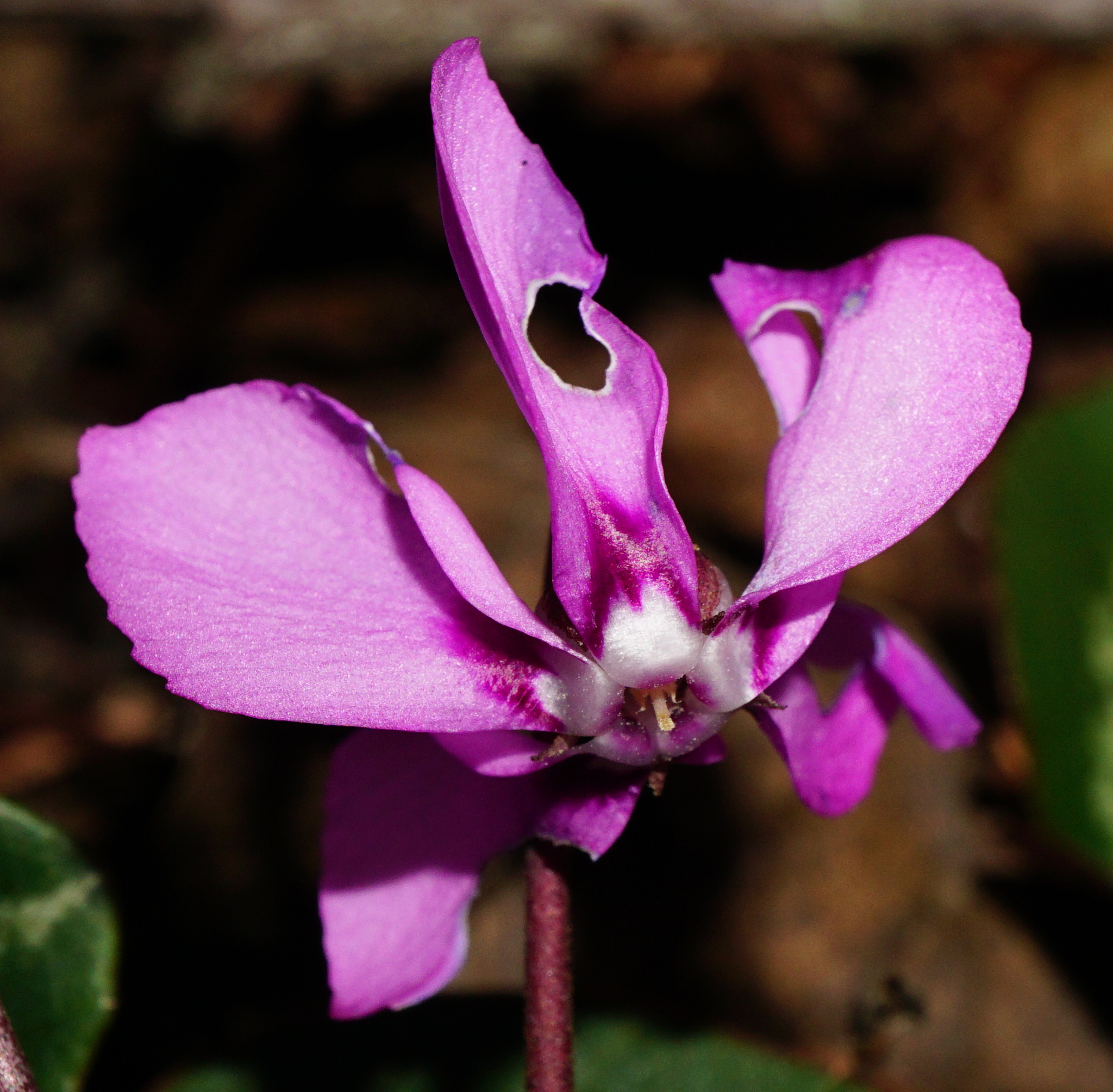
The genus carries rounded, sometimes angular leaves often mottled attractively, and nodding flowers with five reflexed, twisted petals, frequently marked darker at the base. In Cyclamen coum the kidney-shaped foliage ranges from deep lustrous green to fully silver, with countless patterns between, while the small flowers span deep magenta-pink through soft pinks to pure white, some in bicolour form.
Source: RHS
Mice, Squirrels, Weevils
Mice and grey squirrels are known to dig up the tubers in the garden. Under glass, watch for glasshouse red spider mite and vine weevil, both of which trouble cyclamen kept under cover.
Source: RHS
Grey Mould and Damping Off
Fungal problems such as cyclamen grey mould can affect hardy cyclamen, and seedlings are particularly vulnerable to damping off. Grey mould is more of a concern when plants are grown under glass rather than outdoors.
Source: RHS
Care recipe
The species record — the baseline every cultivar inherits unless it says otherwise.
Care notes are early — not yet verified
- Light
- ai:claude-opus-4-8
- Water
- ai:claude-opus-4-8 (range 7-14d)
- Humidity
- ai:claude-opus-4-8
- Soil
- ai:claude-fable-5
- Care
- ai:claude-fable-5
Bright, indirect
≈ every 14 days
Medium
5–18 °C
Well-draining mix, gritty with organic matter
Seed; tubers rest dormant through the off-season
Dilute balanced feed monthly while in active leaf and bloom
Slow
Pink to magenta winter blooms above marbled leaves
Toxic to cats & dogs & humans
Primulaceae, and Cyclamen in particular, contain irritant saponins (triterpenoid saponins) concentrated in the tuber. This is where toxicity lives: every cultivar of this species inherits it and none can override it.
Reference images
Every image credited. Licenses link to their deeds.
Sources: ai:claude-opus-4-8 · ai:claude-opus-4-8 (range 7-14d) · ai:claude-fable-5 · ai:claude-opus-4-8 (family inference)
Kept true by its growers
Every fact here carries its source. Grow Eastern Sowbread yourself? What you’ve observed — how it drinks, how it holds its color, a name that’s off — and a clear photo of your plant are exactly what keep this page honest. Contributions are reviewed before anything changes.
Sign in to add what you know →