Species · genus Cissus · Vitaceae
Veldt Grape
Cissus quadrangularis L.
Also known as: Winged Treebine · Adamant Creeper · Devil's Backbone · Finger Cactus · Single-stemmed Wild Grape
Cultivars of C. quadrangularis
The named forms growers keep — each with its own page, each honest about how much we know.
No named cultivars catalogued under C. quadrangularis yet. When growers document a stable, named form, it earns its own page here.
Guide
The species-level account. Cultivar pages build on this and say where they differ.
A Four-Angled Climber
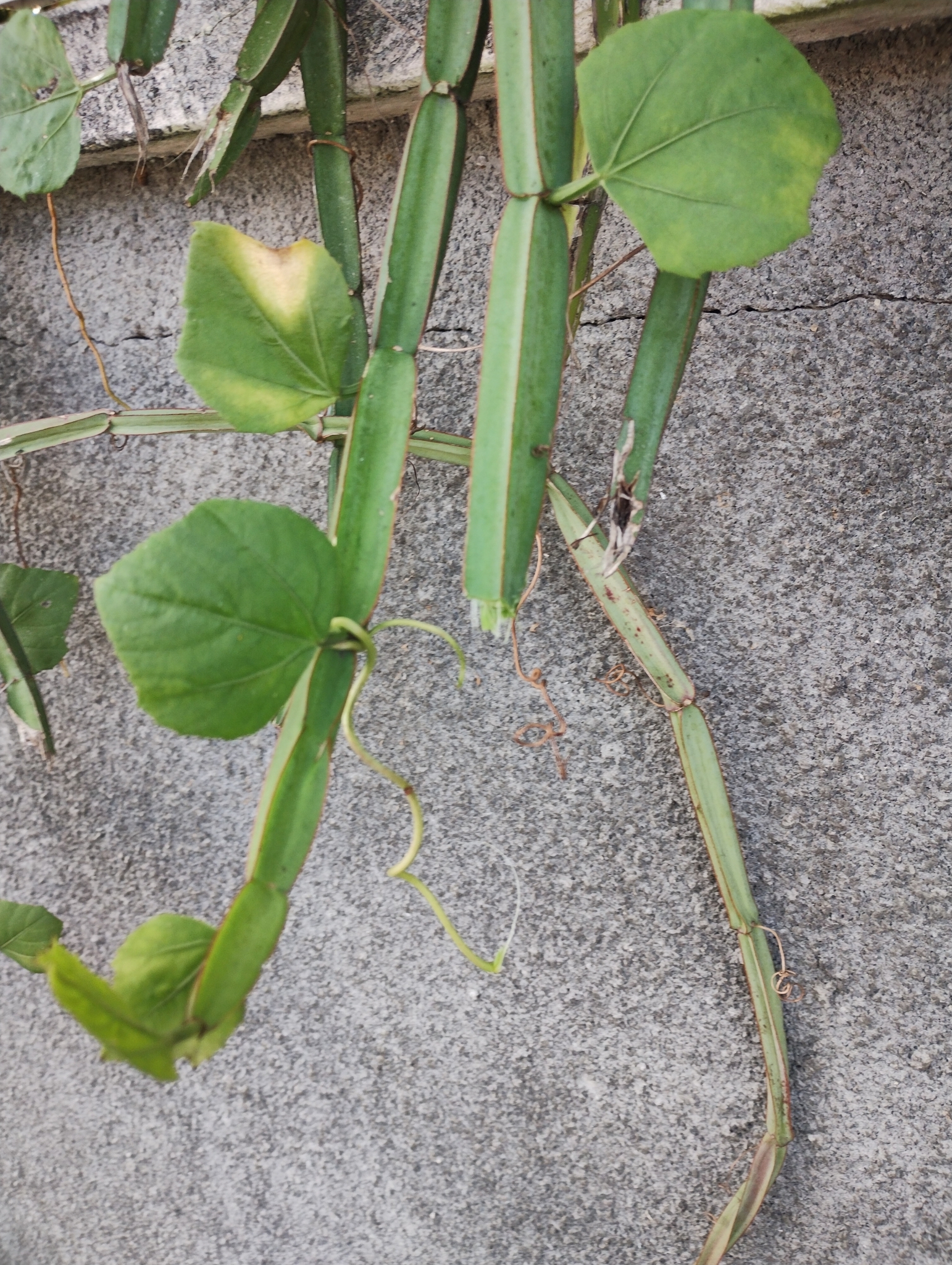
Cissus quadrangularis is a succulent climbing member of the grape family, Vitaceae, known for its thick, jointed, four-angled stems and its tendrils. It carries only sparse, small, rounded leaves along those stems, the succulence doing most of the visual work.
Source: RHS
A Wide Old-World Range
This species is native across a broad swathe of the Old World tropics, from tropical and southern Africa and Madagascar through the Arabian Peninsula to the Indian Subcontinent and Myanmar. It has also been introduced well beyond that range, turning up in places such as Cuba, Jamaica, the Philippines, and several Indian Ocean islands. It grows naturally in seasonally dry tropical settings, which explains its climbing, succulent habit.
Source: Kew
Sun, Grit, and Restraint
Grown under glass, this plant wants full sun and a gritty, free-draining compost, reflecting its dry-tropical origins. Water it moderately while it is actively growing, feed monthly with a balanced liquid feed, then pull back sharply on water through winter. It is rated for the warmest UK protection category, needing glasshouse conditions all year round rather than any outdoor exposure.
Source: RHS
Cuttings or Seed
Propagation is straightforward from stem cuttings, or by sowing seed at around 21°C in spring.
Source: RHS
Stems Over Leaves
The defining feature here is the stem itself: thick, jointed, and distinctly four-angled, functioning as both support and water store. Leaves are secondary, rounded, slightly fleshy, and reaching only about 5cm long, appearing sparsely along the length of stem. As a climber it uses tendrils to hitch onto whatever structure is nearby, and it can reach 1.5 to 2.5 metres in height with a more modest spread.
Source: RHS
Glasshouse Regulars
Under glass this plant can attract the usual protected-crop trio: glasshouse red spider mite, glasshouse whitefly, and mealybugs. It is otherwise generally free of disease.
Source: RHS
Repotting Rhythm
Pot on every two to three years and top dress with fresh compost in spring. Pruning follows the guidance given for climbers in group eleven.
Source: RHS
Care recipe
The species record — the baseline every cultivar inherits unless it says otherwise.
Care notes are early — not yet verified
- Light
- ai:claude-opus-4-8
- Water
- ai:claude-opus-4-8 (range 14-28d)
- Humidity
- ai:claude-opus-4-8
- Soil
- ai:claude-fable-5
- Care
- ai:claude-fable-5
Bright, indirect
≈ every 28 days
Low — average room
13–32 °C
Very gritty, sharply draining succulent mix
Stem-segment cuttings left to callus
Light cactus feed once or twice in summer
Moderate
Rarely flowers indoors
Not yet documented
This is where toxicity lives — every cultivar of this species inherits it and none can override it.
Reference images
Every image credited. Licenses link to their deeds.
PrimarySources: ai:claude-opus-4-8 · ai:claude-opus-4-8 (range 14-28d) · ai:claude-fable-5
Kept true by its growers
Every fact here carries its source. Grow Veldt Grape yourself? What you’ve observed — how it drinks, how it holds its color, a name that’s off — and a clear photo of your plant are exactly what keep this page honest. Contributions are reviewed before anything changes.
Sign in to add what you know →