Cultivar · genus Aglaonema
Silver Bay
Aglaonema commutatum · ‘Silver Bay’
Guide
Written and kept by people who grow it. Every section carries its source.
A Named Chinese Evergreen Selection
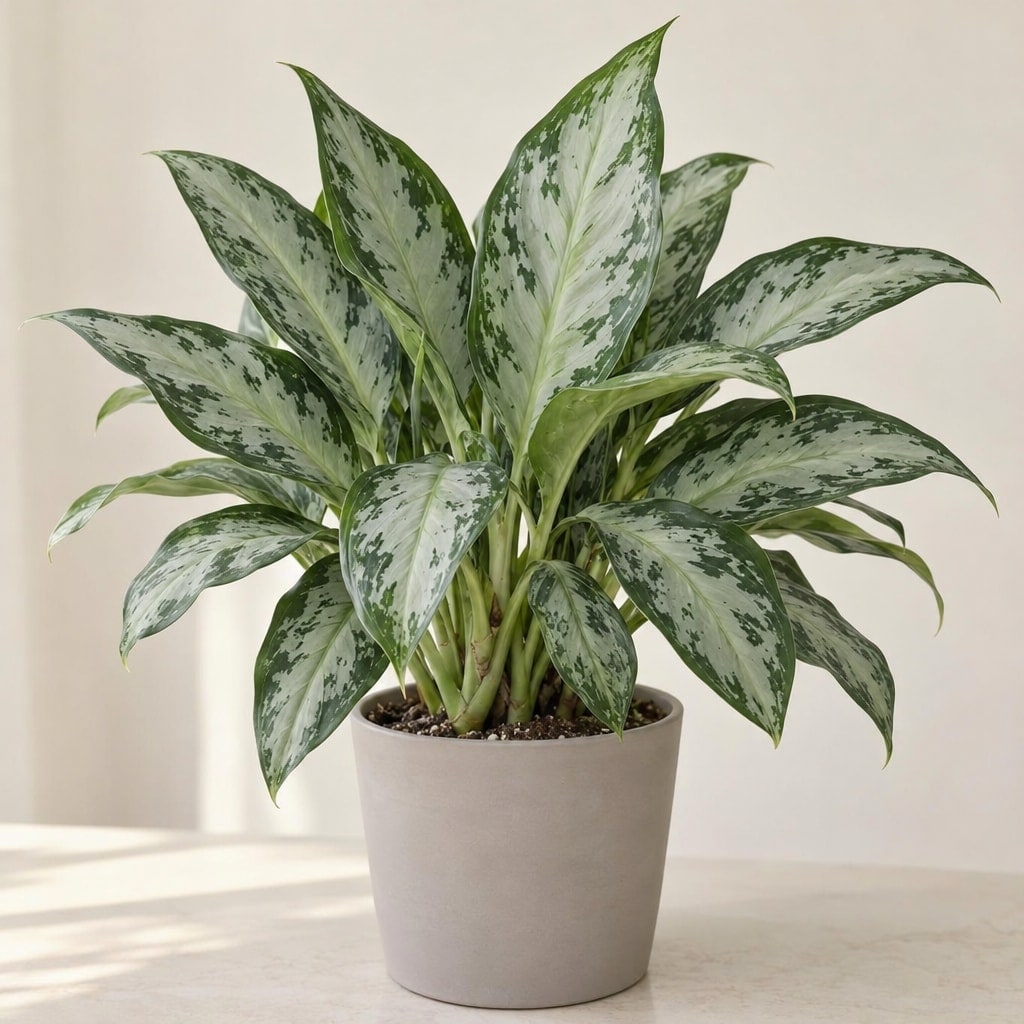
Silver Bay is a cultivated selection of Chinese evergreen rather than a wild species, bred specifically for its distinctive silvery, variegated foliage. It's grown as a floor-sized houseplant prized as much for its pattern as for its famous toughness.
Source: Costa Farms
A University Hybrid
This cultivar was developed in 1992 by the University of Florida's Foliage Plant Breeding Program, a deliberate cross of Aglaonema 'Manila Whirl' and 'Ernesto's Favorite'. Decades later it remains one of the more widely grown Aglaonema varieties to come out of that breeding work.
Source: Costa Farms
Tolerant of Low Light and Neglect
Where this selection diverges from a more finicky Aglaonema is its billed tolerance for genuinely low light and infrequent watering, going several weeks between drinks without complaint and still holding its look without high humidity. Costa Farms is clear that it does best in medium to bright light even though it can get by on little, and warns it is sensitive to root rot if overwatered. RHS, by contrast, categorizes it for partial shade and calls for only moderate watering under glass, since excess water leads to stem rot — a reminder that even a tough selection has real limits.
Source: Costa Farms
Silvery, Feathered Leaf Pattern
What sets 'Silver Bay' apart is its silvery leaf surface marked by irregular dark green edges that feather outward from the center of each leaf. Costa Farms describes it as a showstopping variegation, and it can reach about three feet tall and wide as a mature specimen. RHS notes a similar but distinct reading of the pattern: broad green margins framing a paler green center, held upright in a clump-forming, columnar habit to around waist height.
Source: Costa Farms
Care recipe
Each fact carries its confidence tier — and says whether it belongs to this cultivar or is inherited from the species.
Care notes reviewed by Horta
- Water
- ai:claude-sonnet-5
- Humidity
- ai:claude-sonnet-5
- Soil
- ai:claude-sonnet-5
- Care
- ai:claude-sonnet-5
Medium light
≈ every 14 days
Low — average room
16–29 °C
Well-drained soil; Chalk, Loam, Sand; acid, alkaline or neutral pH
Propagate from basal shoots or by division
Balanced liquid feed monthly in spring and summer
Slow
Occasionally produces modest greenish spathes indoors
Toxic to cats & dogs & humans
Araceae contain insoluble calcium oxalate crystals, which irritate the mouth and digestive tract if chewed. This is where toxicity lives: every cultivar inherits it and none can override it.
Reference images
Every image credited. Licenses link to their deeds.
PrimarySources: ai:claude-sonnet-5 · ai:claude-opus-4-8 (family inference)
Kept true by its growers
Every fact here carries its source. Grow ‘Silver Bay’ yourself? What you’ve observed — how it drinks, how it holds its color, a name that’s off — and a clear photo of your plant are exactly what keep this page honest. Contributions are reviewed before anything changes.
Sign in to add what you know →