Species · genus Aglaonema · Araceae
Chinese Evergreen
Aglaonema commutatum Schott
Also known as: Philippine Evergreen · Silver Queen Aglaonema
Cultivars of A. commutatum
The named forms growers keep — each with its own page, each honest about how much we know.
No named cultivars catalogued under A. commutatum yet. When growers document a stable, named form, it earns its own page here.
Guide
The species-level account. Cultivar pages build on this and say where they differ.
A Shade-Loving Aroid
Aglaonema commutatum, known as Chinese or Philippine evergreen, is an evergreen herbaceous perennial in the arum family. It is grown chiefly as a houseplant for its patterned foliage rather than for its modest flowers, which rarely appear indoors.
Source: Missouri Botanical Garden
Native To Central Malesia
This species is native to the Philippines and Sulawesi, part of the Central Malesian region, where it grows as a subshrub in the wet tropical biome. It has since been introduced well beyond that range, turning up in places from Bangladesh to Cuba and Puerto Rico, and it carries recorded environmental, social, and medicinal uses.
Source: Kew
Steady Light, Even Moisture
Give it diffused sun or good indirect light indoors, keeping it out of direct sun, and grow it in a well-drained, peaty mix. Keep moisture consistent from spring through fall, then ease off from early fall to late winter, never letting the soil go fully dry, while trusting the plant to shrug off drier household air. Normal room temperatures suit it, with a minimum of about 60°F in winter, and it does not demand a true dormant rest, only a quieter one.
Source: Missouri Botanical Garden
Division Is Simplest
Home growers most often propagate by division, since the plant naturally sends up suckers around the base that can fill a pot with young plants. Loosen the mother plant from its pot, tease the roots apart by hand if they aren't tangled, or, if rootbound, slice the mass with a sterile knife into sections that each keep an even share of leaves and stems. Seeds, tip cuttings, and lab tissue culture are also possible routes, though less commonly used at home.
Source: Epic Gardening
Silver-Blotched Foliage
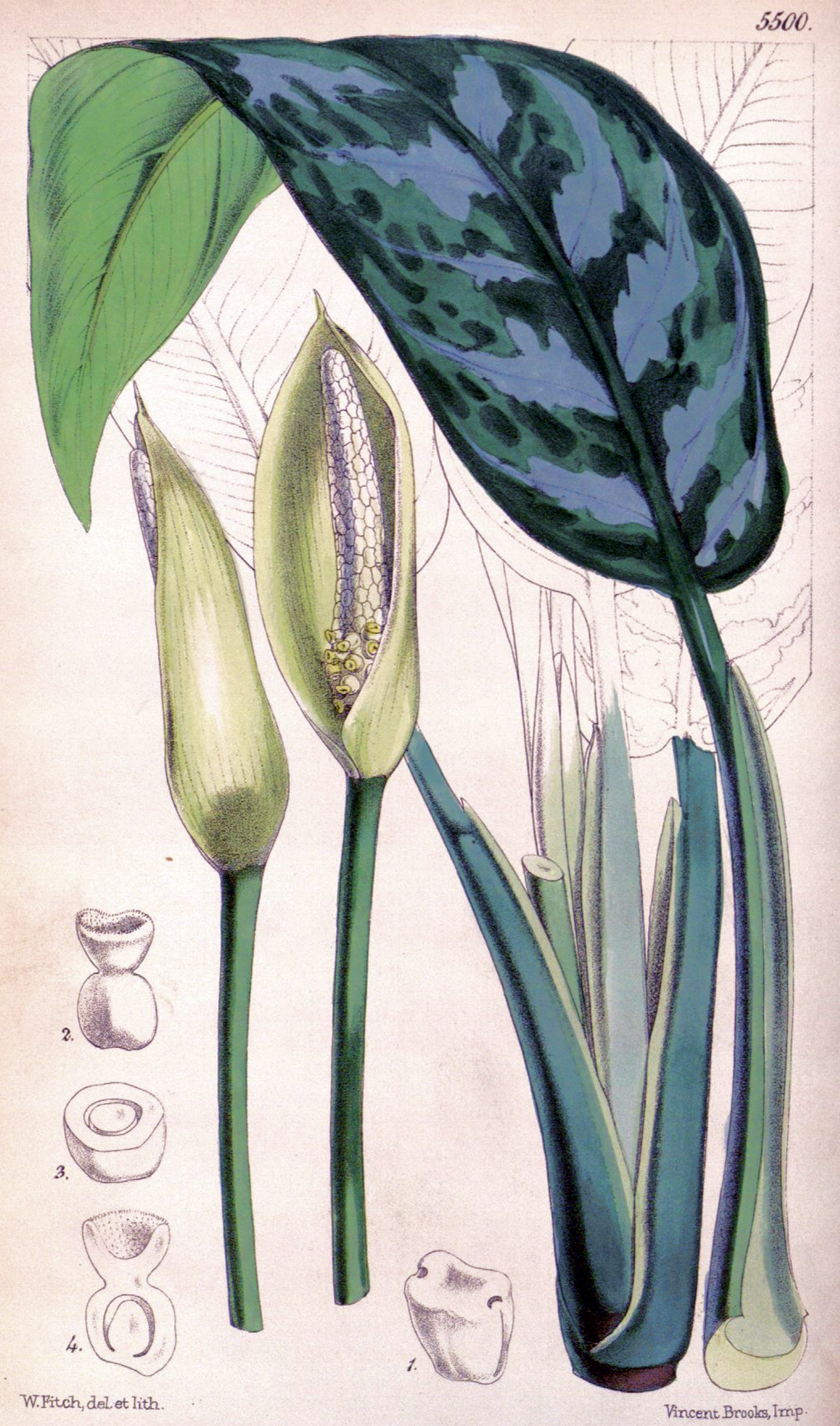
The plant typically reaches about 20 inches tall, with thick, elliptic to lance-shaped dark green leaves marked by silver-gray blotches, carried on erect and sometimes branched stems. On the rare occasion it flowers indoors, usually in late summer or early fall, it produces the classic arum arrangement of a small creamy white spadix wrapped in a pale green spathe, sometimes followed by clusters of red berries. Its genus name nods to the bright, thread-like stamens, while the species name simply means changing in form.
Source: Missouri Botanical Garden
Sap-Sucking Visitors
Watch for mealybugs, which cling to the leathery leaves and draw out sap, along with scale insects that behave similarly. Spider mites and aphids show up less often but cause comparable damage, typically settling on the undersides of leaves and stems.
Source: Epic Gardening
Watering Drives Most Trouble
Yellowing leaves are the most frequent complaint and usually trace back to watering, most often overwatering rather than too little; steady, moderate moisture keeps foliage properly dark green. If yellowing persists despite good watering habits, the cause may be a copper deficiency, since this plant is a notably heavy user of that micronutrient. Browning leaf tips often come from mineral or salt buildup carried in tap water, which can be corrected by leaching the soil with distilled water or simply repotting into fresh mix; browning can also follow from very dry air or a drafty spot.
Source: Epic Gardening
Light Pruning, Periodic Repotting
Pruning is mostly cosmetic here: snip off dead, dark leaves down at the base with sterile tools, but leave leggy live growth alone rather than cutting it back hard, as that risks real damage to the plant. It's worth trimming off flower stalks before buds open, since the blooms aren't much to look at and simply draw energy from foliage growth. Repot into fresh soil roughly every two years, sizing the new pot only modestly larger and replanting at the same depth as before.
Source: Epic Gardening
Care recipe
The species record — the baseline every cultivar inherits unless it says otherwise.
Care notes are early — not yet verified
- Light
- ai:claude-opus-4-8
- Water
- ai:claude-opus-4-8 (range 7-14d)
- Humidity
- ai:claude-opus-4-8
- Soil
- ai:claude-fable-5
- Care
- ai:claude-fable-5
Medium light
≈ every 14 days
Medium
16–29 °C
Loose, well-draining peat-based potting mix
Stem cuttings or division of the clump
Balanced liquid feed monthly in spring and summer
Moderate
Occasionally produces modest greenish spathes indoors
Toxic to cats & dogs & humans
Araceae contain insoluble calcium oxalate crystals, which irritate the mouth and digestive tract if chewed. This is where toxicity lives: every cultivar of this species inherits it and none can override it.
Reference images
Every image credited. Licenses link to their deeds.
Sources: ai:claude-opus-4-8 · ai:claude-opus-4-8 (range 7-14d) · ai:claude-fable-5 · ai:claude-opus-4-8 (family inference)
Kept true by its growers
Every fact here carries its source. Grow Chinese Evergreen yourself? What you’ve observed — how it drinks, how it holds its color, a name that’s off — and a clear photo of your plant are exactly what keep this page honest. Contributions are reviewed before anything changes.
Sign in to add what you know →