Species · genus Yucca · Asparagaceae
Don Quixote's Lace
Yucca treculiana Carrière
Also known as: Don Quixote's Lance · Spanish Bayonet · Spanish Dagger
Cultivars of Y. treculiana
The named forms growers keep — each with its own page, each honest about how much we know.
No named cultivars catalogued under Y. treculiana yet. When growers document a stable, named form, it earns its own page here.
Guide
The species-level account. Cultivar pages build on this and say where they differ.
A Yucca of the Genus
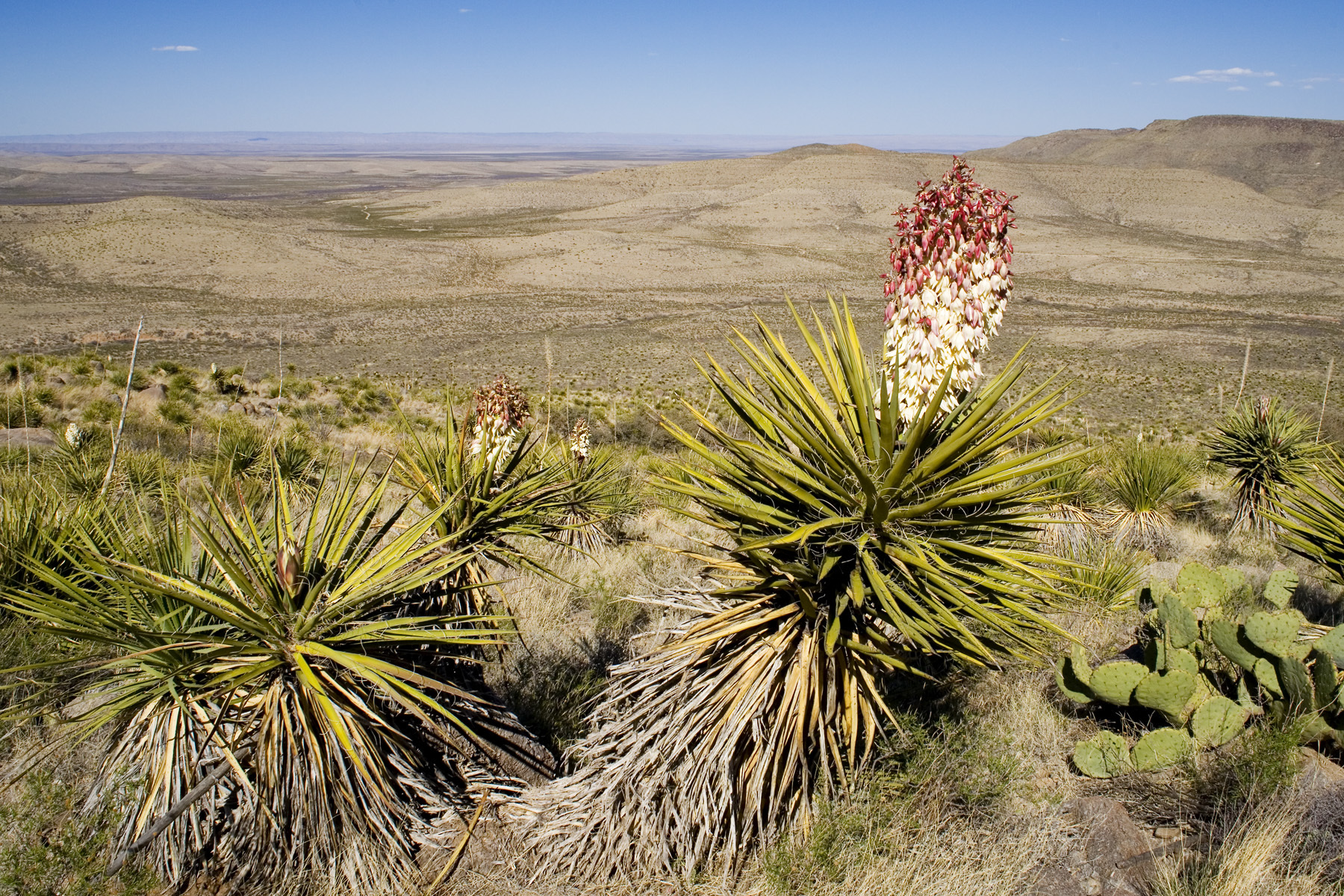
Yucca treculiana is a tree-forming species in the wider Yucca group, part of the asparagus family. It belongs to a genus of some 55 accepted species, most known for stiff, sword-shaped foliage and tall flower spikes.
Source: Kew
A Desert Native
This species comes from south-central parts of the United States through to northeastern Mexico, reaching as far as northern Veracruz. It grows naturally in desert and dry shrubland country, spanning Texas, New Mexico, and the Mexican Gulf and northeast regions. Carrière first described it in 1858, and over the decades botanists attached more than twenty other names to it before it settled under this one.
Source: Kew
Sun, Drainage, Restraint
Like other yuccas, this plant wants a sunny position through the year, with well-drained compost and watering done with some care rather than routine. Outdoors it takes full sun to light shade; indoors, a south-facing window suits winter and an east or west one suits summer, with light shade from the harshest midday sun. Water freely and feed with a balanced liquid feed fortnightly through the growing season from April to September, then hold back in winter, letting the top layer of compost dry before watering again.
Source: RHS
Cuttings, Offsets, Seed
Stem cuttings around 20 to 25cm long can be taken in spring, set into coarse sandy compost, and kept in semi-shade in a propagator with bottom heat of at least 18°C. Offsets that appear at the base of the plant are best removed in March or April, cut free at the rhizome, dried for a couple of days, then treated as cuttings. Seed can also be sown in spring, soaked for 24 hours beforehand to speed germination, at temperatures suited to hardy or tender kinds respectively.
Source: RHS
Aphids and Snails
Grown outdoors, this genus is generally trouble-free, though aphids can trouble the flowers and snails may chew at the leaves. Brown fungal spots are another occasional visitor on the foliage.
Source: RHS
Reading the Leaves
Some yellowing and browning of lower leaves is simply the plant's natural habit as it ages and sheds foliage. Crisp, brown lower leaves usually point to under-watering, while sagging or drooping growth suggests checking watering levels, whether too much or too little, alongside low light. Sudden yellowing and limpness, though, signals overwatering and possible root rot, calling for reduced water, a dry-out period, and if needed a repot into fresh, minimal compost.
Source: RHS
Little Pruning Needed
Pruning is not usually necessary, though damaged leaves and spent flower spikes can be trimmed away in spring. Indoor plants benefit from an occasional turn to stop them leaning toward the light, and an overly tall specimen can have its height reduced by about half in spring once growth resumes, with the cut top usable for propagation.
Source: RHS
Care recipe
The species record — the baseline every cultivar inherits unless it says otherwise.
Care notes are early — not yet verified
- Light
- ai:claude-opus-4-8
- Water
- ai:claude-opus-4-8 (range 14-28d)
- Humidity
- ai:claude-opus-4-8
- Soil
- ai:claude-fable-5
- Care
- ai:claude-fable-5
Direct sun
≈ every 28 days
Low — average room
6–34 °C
Deep, sandy, fast-draining mix
Seed; occasional offsets
Light feed once or twice in the growing season
Slow
Rarely flowers indoors
Toxic to cats & dogs
Saponins — vomiting, drooling. This is where toxicity lives: every cultivar of this species inherits it and none can override it.
Reference images
Every image credited. Licenses link to their deeds.
PrimarySources: ai:claude-opus-4-8 · ai:claude-opus-4-8 (range 14-28d) · ai:claude-fable-5 · ASPCA
Kept true by its growers
Every fact here carries its source. Grow Don Quixote's Lace yourself? What you’ve observed — how it drinks, how it holds its color, a name that’s off — and a clear photo of your plant are exactly what keep this page honest. Contributions are reviewed before anything changes.
Sign in to add what you know →