Species · genus Yucca · Asparagaceae
Beaked Yucca
Yucca rostrata Engelm. ex Trel.
Also known as: Big Bend Yucca
Cultivars of Y. rostrata
The named forms growers keep — each with its own page, each honest about how much we know.
No named cultivars catalogued under Y. rostrata yet. When growers document a stable, named form, it earns its own page here.
Guide
The species-level account. Cultivar pages build on this and say where they differ.
A Sculptural Desert Yucca
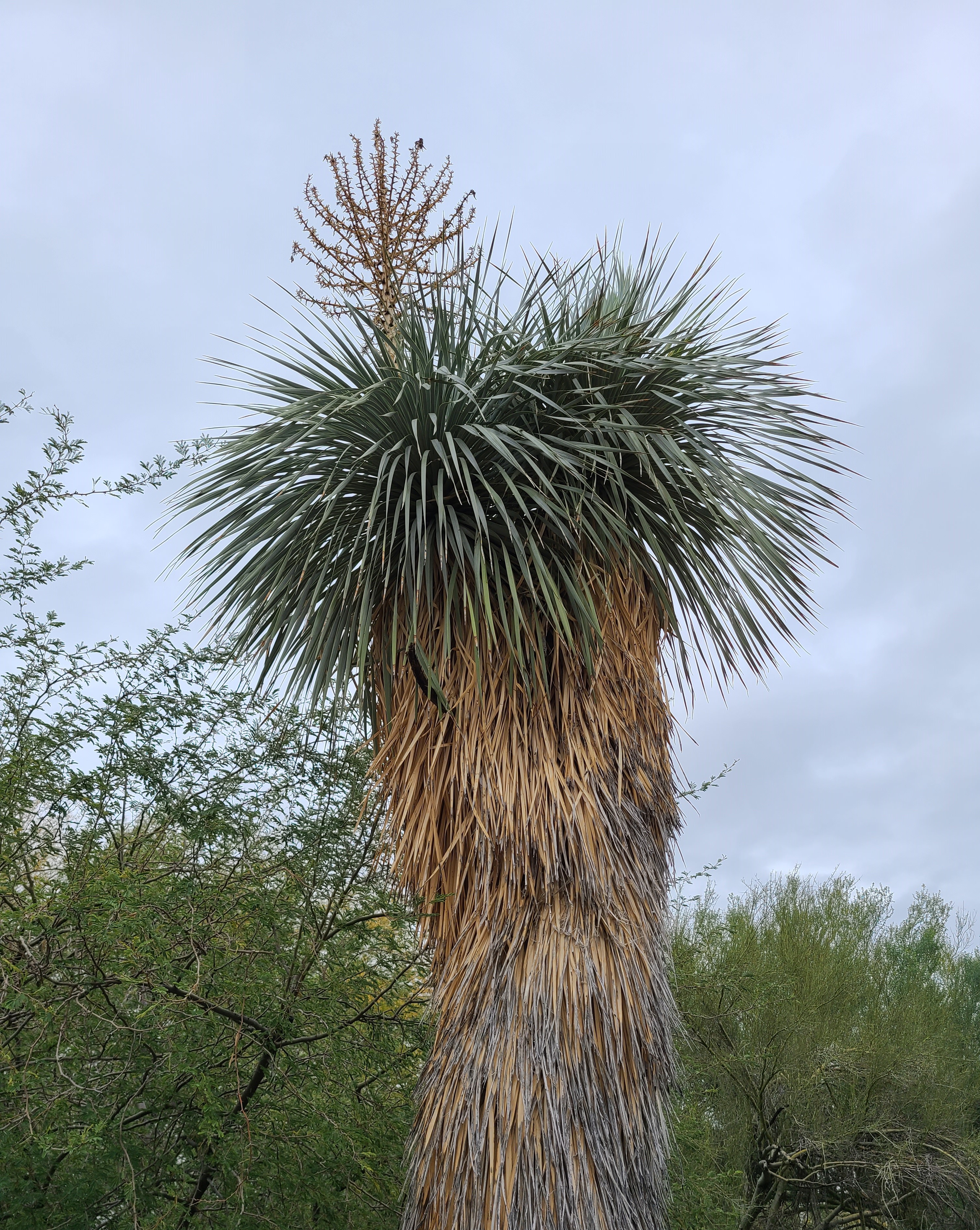
Yucca rostrata, called beaked yucca or Big Bend yucca, is a slow-growing, tree-like evergreen prized for xeriscaping. It forms a dramatic rosette of narrow blue-gray leaves atop a woody trunk, and it is counted among the toughest of the trunk-forming yuccas.
Source: Epic Gardening
Chihuahuan Desert Native
This species comes from the arid high country of northern Mexico and western Texas, growing naturally between roughly 3,000 and 5,000 feet in the Chihuahuan Desert. There it roots into rocky hillsides, limestone outcrops, and sandy, well-draining ground, shaped by intense sun and little rain. It has since naturalized into parts of New Mexico, Utah, and Colorado, where it draws hummingbirds and yucca moths when in bloom.
Source: Epic Gardening
Sun, Drought, and Patience
Beaked yucca wants full sun, at least six hours of direct light a day, since strong light keeps the growth compact and the foliage its characteristic blue-gray. Water it about weekly through spring and summer once the soil has dried, then taper to roughly monthly in fall and winter, always favoring dry over wet. Plant it in sandy, well-draining, neutral-to-alkaline soil, and skip fertilizer unless you want to nudge growth along with a balanced, time-released feed in spring.
Source: Epic Gardening
Seeds, Cuttings, or Suckers
Epic Gardening notes that beaked yucca can be grown from seed collected after its fragrant white flowers, though seedlings are slow to germinate and need consistently moist, well-lit soil. Stem cuttings work too: take a three to four inch piece, strip the top leaves, let it cure for four to five days, then pot it in soil under indirect light, where roots typically form in three to four weeks. The RHS adds that propagation can also be done by seed, sometimes needing hand pollination to set, or by removing rooted suckers.
Source: Epic Gardening
Silvery Rosette on a Trunk
The RHS describes a tree-like shrub to about 3.5 meters, with one or more woody stems topped by a near-spherical rosette of smooth, spine-tipped, blue-green leaves 60 to 90 centimeters long. The leaves stay rigid near the stem but turn flexible past their widest point, so they sway in even a light breeze. In summer or autumn it sends up a flowering stalk as long as 1.5 meters, carrying white, fragrant blooms.
Source: RHS
Sap Suckers to Watch
Epic Gardening lists red spiders (spider mites), mealybugs, scale, and aphids as the usual visitors, manageable with regular water sprays, dust removal, and spot treatment such as alcohol-soaked swabs for scale and mealybugs. The RHS more narrowly flags aphids on the flower spikes and snails as the likely culprits.
Source: Epic Gardening
Overwatering Is the Main Risk
This is a tough, low-maintenance plant that rarely runs into trouble, but excess water is the exception, leading to root rot, yellowing leaves, and a spongy trunk. The fix is to hold off watering until the soil dries out completely, and in more advanced cases to rinse the roots and repot into fresh, well-draining media.
Source: Epic Gardening
Slow Growth, Occasional Repotting
Because it grows slowly, this yucca rarely needs repotting, but when it does, protective gear is essential given the sharply spiked leaves; move it up a container two to four inches larger and trim back the root mass slightly. Old, brown, dead leaves can be pulled away by hand in spring. The RHS notes that no routine pruning is required beyond removing spent flowering stems.
Source: Epic Gardening
Care recipe
The species record — the baseline every cultivar inherits unless it says otherwise.
Care notes are early — not yet verified
- Light
- ai:claude-opus-4-8
- Water
- ai:claude-opus-4-8 (range 14-28d)
- Humidity
- ai:claude-opus-4-8
- Soil
- ai:claude-fable-5
- Care
- ai:claude-fable-5
Direct sun
≈ every 28 days
Low — average room
6–33 °C
Gritty, very fast-draining mineral mix
Seed (solitary trunk, few offsets)
Light cactus feed once or twice in summer
Slow
Rarely flowers indoors
Toxic to cats & dogs
Saponins — vomiting, drooling. This is where toxicity lives: every cultivar of this species inherits it and none can override it.
Reference images
Every image credited. Licenses link to their deeds.
PrimarySources: ai:claude-opus-4-8 · ai:claude-opus-4-8 (range 14-28d) · ai:claude-fable-5 · ASPCA
Kept true by its growers
Every fact here carries its source. Grow Beaked Yucca yourself? What you’ve observed — how it drinks, how it holds its color, a name that’s off — and a clear photo of your plant are exactly what keep this page honest. Contributions are reviewed before anything changes.
Sign in to add what you know →