Species · genus Yucca · Asparagaceae
Pale Leaf Yucca
Yucca pallida McKelvey
Also known as: Pale Yucca · Twistleaf Yucca
Cultivars of Y. pallida
The named forms growers keep — each with its own page, each honest about how much we know.
No named cultivars catalogued under Y. pallida yet. When growers document a stable, named form, it earns its own page here.
Guide
The species-level account. Cultivar pages build on this and say where they differ.
A pale-leaved yucca
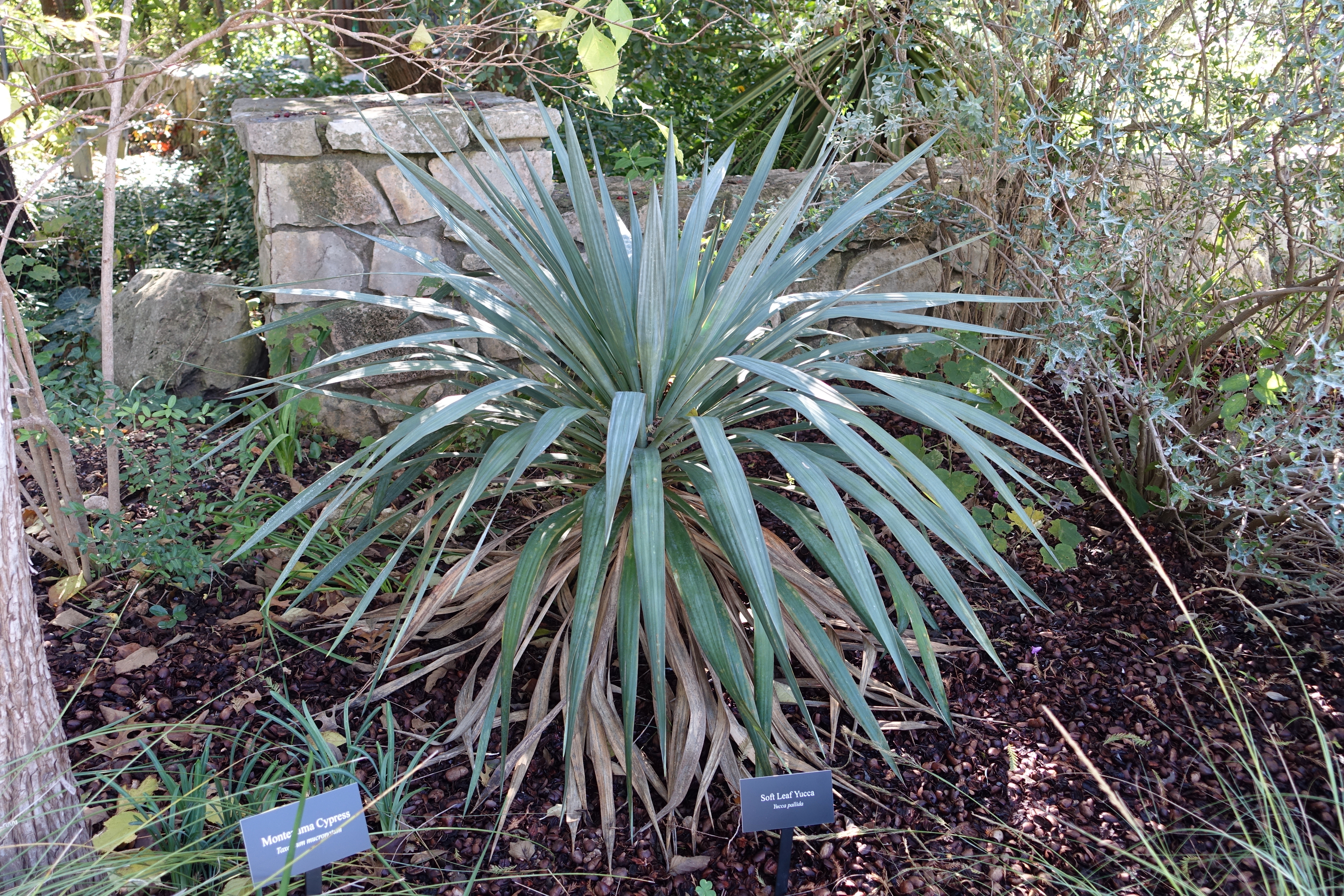
Yucca pallida, the pale-leaf yucca, belongs to the Asparagaceae family alongside its better-known yucca relatives. Like others in the genus, it forms rosettes of stiff, sword-shaped leaves, though its own portrait remains sparingly documented.
Source: RHS
A Texas native
This species comes from east-central Texas, where it grows as a perennial in the subtropical biome. It was first described by McKelvey in 1947, and has since picked up a couple of botanical synonyms along the way.
Source: Kew
Sun, drainage, and restraint
As with other yuccas, this plant wants full light, whether that means full sun outdoors or bright, filtered light near an indoor window. Soil or compost needs to drain sharply, so gritty mixes suit it well. Water freely through the growing season from spring into autumn, feed with a balanced liquid feed during that same stretch, then hold back through winter, letting the top layer of compost dry before watering again.
Source: RHS
Cuttings, offsets, or seed
Yuccas can be propagated from stem cuttings taken in spring, rooted in coarse sandy compost with gentle bottom heat. Offsets that appear at the base can be cut away from the parent rhizome in March or April, dried briefly, then potted on. Seed can also be sown in spring after a 24-hour soak to hasten germination.
Source: RHS
Rosettes and flower spikes
Yuccas in general carry dense or loose rosettes of stiff, sword-shaped leaves, and mature specimens of the larger kinds gradually shed their lower leaves to reveal a bare trunk. Above the foliage rise tall panicles of bell-shaped flowers, typically in cream tones, sometimes tinged with purple.
Source: RHS
Aphids and snails
Outdoors, yuccas are generally untroubled, though aphids may settle on the flowers and snails can mark the leaves. Brown fungal spots sometimes show up on foliage as well.
Source: RHS
Reading the leaves
Crisp, brown lower leaves usually point to under-watering, though some lower leaf loss is simply the plant's natural habit as it grows. Sagging or drooping leaves often trace back to low light, so it is worth checking watering too before assuming that is the cause. Sudden yellowing and limpness, by contrast, signals overwatering and calls for cutting back on water and checking the roots for rot.
Source: RHS
Light pruning, occasional repotting
Yuccas rarely need pruning beyond removing damaged leaves and spent flower spikes in spring. Indoor plants should be turned now and then so they do not lean toward the light, and if one grows too tall it can be cut back by roughly half in spring, with the severed top usable for propagation.
Source: RHS
Care recipe
The species record — the baseline every cultivar inherits unless it says otherwise.
Care notes are early — not yet verified
- Light
- ai:claude-opus-4-8
- Water
- ai:claude-opus-4-8 (range 14-28d)
- Humidity
- ai:claude-opus-4-8
- Soil
- ai:claude-fable-5
- Care
- ai:claude-fable-5
Direct sun
≈ every 28 days
Low — average room
6–33 °C
Sharp, sandy cactus mix
Offsets or seed
Sparse light feed in the growing season
Slow
Rarely flowers indoors
Toxic to cats & dogs
Saponins — vomiting, drooling. This is where toxicity lives: every cultivar of this species inherits it and none can override it.
Reference images
Every image credited. Licenses link to their deeds.
PrimarySources: ai:claude-opus-4-8 · ai:claude-opus-4-8 (range 14-28d) · ai:claude-fable-5 · ASPCA
Kept true by its growers
Every fact here carries its source. Grow Pale Leaf Yucca yourself? What you’ve observed — how it drinks, how it holds its color, a name that’s off — and a clear photo of your plant are exactly what keep this page honest. Contributions are reviewed before anything changes.
Sign in to add what you know →