Species · genus Yucca · Asparagaceae
Great Plains Yucca
Yucca glauca Nutt.
Also known as: Small Soapweed · Spanish Bayonet · Beargrass · Soapweed · Soapweed Yucca
Cultivars of Y. glauca
The named forms growers keep — each with its own page, each honest about how much we know.
No named cultivars catalogued under Y. glauca yet. When growers document a stable, named form, it earns its own page here.
Guide
The species-level account. Cultivar pages build on this and say where they differ.
A prairie yucca
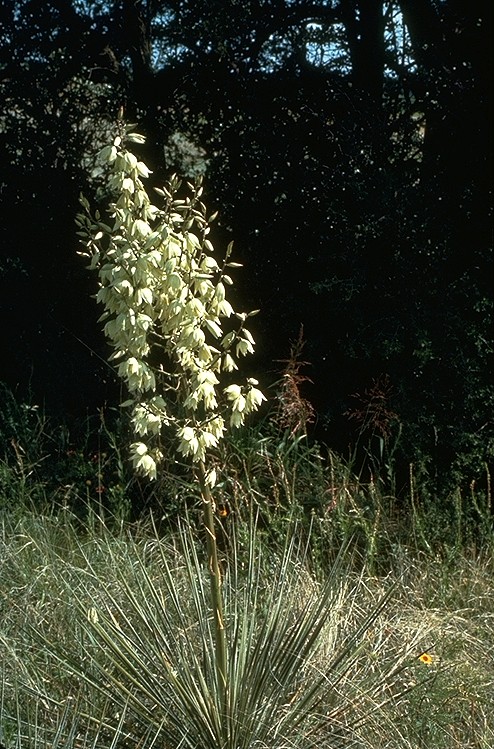
Yucca glauca, known as soapweed, is a shrubby evergreen perennial forming tight rosettes of narrow, grey-green, sword-shaped leaves. Mature clumps eventually send up spikes of large cream flowers in late summer. It stays fairly compact for a yucca, reaching around a metre or so in height and spread.
Source: RHS
Central North American native
This species comes from central North America, where it belongs to the same rosette-and-panicle lineage that runs through the genus Yucca. Its close relative, Yucca filamentosa, follows a similar pattern but hails from the central and eastern United States, native to beaches, dunes and sandy fields from South Carolina down to Florida and Mississippi, and has since spread on its own into New England.
Source: Missouri Botanical Garden
Sun, drainage, little fuss
Grow soapweed in full sun, in any well-drained soil, and expect it to tolerate chalk, loam or sandy ground across a wide pH range. It is rated as properly hardy and drought-resistant, so once established it asks for little beyond a sheltered, south- or west-facing spot. Aftercare is mainly about removing the spent flower stems once blooming has finished.
Source: RHS
Seed or suckers
Soapweed is propagated either from seed sown at 18°C in spring, or by removing rooted suckers from the base of the plant in spring. Basal offsets are the easier route for gardeners wanting a quicker, true-to-parent plant.
Source: RHS
Rosettes, spikes, thread-edged leaves
The defining look here is the stiff basal rosette of sword-shaped leaves topped, once mature, by a tall flowering spike of nodding, bell-shaped cream flowers. In the related Yucca filamentosa this rosette habit is paired with curly filamentous threads fraying along the leaf margins, giving the plant its filamentosa name, and the flower stalk can rise well above the foliage clump. Over time such plants can form a small colony from offsets at the base.
Source: Missouri Botanical Garden
Largely trouble-free
Soapweed is generally pest-free and disease-free, and its relative Yucca filamentosa likewise has no serious insect or disease problems to speak of. Deer also tend to leave these plants alone.
Source: Missouri Botanical Garden
Minimal upkeep
No routine pruning is required beyond removing spent flower stems after flowering. This is a low-maintenance plant by design, well suited to architectural, coastal, or low-maintenance planting schemes where little seasonal fuss is wanted.
Source: RHS
Care recipe
The species record — the baseline every cultivar inherits unless it says otherwise.
Care notes are early — not yet verified
- Light
- ai:claude-opus-4-8
- Water
- ai:claude-opus-4-8 (range 14-28d)
- Humidity
- ai:claude-opus-4-8
- Soil
- ai:claude-fable-5
- Care
- ai:claude-fable-5
Direct sun
≈ every 28 days
Low — average room
4–32 °C
Sandy, gritty, fast-draining mix
Offsets or seed
Minimal — a light spring feed at most
Slow
Rarely flowers indoors
Toxic to cats & dogs
Saponins — vomiting, drooling. This is where toxicity lives: every cultivar of this species inherits it and none can override it.
Reference images
Every image credited. Licenses link to their deeds.
Sources: ai:claude-opus-4-8 · ai:claude-opus-4-8 (range 14-28d) · ai:claude-fable-5 · ASPCA
Kept true by its growers
Every fact here carries its source. Grow Great Plains Yucca yourself? What you’ve observed — how it drinks, how it holds its color, a name that’s off — and a clear photo of your plant are exactly what keep this page honest. Contributions are reviewed before anything changes.
Sign in to add what you know →