Species · genus Yucca · Asparagaceae
Spineless Yucca
Yucca gigantea Lem.
Cultivars of Y. gigantea
The named forms growers keep — each with its own page, each honest about how much we know.
No named cultivars catalogued under Y. gigantea yet. When growers document a stable, named form, it earns its own page here.
Guide
The species-level account. Cultivar pages build on this and say where they differ.
A Sculptural Yucca
Yucca gigantea, also sold as Yucca elephantipes, is a tender, tree-like yucca grown outdoors in warm climates and widely kept as a houseplant or conservatory subject elsewhere. It carries the family's trademark stiff, sword-shaped leaves atop one or more slender trunks, lending an architectural presence to a room.
Source: RHS
Native Range
This species is native to Mexico and Central America, part of the wider Yucca genus within the Asparagaceae family. In cultivation it has become a familiar sight as an indoor or conservatory specimen in cooler regions where it cannot survive outdoors year-round.
Source: RHS
Light, Water, Feeding
Give it a sunny position all year, ideally a south-facing window in winter and an east- or west-facing spot in summer, with light shade from the harshest midday sun and good ventilation to avoid overheating. Grow it in well-drained, loam-based compost with added grit, watering freely and feeding with a balanced liquid fertiliser during active growth from spring into early autumn, then watering only sparingly through winter. It can spend late spring to summer outdoors in a sheltered spot once settled and stable against wind, but should come back indoors before cold weather, tolerating a minimum night temperature of around 7°C.
Source: RHS
Cuttings, Suckers, Seed
New plants can be raised from seed sown in spring at 19–24°C, though flowers often need hand-pollination to set seed in the first place. Rooted suckers can be detached and potted on in spring, or root cuttings taken in winter; stem cuttings more generally are placed in coarse sandy compost in a propagator with bottom heat of at least 18°C.
Source: RHS
Trunks and Rosettes
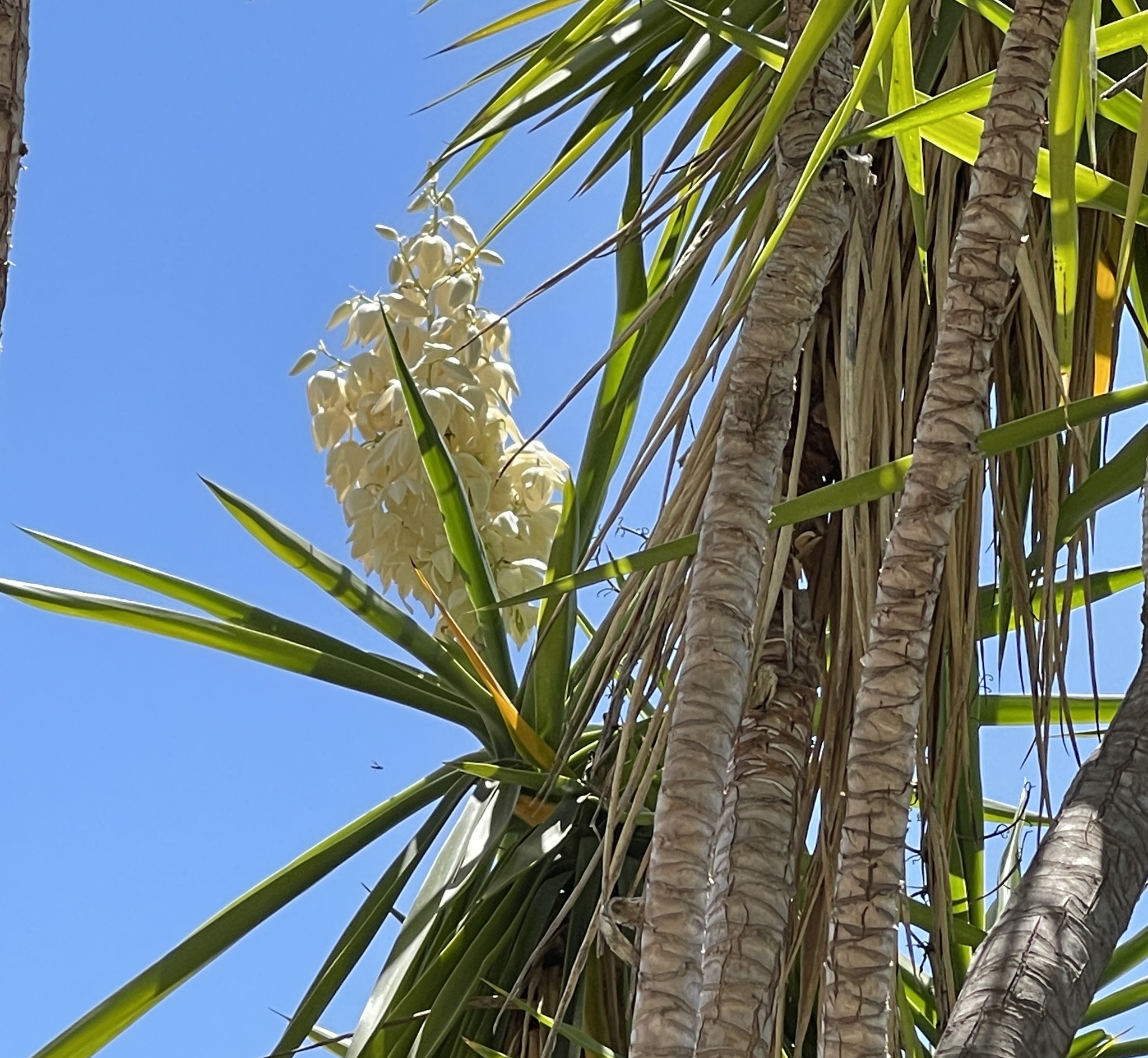
Left to mature, this yucca becomes a large, upright shrub or small tree, often sending up several trunks from near ground level with sparse branching. Its narrow, leathery leaves can reach up to a metre in length, and mature plants produce flowering spikes up to a metre long, carrying large numbers of hanging, creamy-white blooms in summer and autumn.
Source: RHS
Aphids and Snails
The main pests to watch for are aphids, which tend to settle on the flower spikes, and snails, which can chew at the leaves. Yucca leaf spot disease is also a possibility worth checking for on the foliage.
Source: RHS
Pruning as Needed
Pruning is not generally required; simply remove damaged leaves and spent flower spikes as necessary in spring. Indoors, turn the plant regularly so it does not lean or grow lopsided toward the light, and if it has grown too tall it can be cut back by around half once growth resumes in spring, with the removed top section usable for propagation.
Source: RHS
Care recipe
The species record — the baseline every cultivar inherits unless it says otherwise.
Care notes are early — not yet verified
- Light
- ai:claude-opus-4-8
- Water
- ai:claude-opus-4-8 (range 10-21d)
- Humidity
- ai:claude-opus-4-8
- Soil
- ai:claude-fable-5
- Care
- ai:claude-fable-5
Direct sun
≈ every 21 days
Low — average room
10–30 °C
Well-draining, loamy potting mix with grit
Stem or trunk cuttings; offsets
Balanced feed monthly through spring and summer
Moderate
Rarely flowers indoors
Toxic to cats & dogs
Saponins — vomiting, drooling. This is where toxicity lives: every cultivar of this species inherits it and none can override it.
Reference images
Every image credited. Licenses link to their deeds.
PrimarySources: ai:claude-opus-4-8 · ai:claude-opus-4-8 (range 10-21d) · ai:claude-fable-5 · ASPCA
Kept true by its growers
Every fact here carries its source. Grow Spineless Yucca yourself? What you’ve observed — how it drinks, how it holds its color, a name that’s off — and a clear photo of your plant are exactly what keep this page honest. Contributions are reviewed before anything changes.
Sign in to add what you know →