Species · genus Yucca · Asparagaceae
Palmella
Yucca elata (Engelm.) Engelm.
Also known as: Soaptree · Soaptree Yucca · Soapweed · Soapweed Yucca
Cultivars of Y. elata
The named forms growers keep — each with its own page, each honest about how much we know.
No named cultivars catalogued under Y. elata yet. When growers document a stable, named form, it earns its own page here.
Guide
The species-level account. Cultivar pages build on this and say where they differ.
The Soap Tree
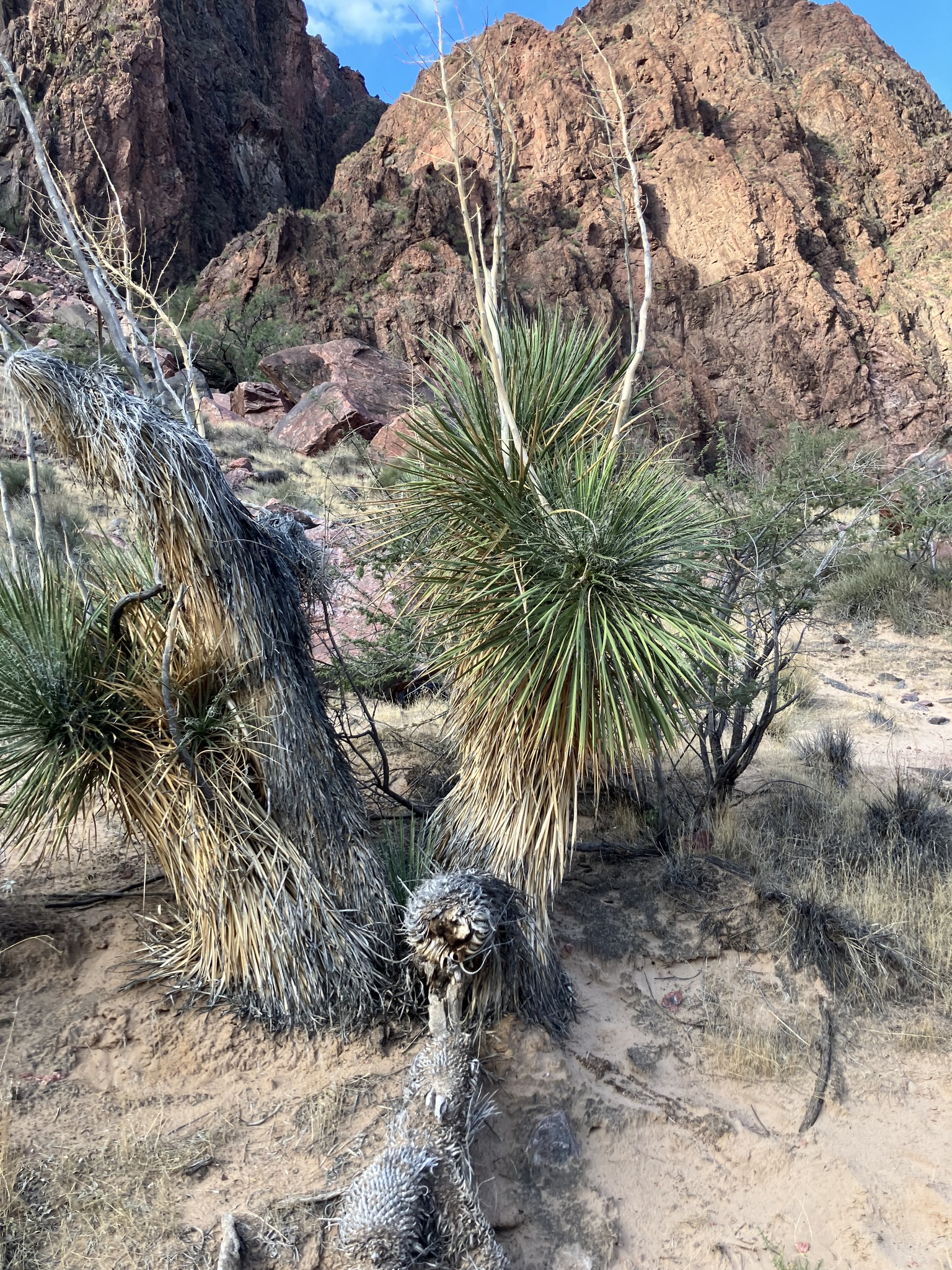
Yucca elata, known as the soap tree or soap weed, is a tall, dense, slow-growing evergreen perennial that forms a rosette of long, narrow, sharply pointed foliage. Its grey-green to blue-green leaves carry white margins and white fibres, and in late spring it sends up showy spikes of white, waxy flowers.
Source: RHS
A Desert Native
This species belongs to the Asparagaceae family and is native to Arizona, New Mexico, Texas, and northeastern and northwestern Mexico. In the wild it grows as a shrub or small tree in desert and dry shrubland, where mature plants can reach around 5m, though those cultivated in the UK typically stay closer to 3m.
Source: Kew
Sun, Drainage, Shelter
Give this yucca full sun in a south-facing, sheltered spot, whether planted in chalk, loam or sandy soil outdoors or in well-drained, peat-free compost as a houseplant. It tolerates drought and copes with acid, alkaline or neutral soils, but it needs shelter from strong winds and soil that never stays wet. As a genus, yuccas grown in containers benefit from extra grit for drainage, generous water and fortnightly balanced feed through the growing season, then much sparer watering and no feed in winter.
Source: RHS
Seed, Cuttings, Offsets
Yucca elata can be raised from seed, from stem cuttings taken in spring to early summer, or from offsets removed in spring. Across the genus, stem cuttings are typically set in coarse sandy compost with bottom heat, offsets are cut from the base and allowed to dry before potting, and seed benefits from a 24-hour soak before sowing.
Source: RHS
Spikes and Fibres
The soap tree's defining traits are its dense rosette of stiff, pointed leaves edged in white fibres and its columnar, upright habit. It flowers in late spring with masses of white, waxy blooms held on tall, showy spikes, and it is slow to reach maturity, generally taking ten to twenty years.
Source: RHS
Common Culprits
Watch for aphids, scale insects and mealybugs, which are the pests this species is most often troubled by.
Source: RHS
Leaf Spot Watch
Yucca elata can be susceptible to yucca leaf spot, so keep an eye on the foliage for signs of this disease. It is also worth noting the sap is a skin allergen, so gloves and protective equipment are worth wearing when handling the plant, and it is harmful to pets if eaten.
Source: RHS
Little Pruning Needed
This yucca asks for no routine pruning. Its slow, steady growth toward maturity over ten to twenty years means maintenance stays light once it is settled in a sheltered, well-drained spot.
Source: RHS
Care recipe
The species record — the baseline every cultivar inherits unless it says otherwise.
Care notes are early — not yet verified
- Light
- ai:claude-opus-4-8
- Water
- ai:claude-opus-4-8 (range 14-28d)
- Humidity
- ai:claude-opus-4-8
- Soil
- ai:claude-fable-5
- Care
- ai:claude-fable-5
Direct sun
≈ every 28 days
Low — average room
5–33 °C
Deep, gritty, fast-draining sandy mix
Seed (solitary — few offsets)
Rarely needed; light feed in spring only
Slow
Rarely flowers indoors
Toxic to cats & dogs
Saponins — vomiting, drooling. This is where toxicity lives: every cultivar of this species inherits it and none can override it.
Reference images
Every image credited. Licenses link to their deeds.
PrimarySources: ai:claude-opus-4-8 · ai:claude-opus-4-8 (range 14-28d) · ai:claude-fable-5 · ASPCA
Kept true by its growers
Every fact here carries its source. Grow Palmella yourself? What you’ve observed — how it drinks, how it holds its color, a name that’s off — and a clear photo of your plant are exactly what keep this page honest. Contributions are reviewed before anything changes.
Sign in to add what you know →