Species · genus Yucca · Asparagaceae
Buckley's Yucca
Yucca constricta Buckley
Cultivars of Y. constricta
The named forms growers keep — each with its own page, each honest about how much we know.
No named cultivars catalogued under Y. constricta yet. When growers document a stable, named form, it earns its own page here.
Guide
The species-level account. Cultivar pages build on this and say where they differ.
A bold desert sculpture
Yucca is a genus of evergreen perennials, shrubs, or trees, valued for their stiff, sword-shaped leaves gathered into rosettes and their tall spires of bell-shaped flowers. Some, like Yucca gloriosa and Y. filamentosa, are garden-hardy, while tender species such as Y. elephantipes and Y. aloifolia are grown as house or conservatory plants.
Source: RHS
From the Chihuahuan desert
Yucca rostrata, the beaked yucca, comes from the arid high country of northern Mexico and western Texas, growing at elevations between 3,000 and 5,000 feet in the Chihuahuan Desert. There it roots into rocky hillsides, limestone outcrops, and sandy, well-draining ground, shaped by intense sun and little rain. It has since naturalised further north into New Mexico, Utah, and Colorado.
Source: Epic Gardening
Sun, drainage, restraint
Outdoors, hardy yuccas want full sun and well-drained soil, while indoor plants need a sunny spot year-round, ideally a south-facing window in winter and an east or west one in summer, with light shade from harsh summer sun and good airflow. In containers, add extra grit to the compost, water freely and feed fortnightly through the growing season from April to September, then cut back to sparing winter watering once the top of the compost has dried. Tender species can spend summer outdoors in a sheltered spot but should return indoors well before frost, tolerating a minimum night temperature of around 7°C.
Source: RHS
Cuttings, offsets, seed
Yuccas can be propagated in spring from stem cuttings around 20-25cm long, set in coarse sandy compost in a propagator with bottom heat of at least 18°C. Offsets that appear at the base can be removed in March or April, dried for a couple of days, then treated like cuttings. Seed can also be sown in spring, soaked for 24 hours beforehand to speed germination, at temperatures suited to hardy or tender species.
Source: RHS
Rosettes, spines, and spires
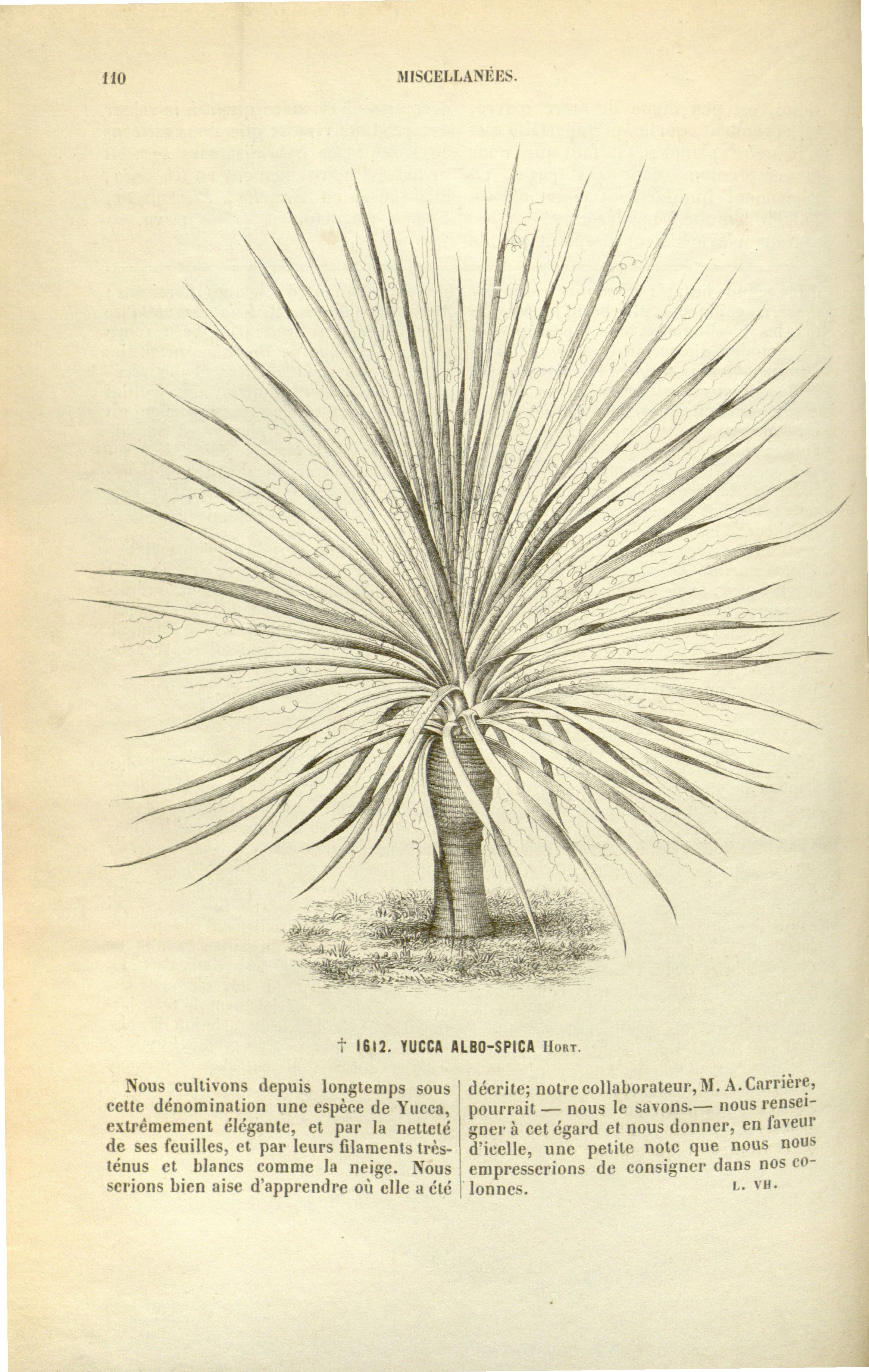
The genus carries stiff, sword-shaped leaves in dense or looser rosettes, with larger forms slowly shedding their lower leaves as they age to reveal a bare trunk. Yucca rostrata in particular forms a shimmering, pom-pom-like head of slender blue-gray leaves atop its trunk, edged in pale fibers from old growth. Flower panicles are bell-shaped and cream-coloured, appearing sparsely in summer or, for the beaked yucca, as yellow-orange stalks bearing white clusters in late spring.
Source: RHS
Watch for sap-suckers
Outdoors, yuccas are generally trouble-free, though aphids can trouble the flowers and snails may damage leaves. Yucca rostrata is also prone to spider mites, mealybugs, scale, and aphids, which can be discouraged by spraying leaves with water in dry weather and wiping off dust; scale and mealybugs can be removed by hand with an alcohol-soaked swab.
Source: Epic Gardening
Reading the leaves
Crisp brown lower leaves usually mean under-watering, though some natural shedding of lower leaves is normal as the plant grows. Sagging or drooping leaves point to low light, but check watering too, since sudden yellowing and limpness of lower leaves signals overwatering. If roots have begun to rot, ease the plant from its pot, remove the excess compost and rotted roots, and repot into a container just large enough for the reduced root ball, watering sparingly afterward in warm conditions.
Source: RHS
Light pruning, slow repotting
Pruning is rarely needed beyond removing damaged leaves and spent flower spikes in spring, and indoor plants benefit from being turned regularly so they don't lean toward the light. An overly tall plant can be cut back by half in spring, with the severed top usable for propagation. Yucca rostrata is a slow grower and needs repotting only occasionally, best done in a container two to four inches larger with some root trimming, and handled with thick gloves given its spiked leaves.
Source: RHS
Care recipe
The species record — the baseline every cultivar inherits unless it says otherwise.
Care notes are early — not yet verified
- Light
- ai:claude-opus-4-8
- Water
- ai:claude-opus-4-8 (range 14-28d)
- Humidity
- ai:claude-opus-4-8
- Soil
- ai:claude-fable-5
- Care
- ai:claude-fable-5
Direct sun
≈ every 28 days
Low — average room
6–32 °C
Sandy, sharply draining mineral mix
Offsets or seed
Minimal — a light spring feed at most
Slow
Rarely flowers indoors
Toxic to cats & dogs
Saponins — vomiting, drooling. This is where toxicity lives: every cultivar of this species inherits it and none can override it.
Reference images
Every image credited. Licenses link to their deeds.
Sources: ai:claude-opus-4-8 · ai:claude-opus-4-8 (range 14-28d) · ai:claude-fable-5 · ASPCA
Kept true by its growers
Every fact here carries its source. Grow Buckley's Yucca yourself? What you’ve observed — how it drinks, how it holds its color, a name that’s off — and a clear photo of your plant are exactly what keep this page honest. Contributions are reviewed before anything changes.
Sign in to add what you know →