Species · genus Xanthosoma · Araceae
Purplestem Taro
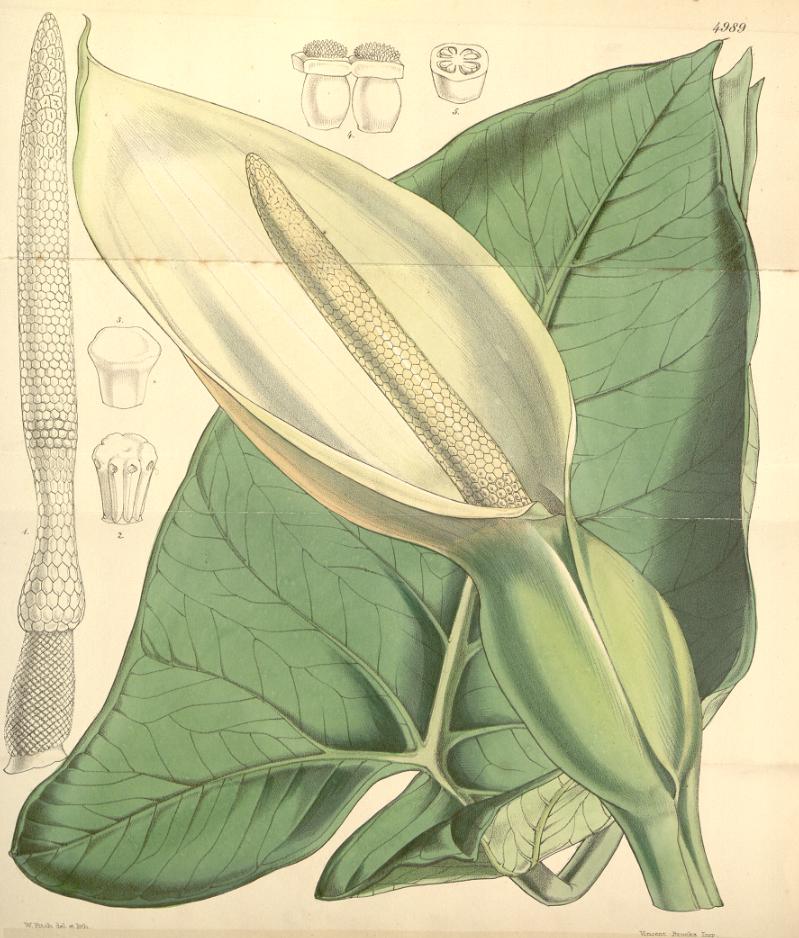
Xanthosoma violaceum Schott
Also known as: Black Malanga · Blue Ape · Blue-taro · Primrose Malanga · Yautia
Cultivars of X. violaceum
The named forms growers keep — each with its own page, each honest about how much we know.
No named cultivars catalogued under X. violaceum yet. When growers document a stable, named form, it earns its own page here.
Guide
The species-level account. Cultivar pages build on this and say where they differ.
A striking aroid
Xanthosoma is a member of the arum family, Araceae, grown as a bold-leaved tropical houseplant. The Kew and RHS records point to some nomenclatural tangling in this genus, with the name Xanthosoma violaceum itself treated as a synonym of Xanthosoma sagittifolium, while other sellers apply the Xanthosoma name to a related plant, Caladium lindenii. It is worth reading any plant tag with a little caution here, as the naming has shifted more than once.
Source: Kew
A tangled naming history
The species named Xanthosoma violaceum was first published in 1853, and taxonomic authorities now generally fold it into Xanthosoma sagittifolium, though a handful of regional floras from Central America, Colombia, Bangladesh, and São Tomé still list it under its own name. The RHS, meanwhile, keeps a separate entry for Xanthosoma violaceum under the common names blue tannia, blue taro, and yautia. Confusingly, the ornamental houseplant sold commercially as xanthosoma is often a different plant altogether, Caladium lindenii, native to Colombia.
Source: Kew
Bright light, even moisture
Indoors this plant wants medium to bright indirect light, tolerating natural or artificial light sources but resenting direct afternoon sun, which can scorch the foliage; a sheer curtain over a sunny window works as a filter. Water once the top couple of inches of potting mix have dried, watching the leaves for cues, as they stand upright when well watered and droop when thirsty. It also prefers above-average humidity, and feeding with a general-purpose houseplant fertilizer through spring and summer keeps growth moving, following label rates rather than exceeding them.
Source: Costa Farms
Arrow leaves, pale veins
The houseplant commonly sold as xanthosoma carries large, arrow-shaped green leaves dramatically marked with creamy-white veins, a look distinctive enough to stand out even among other variegated foliage. Mature plants reach two to three feet tall, with leaves that can exceed fifteen inches in length. Younger specimens stay compact enough for a bright desk or tabletop before they grow into more substantial floor plants. Its petioles also carry reddish-brown hairs, a natural feature of the plant rather than any sign of trouble.
Source: Costa Farms
Reading the leaves
Overwatering is the main hazard: if the mix stays wet for too long, especially during the shorter days of winter, the roots can suffocate and rot. Dry indoor air shows up as browning, crispy tips and edges on the leaves. Sunburned patches on the foliage point to too much direct sun, even filtered through a window.
Source: Costa Farms
Light pruning only
Maintenance is modest: simply clip off old, faded leaves as they age, and no further pruning is needed.
Source: Costa Farms
Care recipe
The species record — the baseline every cultivar inherits unless it says otherwise.
Care notes are early — not yet verified
- Light
- ai:claude-opus-4-8
- Water
- ai:claude-opus-4-8 (range 7-14d)
- Humidity
- ai:claude-opus-4-8
- Soil
- ai:claude-fable-5
- Care
- ai:claude-fable-5
Bright, indirect
≈ every 14 days
High
16–30 °C
Rich, moisture-retentive aroid mix that drains freely
Division of tubers or offsets
Balanced monthly feed during active growth
Fast
Rarely flowers indoors; grown for violet-tinged leaves and stems
Toxic to cats & dogs & humans
Araceae contain insoluble calcium oxalate crystals that irritate the mouth, throat, and digestive tract if chewed or ingested. This is where toxicity lives: every cultivar of this species inherits it and none can override it.
Reference images
Every image credited. Licenses link to their deeds.
Sources: ai:claude-opus-4-8 · ai:claude-opus-4-8 (range 7-14d) · ai:claude-fable-5 · ai:claude-opus-4-8 (family inference)
Kept true by its growers
Every fact here carries its source. Grow Purplestem Taro yourself? What you’ve observed — how it drinks, how it holds its color, a name that’s off — and a clear photo of your plant are exactly what keep this page honest. Contributions are reviewed before anything changes.
Sign in to add what you know →