Species · genus Xanthosoma · Araceae
Arrowleaf Elephant's Ear
Xanthosoma sagittifolium (L.) Schott
Also known as: New Cocoyam · Callaloo · Tania · Tannia · White-malanga
Cultivars of X. sagittifolium
The named forms growers keep — each with its own page, each honest about how much we know.
No named cultivars catalogued under X. sagittifolium yet. When growers document a stable, named form, it earns its own page here.
Guide
The species-level account. Cultivar pages build on this and say where they differ.
A Tuberous Aroid
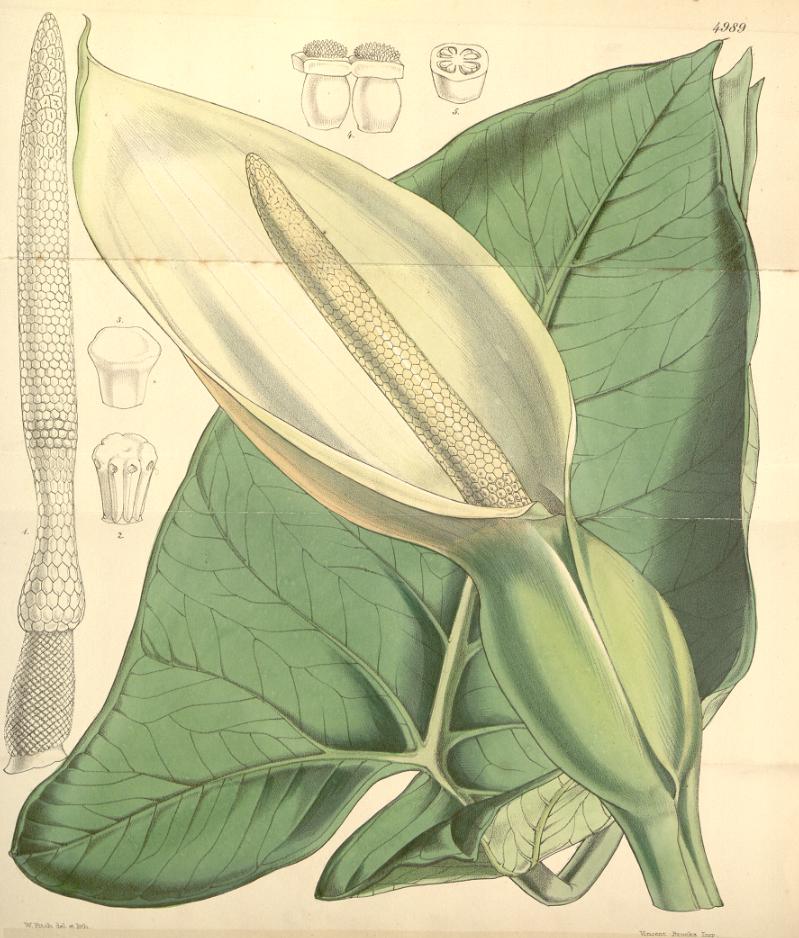
Xanthosoma sagittifolium is a tuberous subshrub in the arum family, Araceae. The Royal Horticultural Society lists it under the common names arrow-leaved spoonflower, tania, and tannia, names that hint at its arrow-shaped foliage and its long history as a food crop.
Source: RHS
Tropical American Roots
This species is native to Costa Rica and the surrounding stretch of South Tropical America, including Brazil, Colombia, Ecuador, Panama, Peru, and Venezuela, where it grows in the wet tropical biome. It has since been carried far beyond that native range and now grows as an introduced plant across parts of the Caribbean, Africa, South and Southeast Asia, and the Pacific islands. Kew's Plants of the World Online records dozens of historical synonyms for it, a sign of how widely it has been collected and renamed over the centuries.
Source: Kew
Tuber and Foliage
At its core this is a tuberous subshrub, its arrow-shaped leaves giving rise to the common name arrow-leaved spoonflower. Kew notes the many botanical synonyms built around leaf and tuber traits, from sagittifolium (arrow-leaved) to violaceum and nigrum, reflecting variation in colour that has been observed and named across its range.
Source: Kew
A Plant Put to Use
Kew records that this species has long served people directly: as animal food, as a vegetable, as a poison, as a medicine, and for broader environmental use. That range of uses marks it out among aroids as a genuinely multipurpose plant rather than one grown for foliage alone.
Source: Kew
Care recipe
The species record — the baseline every cultivar inherits unless it says otherwise.
Care notes are early — not yet verified
- Light
- ai:claude-opus-4-8
- Water
- ai:claude-opus-4-8 (range 7-12d)
- Humidity
- ai:claude-opus-4-8
- Soil
- ai:claude-fable-5
- Care
- ai:claude-fable-5
Bright, indirect
≈ every 12 days
High
16–30 °C
Rich, moist, well-draining loamy mix
Division of the tuberous corms
Feed monthly with a balanced fertilizer while growing
Fast
Seldom flowers indoors; prized for bold foliage
Toxic to cats & dogs & humans
Araceae contain insoluble calcium oxalate crystals, which irritate the mouth and digestive tract if chewed. This is where toxicity lives: every cultivar of this species inherits it and none can override it.
Reference images
Every image credited. Licenses link to their deeds.
Sources: ai:claude-opus-4-8 · ai:claude-opus-4-8 (range 7-12d) · ai:claude-fable-5 · ai:claude-opus-4-8 (family inference)
Kept true by its growers
Every fact here carries its source. Grow Arrowleaf Elephant's Ear yourself? What you’ve observed — how it drinks, how it holds its color, a name that’s off — and a clear photo of your plant are exactly what keep this page honest. Contributions are reviewed before anything changes.
Sign in to add what you know →