Species · genus Vanda · Orchidaceae
Orchid
Vanda tricolor Lindl.
Cultivars of V. tricolor
The named forms growers keep — each with its own page, each honest about how much we know.
No named cultivars catalogued under V. tricolor yet. When growers document a stable, named form, it earns its own page here.
Guide
The species-level account. Cultivar pages build on this and say where they differ.
A Fragrant Javan Vanda
Vanda tricolor var. suavis, also known as the sweet soft vanda, is a large evergreen epiphytic orchid grown in conservatories and greenhouses for its many waxy, fragrant blooms. It belongs to the classic monopodial vandas, orchids that grow ever upward from a single stem rather than in clumps.
Source: RHS
Native to Java
This variety, along with the species Vanda tricolor itself, is native to Java, with the wider species range running from Java through to the Lesser Sunda Islands of Indonesia. Kew records it as an epiphytic subshrub of the wet tropical biome, and it has also become naturalised in Hawaii. It was first described by Lindley in 1847, and over time growers and botanists have named numerous forms and varieties as its flower colour and pattern proved so variable.
Source: Kew
Light, Humidity, Feeding
This orchid wants high light and long bright days to flower well, sitting somewhere warm and sunny in summer while avoiding harsh midday sun. Its fleshy roots do the work of storing water, and dark green or purplish root tips are a good sign of active growth, so regular misting and humidity of 70-80% with decent air movement suit it best through the growing season. It feeds heavily, so orchid fertiliser should be applied regularly from spring to autumn, with a night-time low around 15°C and summer days reaching up to 30°C, and growth is typically in an open basket or coarse bark mix. In cooler conditions with shorter days it may rest over winter, when misting can ease off, though it should never be left dry for long stretches.
Source: RHS
Keiki, Not Seed
Seed propagation only really works under laboratory conditions, so at home the practical route is dividing the sideshoots, or keiki, that mature plants send out. These are best removed and potted on once they have grown at least three roots of their own, each around 2cm long.
Source: RHS
Long Stems, Waxy Blooms
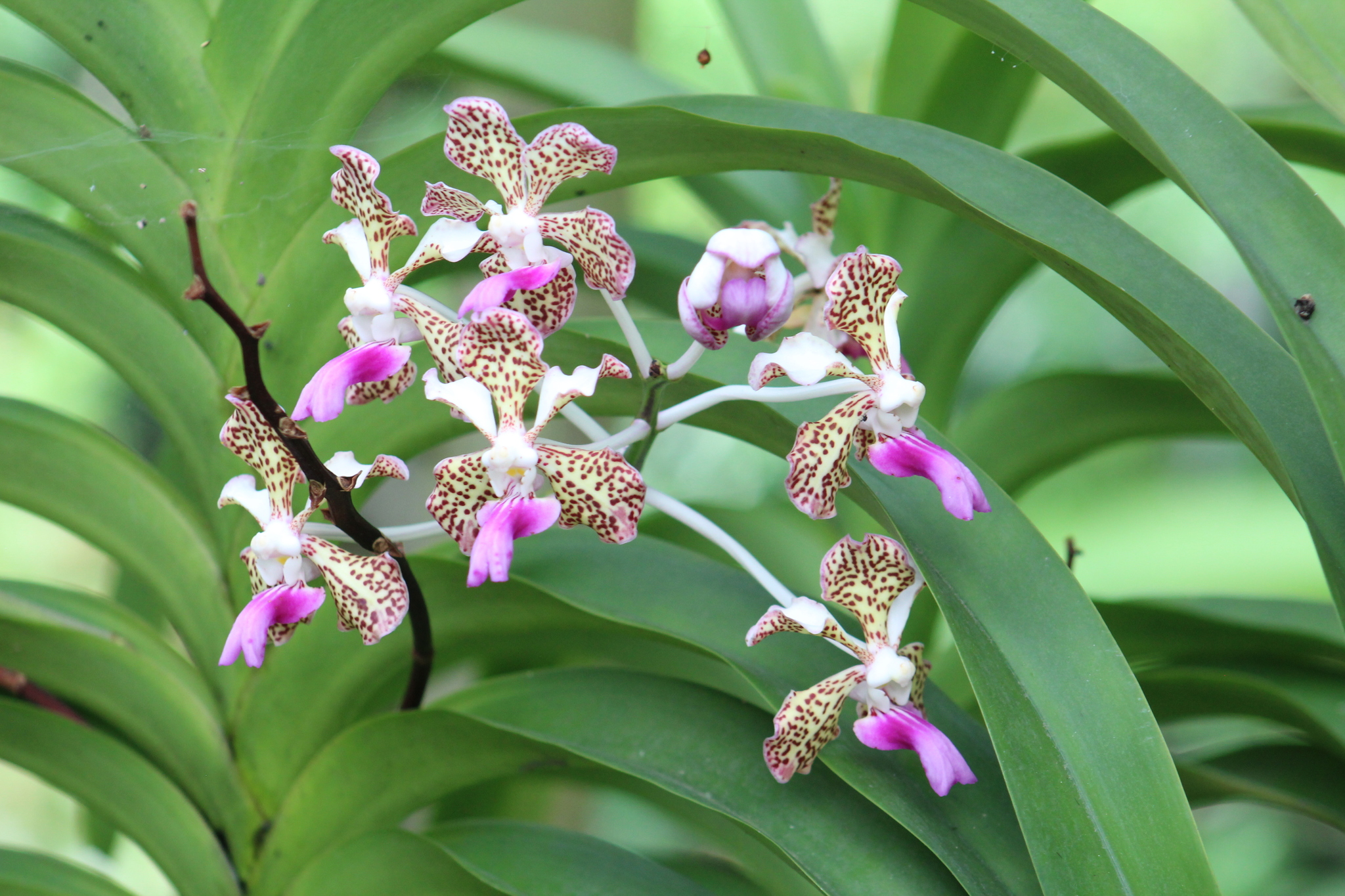
The plant grows a long, upright, stem-like rhizome clothed in overlapping leaf sheaths, with strap-shaped leaves up to 60cm reaching out from the main stem while the oldest, lowest leaves drop away over time. Beneath it hangs a striking curtain of thick, sponge-like roots that follow the stem upward as the plant grows. Multiple flower spikes can open at once, each carrying fifteen or more long-lived, fragrant flowers around 5-7cm across, white with maroon spotting, pink edges, and a bright pink or purple lip, the exact pattern varying from plant to plant.
Source: RHS
Scale, Mealybugs, Thrips
Scale insects and mealybugs are the pests most likely to trouble this vanda, while thrips tend to target the flowers and developing buds. Otherwise the plant is generally untroubled by disease.
Source: RHS
Pruning a Leggy Stem
Spent flower stems should be cut back to their base once blooming finishes. An old plant that has become bare and leggy can be cut back during active growth by slicing through the rhizome just below a healthy set of aerial roots, and laying the cut piece horizontally or hanging it upside down encourages fresh roots to form. Good air movement matters too, since poor circulation is what tends to invite bacterial or fungal rot, and clean, sterilised tools help keep virus diseases from spreading.
Source: RHS
Care recipe
The species record — the baseline every cultivar inherits unless it says otherwise.
Care notes are early — not yet verified
- Light
- ai:claude-opus-4-8
- Water
- ai:claude-opus-4-8 (range 3-7d)
- Humidity
- ai:claude-opus-4-8
- Soil
- ai:claude-fable-5
- Care
- ai:claude-fable-5
Bright, indirect
≈ every 7 days
High
16–30 °C
Open, chunky orchid bark; bare-root or slatted basket
Keiki offsets or top-cutting of a tall stem
Dilute orchid feed weekly, flushed regularly
Moderate
Fragrant tessellated brown-and-cream blooms when well cared for
Not yet documented
This is where toxicity lives — every cultivar of this species inherits it and none can override it.
Reference images
Every image credited. Licenses link to their deeds.
Sources: ai:claude-opus-4-8 · ai:claude-opus-4-8 (range 3-7d) · ai:claude-fable-5
Kept true by its growers
Every fact here carries its source. Grow Orchid yourself? What you’ve observed — how it drinks, how it holds its color, a name that’s off — and a clear photo of your plant are exactly what keep this page honest. Contributions are reviewed before anything changes.
Sign in to add what you know →