Species · genus Tradescantia · Commelinaceae
Moses-in-the-cradle
Tradescantia spathacea Sw.
Also known as: Boat Lily · Boatlily · Oysterplant · Oyster Plant · Cradle Lily
Cultivars of T. spathacea
The named forms growers keep — each with its own page, each honest about how much we know.
No named cultivars catalogued under T. spathacea yet. When growers document a stable, named form, it earns its own page here.
Guide
The species-level account. Cultivar pages build on this and say where they differ.
An Oyster Named for Boats
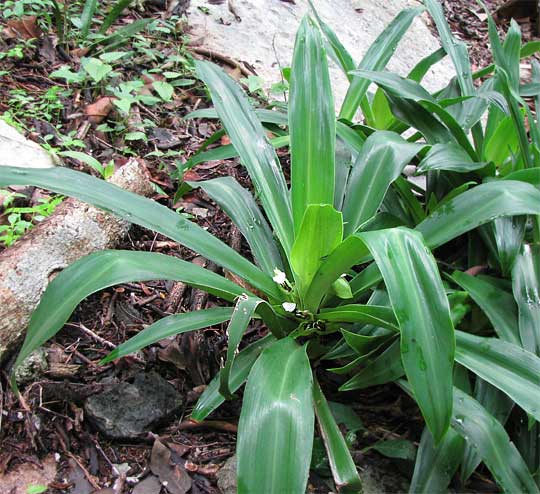
Tradescantia spathacea, commonly called oyster plant, is an evergreen clump-forming perennial in the Commelinaceae family, reaching about 30cm in height. Its many folk names, boat lily, Moses in the cradle, three men in a boat, all nod to the small white flowers cupped inside purple, boat-shaped bracts tucked among the leaves.
Source: RHS
A Central American Native
This species has its natural range in Central America, and it is not native to Britain or Ireland. In cultivation it is most often kept under glass or as a houseplant, though it can spend summer outdoors in containers.
Source: RHS
Bright Light, Moderate Water
Indoors, this is an undemanding houseplant that wants bright filtered light rather than direct sun, which can scorch the leaves, and a peat-free, houseplant or multipurpose compost. Water moderately and feed with a liquid fertiliser monthly while the plant is in active growth, then cut back on watering over winter. Grown outdoors for summer, it prefers fertile, free-draining soil in full sun or partial shade.
Source: RHS
Cuttings or Division
New plants are raised from stem tip cuttings or by division of the clump. For the variegated 'Vittata', softwood stem-tip cuttings taken in spring or summer can be rooted in cutting compost or even water, then potted on into a loam-based mix.
Source: RHS
Rosettes, Bracts, and Colour
The plant forms rosettes of narrow, lance-shaped leaves up to 30cm long, dark green above and deep purple beneath. Small white flowers emerge in axillary clusters, each held within leaf-like purple bracts. A variegated form, 'Vittata', carries the same purple undersides but with leaves striped gold and green on top.
Source: RHS
Familiar Houseplant Pests
Keep an eye out for red spider mite, mealybugs, aphids, vine weevil, and thrips, the usual suspects that trouble this plant. On the plus side, it is generally free of disease.
Source: RHS
Tidying and Repotting
Maintenance is light: remove faded flowered stems as they go over, and for the variegated form, pinch out growing tips to encourage a bushier habit. Time to maturity runs one to two years for the species and two to five years for 'Vittata'.
Source: RHS
Care recipe
The species record — the baseline every cultivar inherits unless it says otherwise.
Care notes are early — not yet verified
- Light
- ai:claude-opus-4-8
- Water
- ai:claude-opus-4-8 (range 7-14d)
- Humidity
- ai:claude-opus-4-8
- Soil
- ai:claude-fable-5
- Care
- ai:claude-fable-5
Bright, indirect
≈ every 14 days
Medium
13–29 °C
Well-draining potting mix with some grit
Offset pups separated from the base, or seed
Monthly balanced feed during active growth
Moderate
Small white flowers cupped in boat-shaped bracts
Toxic to cats & dogs
Inch plant / wandering dude — irritant sap; dermatitis, mild GI upset. This is where toxicity lives: every cultivar of this species inherits it and none can override it.
Reference images
Every image credited. Licenses link to their deeds.
PrimarySources: ai:claude-opus-4-8 · ai:claude-opus-4-8 (range 7-14d) · ai:claude-fable-5 · ASPCA
Kept true by its growers
Every fact here carries its source. Grow Moses-in-the-cradle yourself? What you’ve observed — how it drinks, how it holds its color, a name that’s off — and a clear photo of your plant are exactly what keep this page honest. Contributions are reviewed before anything changes.
Sign in to add what you know →