Species · genus Tradescantia · Commelinaceae
Purple Queen
Tradescantia pallida (Rose) D.R.Hunt
Also known as: Purple Heart · "Wandering Jew" · Purpleheart · Wandering Jew
Cultivars of T. pallida
The named forms growers keep — each with its own page, each honest about how much we know.
No named cultivars catalogued under T. pallida yet. When growers document a stable, named form, it earns its own page here.
Guide
The species-level account. Cultivar pages build on this and say where they differ.
The Purple Heart Plant
Tradescantia pallida is a trailing, slightly succulent perennial best known by the common name purple heart, prized for its vivid purple foliage and small three-petaled flowers. It suits life as bedding, in containers, hanging baskets, or simply as a houseplant.
Source: RHS
From Eastern Mexico
This plant originates in eastern Mexico. It has passed through several botanical names over the years, starting as Setcreasea pallida in 1911 and later Setcreasea purpurea, before being reclassified as Tradescantia pallida in 1975. Its common names are just as varied, including purple queen, purple secretia, and the older, now-discouraged name wandering jew.
Source: Epic Gardening
Light, Water, and Feeding
Purple heart takes full sun or partial shade, though indoors bright filtered light works well since direct sun can scorch leaves in some settings; outdoors, full sun is what brings out the deepest purple color, while low light causes the foliage to fade toward green. Grow it in loam or sandy, moist but well-drained soil, watering moderately during active growth and sparingly through winter. Feed at least monthly during the growing season with a balanced organic fertilizer, and keep in mind the roots tolerate cold down to about 10°F (-12°C) even though the foliage will die back in frost.
Source: Epic Gardening
Rooting from Cuttings
Propagation is done from softwood stem-tip cuttings taken in spring or summer, rooted either in peat-free cutting compost or simply in water, then potted on into loam-based potting compost. The stems are naturally weak at their joints, snapping off easily, but this same trait means cuttings root readily without any special treatment or rooting hormone.
Source: RHS
Color, Form, and Blooms
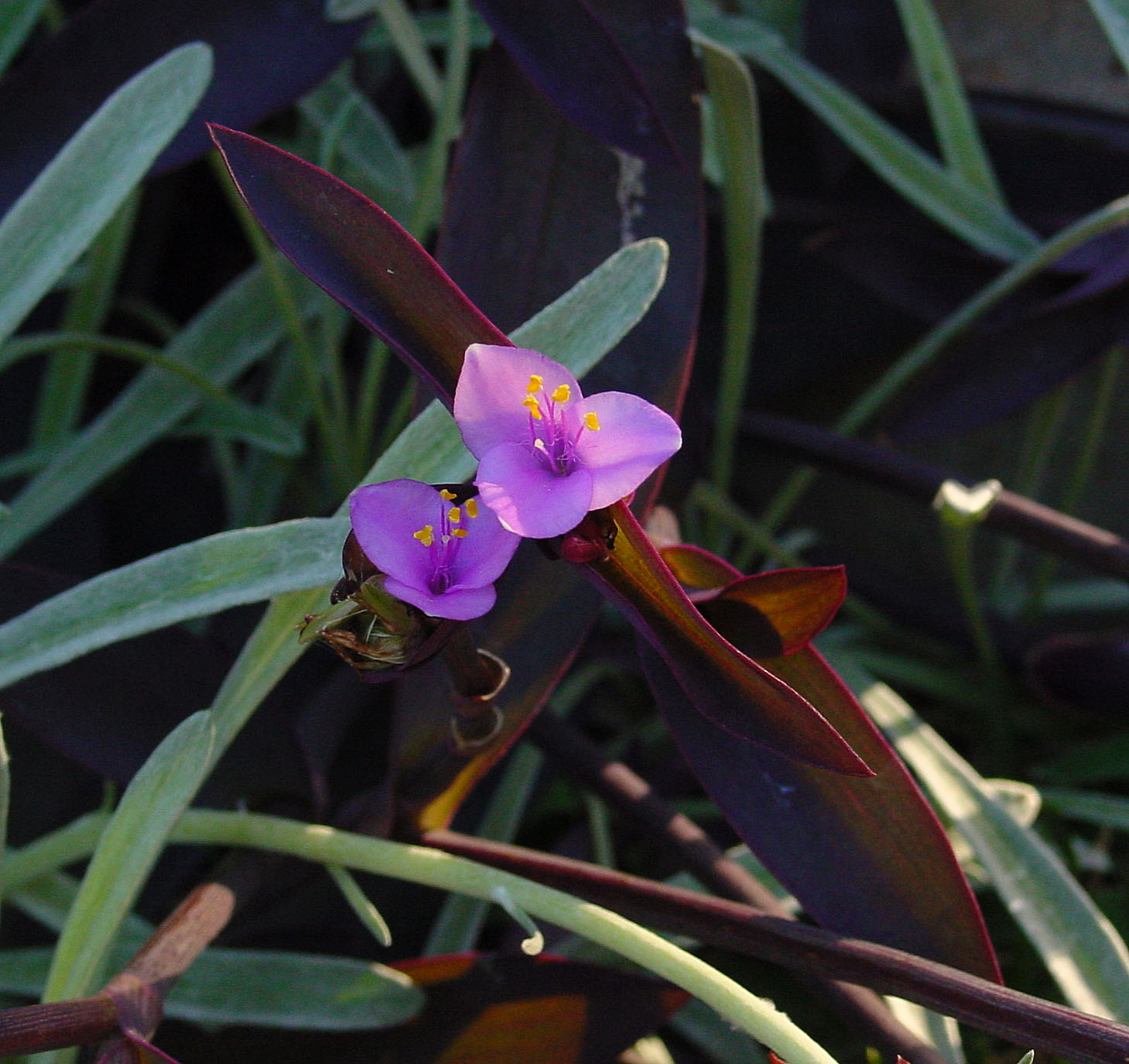
The leaves are long, narrowly oblong, and pointed, reaching up to about seven inches, glaucous green above and purplish beneath, with tips that sometimes stay red or green even as the rest of the leaf deepens to purple. Stems are visibly segmented and somewhat succulent, growing to around 20cm tall as a trailing habit. In summer it produces small three-petaled flowers, roughly 2-3cm across, in shades from white to pink and lavender, more of a quiet counterpoint than a showy display.
Source: RHS
Watch for Sap-Suckers
This plant can be susceptible to red spider mite, mealybugs, aphids, vine weevil, and thrips. On the whole it is generally disease-free, so pest pressure is the main thing to watch for.
Source: RHS
Pinching for Bushiness
Pinch growing tips to keep the plant bushy and remove any foliage that reverts to plain green. Pinch just above a leaf joint, since new growth starts there, and cut the plant back once flowering has finished to keep it tidy. Handle it gently, whether hanging or in a container, since a knock can easily snap the fragile stems at their joints.
Source: Epic Gardening
Care recipe
The species record — the baseline every cultivar inherits unless it says otherwise.
Care notes are early — not yet verified
- Light
- ai:claude-opus-4-8
- Water
- ai:claude-opus-4-8 (range 7-14d)
- Humidity
- ai:claude-opus-4-8
- Soil
- ai:claude-fable-5
- Care
- ai:claude-fable-5
Bright, indirect
≈ every 14 days
Medium
10–29 °C
Gritty, well-draining mix; tolerates lean soil
Stem cuttings root quickly in soil or water
Monthly balanced feed; sparse feeder overall
Fast
Small pink flowers set off the deep purple foliage
Toxic to cats & dogs
Inch plant / wandering dude — irritant sap; dermatitis, mild GI upset. This is where toxicity lives: every cultivar of this species inherits it and none can override it.
Reference images
Every image credited. Licenses link to their deeds.
Sources: ai:claude-opus-4-8 · ai:claude-opus-4-8 (range 7-14d) · ai:claude-fable-5 · ASPCA
Kept true by its growers
Every fact here carries its source. Grow Purple Queen yourself? What you’ve observed — how it drinks, how it holds its color, a name that’s off — and a clear photo of your plant are exactly what keep this page honest. Contributions are reviewed before anything changes.
Sign in to add what you know →