Species · genus Tillandsia · Bromeliaceae
Spreading Airplant
Tillandsia utriculata L.
Also known as: Wild Pine · Jumbie-pineapple · Giant Airplant · Giant Wild Pine
Cultivars of T. utriculata
The named forms growers keep — each with its own page, each honest about how much we know.
No named cultivars catalogued under T. utriculata yet. When growers document a stable, named form, it earns its own page here.
Guide
The species-level account. Cultivar pages build on this and say where they differ.
A Large Epiphytic Tillandsia
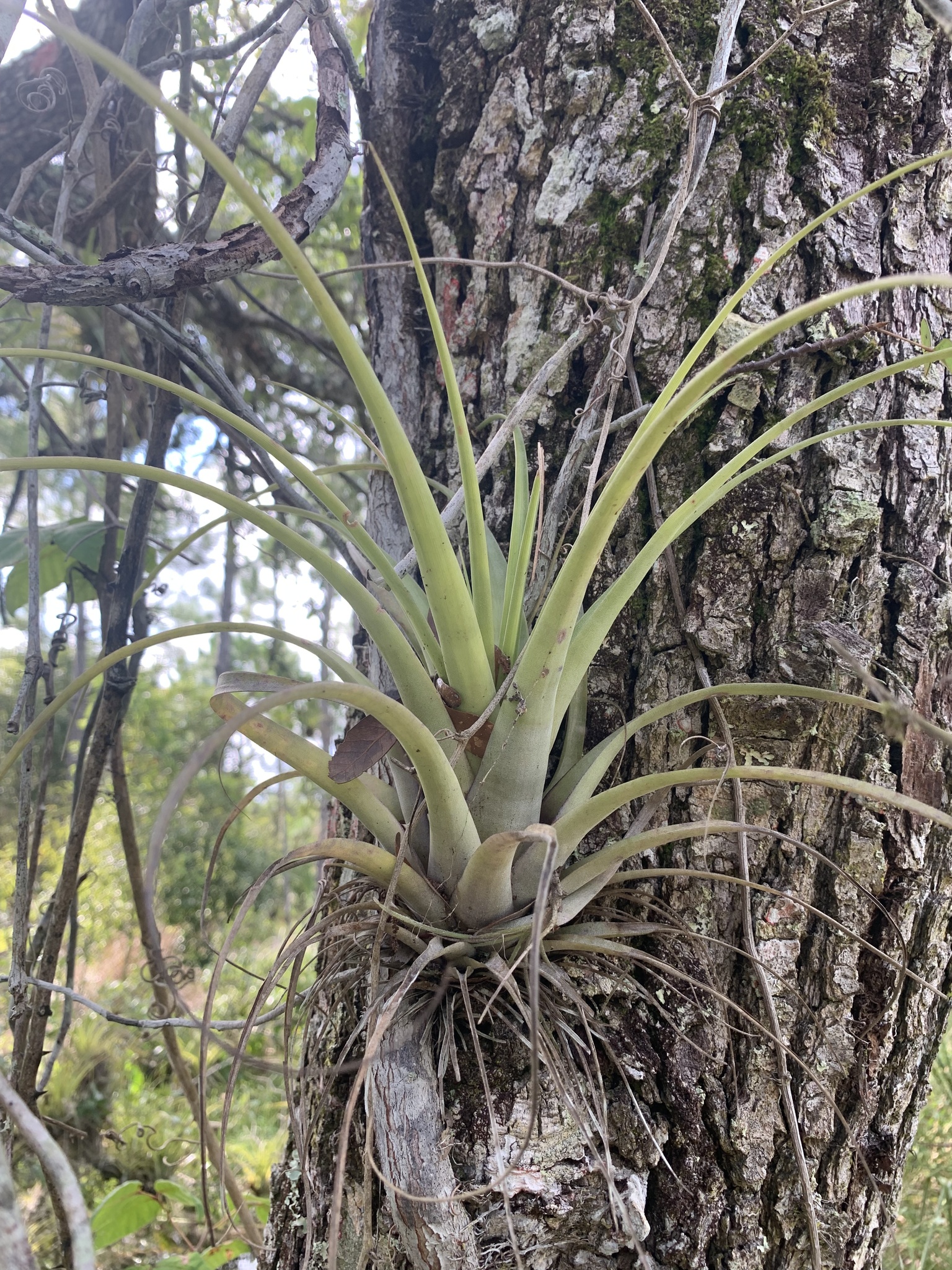
Tillandsia utriculata is an epiphyte in the bromeliad family, one of the larger species in its genus. It is also known to be used medicinally in parts of its range.
Source: Kew
From the Caribbean Basin
This species ranges naturally from southern Mexico down to northern Venezuela, and from Florida across the Caribbean, taking in territories such as Cuba, the Bahamas, Puerto Rico, and the Windward and Leeward Islands. It grows in the wet tropical biome, living as an epiphyte on trees rather than rooting in soil. Over the years it has accumulated numerous synonyms, including a named variegated form, reflecting a long history of botanical study since Linnaeus first published the species in 1753.
Source: Kew
Air, Light, Water, Warmth
Good growing rests on four things: airflow, bright but diffused light, careful watering, and steady warmth. From spring to autumn the plant benefits from being immersed in rainwater a few times a week and then left to dry fully before the next soak, since tap water's dissolved minerals can clog the trichomes and block moisture uptake. Misting between soakings helps stave off dehydration but cannot substitute for immersion, and watering should be skipped once temperatures fall near 12°C. A summer overnight soak with a diluted orchid feed can top up both hydration and nutrition, though the plant will not tolerate being kept continuously wet.
Source: RHS
Offsets and Seed
The easiest route is by detaching offsets once they have reached about a third of the parent's size, after which they can be grown on as mature plants. Propagation from seed is slower and more exacting, needing warmth, moisture, light, and good air movement, with young seedlings raised on a substrate such as stretched stocking fabric or sphagnum moss under strong diffused light and high humidity. Seedlings are watered by misting whenever their surface looks dry and fed weekly with a very dilute liquid or orchid feed until they are large enough, around 1.25 cm tall, to be separated onto their own growing supports.
Source: RHS
Trichomes and Tied-On Growth
Like other air plants, this species carries leaves coated in fine, water-absorbent scales called trichomes, which in some kin give a silvery, frosted look. These structures are the plant's main way of drawing in moisture from rain or fog, since it has no need of soil roots. In cultivation such plants are often mounted on wood, shells, or rock rather than potted, and their exotic flowers add to their appeal.
Source: RHS
Slugs and Snails
When set outdoors for the summer, air plants can attract slugs and snails, which become the main pest concern in that season.
Source: RHS
Rot, Drying, Scorch
Rot, seen as browning or blackening at the crown or on leaves, usually follows water pooling in the centre of the plant combined with poor airflow. Dehydration comes from a mix of infrequent watering, heat, and low humidity, or from relying too long on hard water instead of rainwater; an overnight soak can sometimes revive a dried-out plant. Dropped lower leaves point to general stress or the onset of rot, while brown or bleached patches usually mean the plant has scorched under direct sun and dry air, calling for more shade and higher humidity.
Source: RHS
Monocarpic Habit, Minimal Pruning
Most bromeliads, this species included, are monocarpic: they mature, flower, set seed, and then die, but not before producing offsets at the base. Once the mother plant has fully died back it can be cut away, leaving its offsets to continue growing, and beyond that little pruning is needed. Plants are also best angled downward when mounted, or gently shaken after watering, so water drains from the crown rather than sitting there.
Source: RHS
Care recipe
The species record — the baseline every cultivar inherits unless it says otherwise.
Care notes are early — not yet verified
- Light
- ai:claude-opus-4-8
- Water
- ai:claude-opus-4-8 (range 5-10d)
- Humidity
- ai:claude-opus-4-8
- Soil
- ai:claude-fable-5
- Care
- ai:claude-fable-5
Bright, indirect
≈ every 10 days
Medium
10–32 °C
None — mounted or displayed bare as an air plant
Seed, or occasional offsets after flowering
Dilute air-plant feed misted monthly
Slow
Sends up a tall spike, then dies after blooming
Not yet documented
This is where toxicity lives — every cultivar of this species inherits it and none can override it.
Reference images
Every image credited. Licenses link to their deeds.
PrimarySources: ai:claude-opus-4-8 · ai:claude-opus-4-8 (range 5-10d) · ai:claude-fable-5
Kept true by its growers
Every fact here carries its source. Grow Spreading Airplant yourself? What you’ve observed — how it drinks, how it holds its color, a name that’s off — and a clear photo of your plant are exactly what keep this page honest. Contributions are reviewed before anything changes.
Sign in to add what you know →