Species · genus Tillandsia · Bromeliaceae
Ballmoss
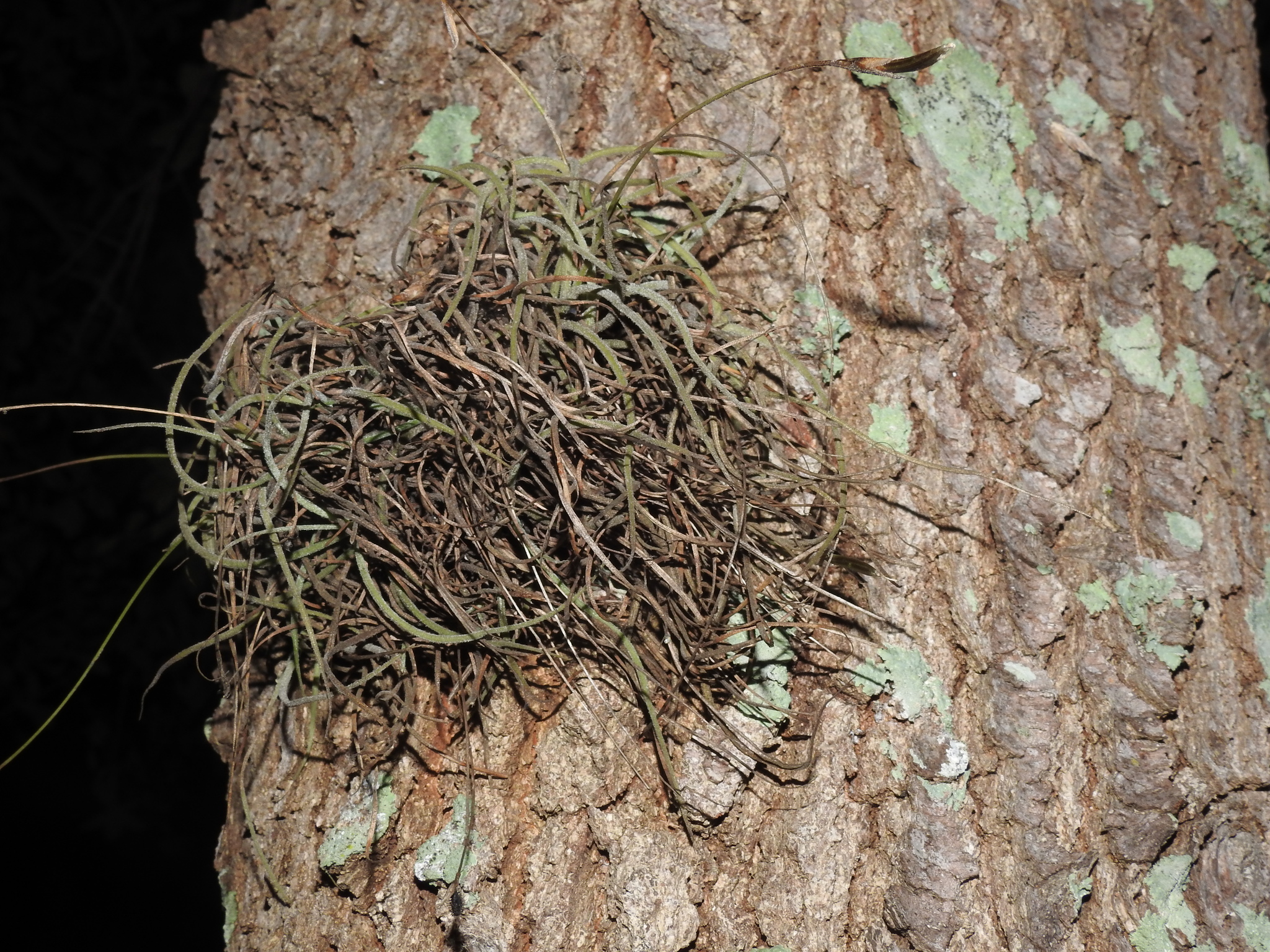
Tillandsia recurvata (L.) L.
Also known as: Small Ballmoss · Ball-moss · Bunch-moss · Old Man's Beard
Cultivars of T. recurvata
The named forms growers keep — each with its own page, each honest about how much we know.
No named cultivars catalogued under T. recurvata yet. When growers document a stable, named form, it earns its own page here.
Guide
The species-level account. Cultivar pages build on this and say where they differ.
What Ball Moss Is
Ball moss, Tillandsia recurvata, is a small evergreen bromeliad grown as an epiphyte rather than in soil. The RHS lists it in the Bromeliaceae family, kin to the strap-leaved, rosette-forming Tillandsias with their tubular flowers and showy bracts.
Source: RHS
A Wide American Range
Kew's records place this species natively across Tropical and Subtropical America, from the southern United States states of Texas, Florida, Georgia, Arizona and New Mexico down through Mexico, Central America, the Caribbean, and into South America as far as Argentina and Chile. It grows primarily in the seasonally dry tropical biome, always as an epiphyte perched on other plants rather than rooted in ground. Kew notes it has also been put to use for unspecified medicinal purposes, in food, and for environmental applications.
Source: Kew
A Relative Worth Knowing
Ball moss shares its genus with the better-known Spanish moss, Tillandsia usneoides, and the two have even been crossed to produce a hybrid called T. 'Kimberly', which forms dense clumps of silvery-green slender leaves and stays in the dwarf range for Tillandsias. That hybrid gives a useful sense of ball moss's own character: fine, wiry foliage and a compact, clustering habit rather than the long swaying strands of its cousin.
Source: Epic Gardening
Care recipe
The species record — the baseline every cultivar inherits unless it says otherwise.
Care notes are early — not yet verified
- Light
- ai:claude-opus-4-8
- Water
- ai:claude-opus-4-8 (range 3-7d)
- Humidity
- ai:claude-opus-4-8
- Soil
- ai:claude-fable-5
- Care
- ai:claude-fable-5
Bright, indirect
≈ every 7 days
Medium
10–32 °C
None — mounted or displayed bare as an air plant
Offset pups; forms ball-like colonies
Dilute air-plant feed misted occasionally
Slow
Small pale violet flowers when mature
Not yet documented
This is where toxicity lives — every cultivar of this species inherits it and none can override it.
Reference images
Every image credited. Licenses link to their deeds.
PrimarySources: ai:claude-opus-4-8 · ai:claude-opus-4-8 (range 3-7d) · ai:claude-fable-5
Kept true by its growers
Every fact here carries its source. Grow Ballmoss yourself? What you’ve observed — how it drinks, how it holds its color, a name that’s off — and a clear photo of your plant are exactly what keep this page honest. Contributions are reviewed before anything changes.
Sign in to add what you know →