Species · genus Tillandsia · Bromeliaceae
Berger's Air Plant
Tillandsia bergeri Mez
Cultivars of T. bergeri
The named forms growers keep — each with its own page, each honest about how much we know.
No named cultivars catalogued under T. bergeri yet. When growers document a stable, named form, it earns its own page here.
Guide
The species-level account. Cultivar pages build on this and say where they differ.
Berger's Air Plant
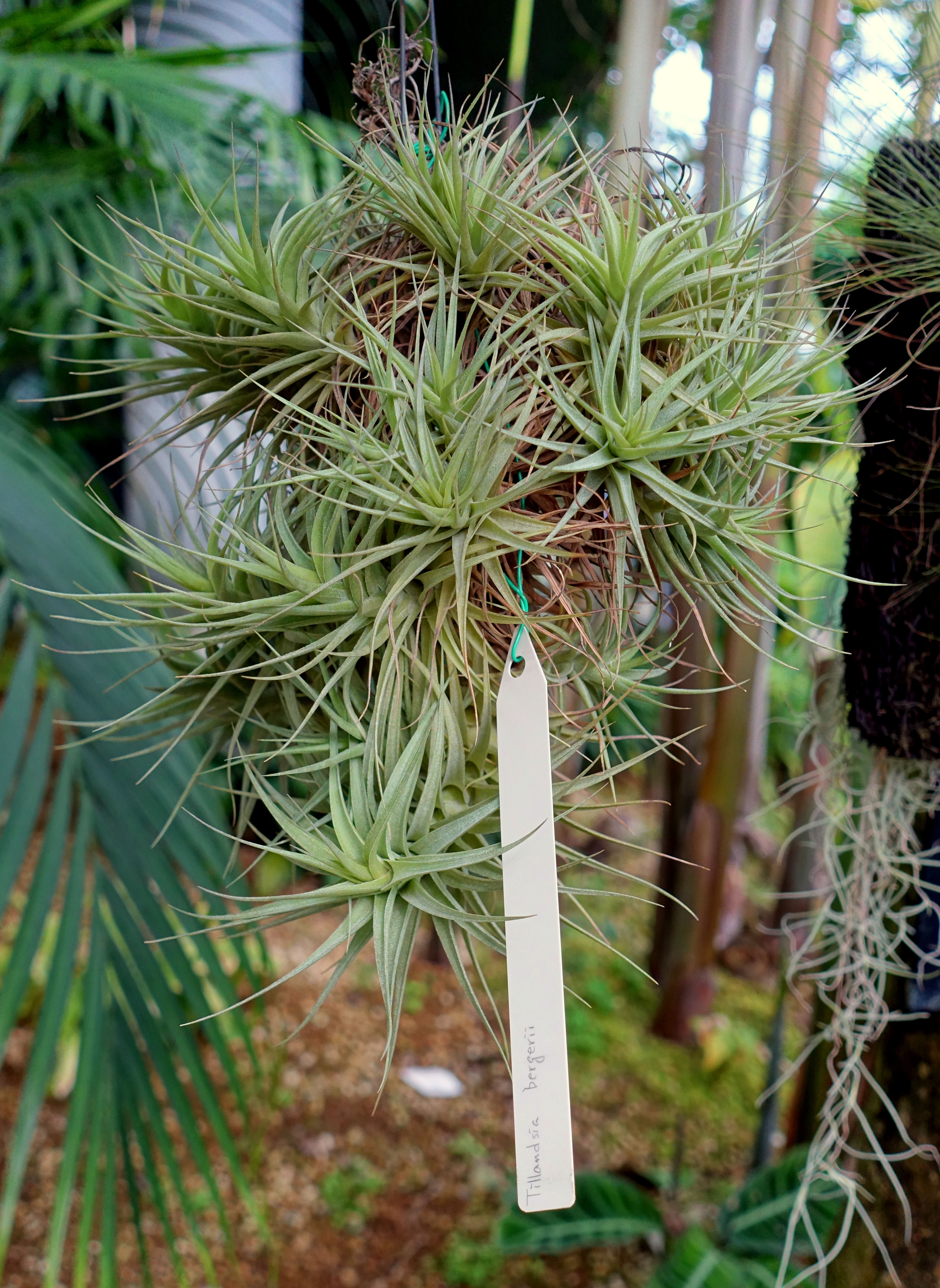
Tillandsia bergeri, known as Berger's air plant, is an evergreen epiphyte in the bromeliad family that grows in clumping rosettes. It carries blue flowers with white centres and twisted petals, held above pink bracts in summer.
Source: RHS
South American Roots
This species is native to a stretch running from Rio Grande do Sul in southern Brazil down into the Buenos Aires region of Argentina. It grows there as an epiphyte, mainly within subtropical habitats. It has since been introduced further afield, including the Canary Islands and Great Britain.
Source: Kew
Light, Water, Compost
Grow this air plant in partial shade, whether potted in terrestrial bromeliad compost with the leaf bases sitting at or just below the surface, or mounted on bark or a section of tree. Outdoors it wants coarse, open, leafy soil in partial or dappled shade and a frost-free spot. Water with soft water, generously through summer and only sparingly the rest of the year.
Source: RHS
Seed Or Offsets
Propagate from seed, or by removing offsets once they have reached at least a third the size of the parent rosette.
Source: RHS
Rosette And Bloom
The plant forms a rosette of greyish-green, narrowly triangular leaves that taper to a point and reach up to 15cm long. In summer it sends up flower spikes of 7 to 12cm bearing blue, white-centred flowers with twisted petals emerging from pink bracts. It stays compact, generally reaching only 0.1 to 0.5 metres in height and spread.
Source: RHS
Aphids And Mealybugs
Keep an eye out for aphids and mealybugs, the two pests this plant can be susceptible to. Otherwise it is generally free of disease.
Source: RHS
Removing Spent Rosettes
Once a rosette has flowered and died back, simply remove it to tidy the clump.
Source: RHS
Care recipe
The species record — the baseline every cultivar inherits unless it says otherwise.
Care notes are early — not yet verified
- Light
- ai:claude-opus-4-8
- Water
- ai:claude-opus-4-8 (range 5-10d)
- Humidity
- ai:claude-opus-4-8
- Soil
- ai:claude-fable-5
- Care
- ai:claude-fable-5
Bright, indirect
≈ every 10 days
Medium
10–30 °C
None — mounted or displayed bare as an air plant
Separation of offset pups; forms clustering clumps
Dilute air-plant feed misted monthly
Moderate
Blooms pale lavender flowers when mature
Not yet documented
This is where toxicity lives — every cultivar of this species inherits it and none can override it.
Reference images
Every image credited. Licenses link to their deeds.
PrimarySources: ai:claude-opus-4-8 · ai:claude-opus-4-8 (range 5-10d) · ai:claude-fable-5
Kept true by its growers
Every fact here carries its source. Grow Berger's Air Plant yourself? What you’ve observed — how it drinks, how it holds its color, a name that’s off — and a clear photo of your plant are exactly what keep this page honest. Contributions are reviewed before anything changes.
Sign in to add what you know →