Species · genus Syngonium · Araceae
Fivefingers
Syngonium angustatum Schott
Cultivars of S. angustatum
The named forms growers keep — each with its own page, each honest about how much we know.
No named cultivars catalogued under S. angustatum yet. When growers document a stable, named form, it earns its own page here.
Guide
The species-level account. Cultivar pages build on this and say where they differ.
An Arum Family Climber
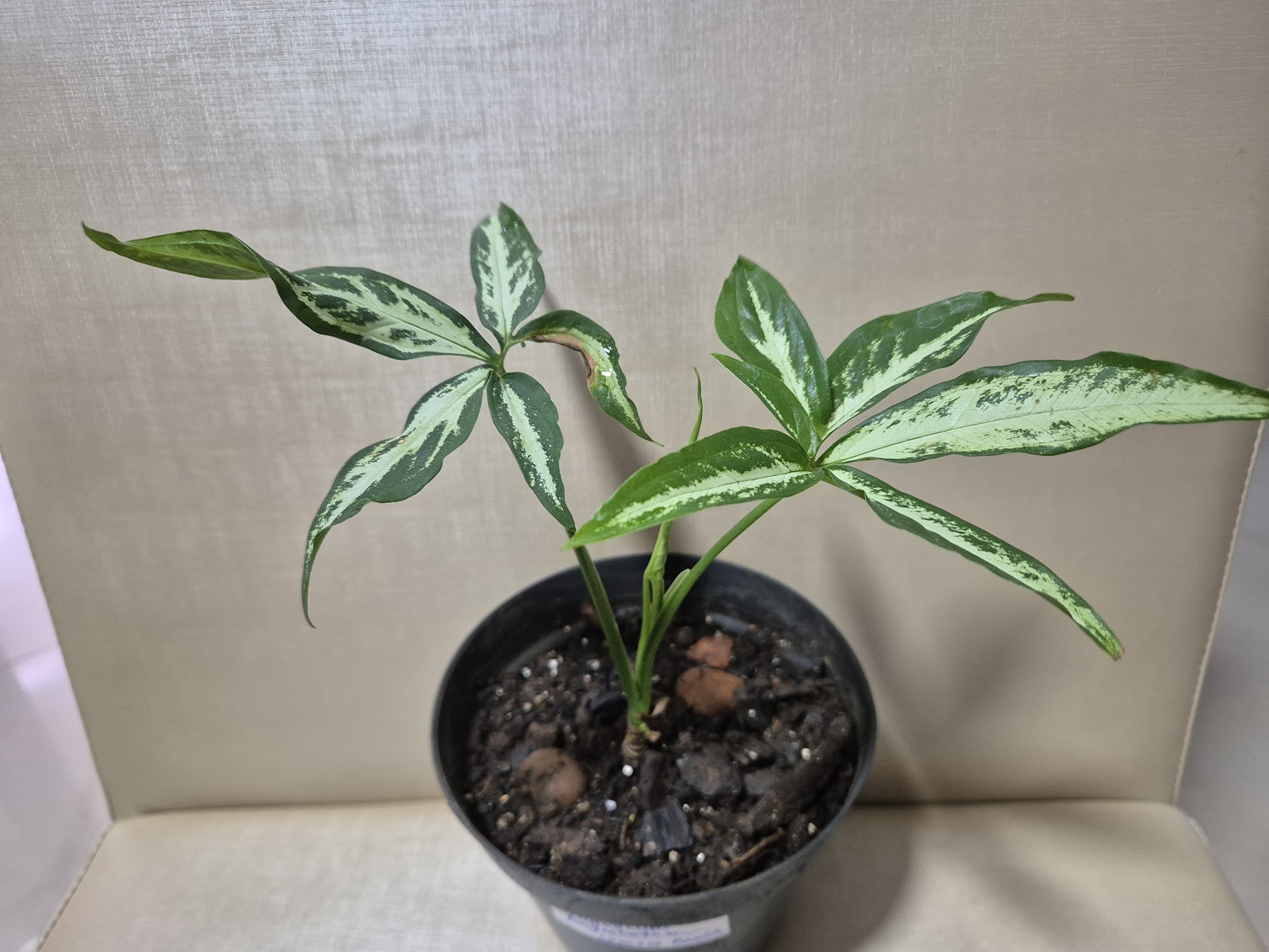
Syngonium angustatum is an evergreen climbing aroid, grown for its ovate to arrow-shaped leaves that become lobed as the plant matures. Flowers are arum-like, with cream, green or purple spathes, though they are rarely seen on plants kept indoors.
Source: RHS
From Mexico to Panama
This species is native to Mexico through Central Panama, extending into San Andrés and Providencia, and it has since naturalised well beyond that range, turning up from Florida to Brazil. In the wild it grows as a climber, rooting its way up through the seasonally dry tropical forest. It was first described by Schott in 1858, and beyond ornamental use it has a recorded history as a medicine and in environmental applications.
Source: Kew
Light, Water, Humidity
A related Syngonium podophyllum selection grown as a houseplant is treated as wanting as much indoor light as it can get, though it will get by in medium light, doing best within about five feet of an unobstructed east- or west-facing window. It is watered as the top quarter to half of the potting mix dries, and given average household temperatures with average to above-average relative humidity, ideally above 45 percent.
Source: Costa Farms
Easy to Share
This kind of Syngonium is described as easy to propagate, making it a plant readily shared with friends once it has put on some growth.
Source: Costa Farms
Leaves That Change Shape
The genus habit shows in this species clearly: young leaves are simple and arrow-shaped, but as the plant climbs and matures, the foliage becomes pedately lobed, divided into finger-like sections. It climbs by way of aerial roots, which let it cling and ascend as it would in its native forest.
Source: RHS
Variegation Can Wander
A variegated Syngonium podophyllum selection has a tendency to throw off sports that lose their patterning, or that come in entirely white with no chlorophyll at all, which such growth cannot sustain long term.
Source: Costa Farms
Care recipe
The species record — the baseline every cultivar inherits unless it says otherwise.
Care notes are early — not yet verified
- Light
- ai:claude-opus-4-8
- Water
- ai:claude-opus-4-8 (range 7-12d)
- Humidity
- ai:claude-opus-4-8
- Soil
- ai:claude-fable-5
- Care
- ai:claude-fable-5
Bright, indirect
≈ every 12 days
Medium
16–29 °C
Light, well-draining aroid mix with peat or coco and perlite
Stem cuttings with a node, rooted in water or moist mix
Balanced liquid feed monthly through spring and summer
Fast
Rarely flowers indoors
Toxic to cats & dogs & humans
Araceae contain insoluble calcium oxalate crystals, which irritate the mouth and digestive tract if chewed. This is where toxicity lives: every cultivar of this species inherits it and none can override it.
Reference images
Every image credited. Licenses link to their deeds.
PrimarySources: ai:claude-opus-4-8 · ai:claude-opus-4-8 (range 7-12d) · ai:claude-fable-5 · ai:claude-opus-4-8 (family inference)
Kept true by its growers
Every fact here carries its source. Grow Fivefingers yourself? What you’ve observed — how it drinks, how it holds its color, a name that’s off — and a clear photo of your plant are exactly what keep this page honest. Contributions are reviewed before anything changes.
Sign in to add what you know →