Species · genus Strobilanthes · Acanthaceae
Persian Shield
Strobilanthes auriculata Nees
Also known as: Royal Purple Plant
Cultivars of S. auriculata
The named forms growers keep — each with its own page, each honest about how much we know.
No named cultivars catalogued under S. auriculata yet. When growers document a stable, named form, it earns its own page here.
Guide
The species-level account. Cultivar pages build on this and say where they differ.
A Purple-Leaved Standout
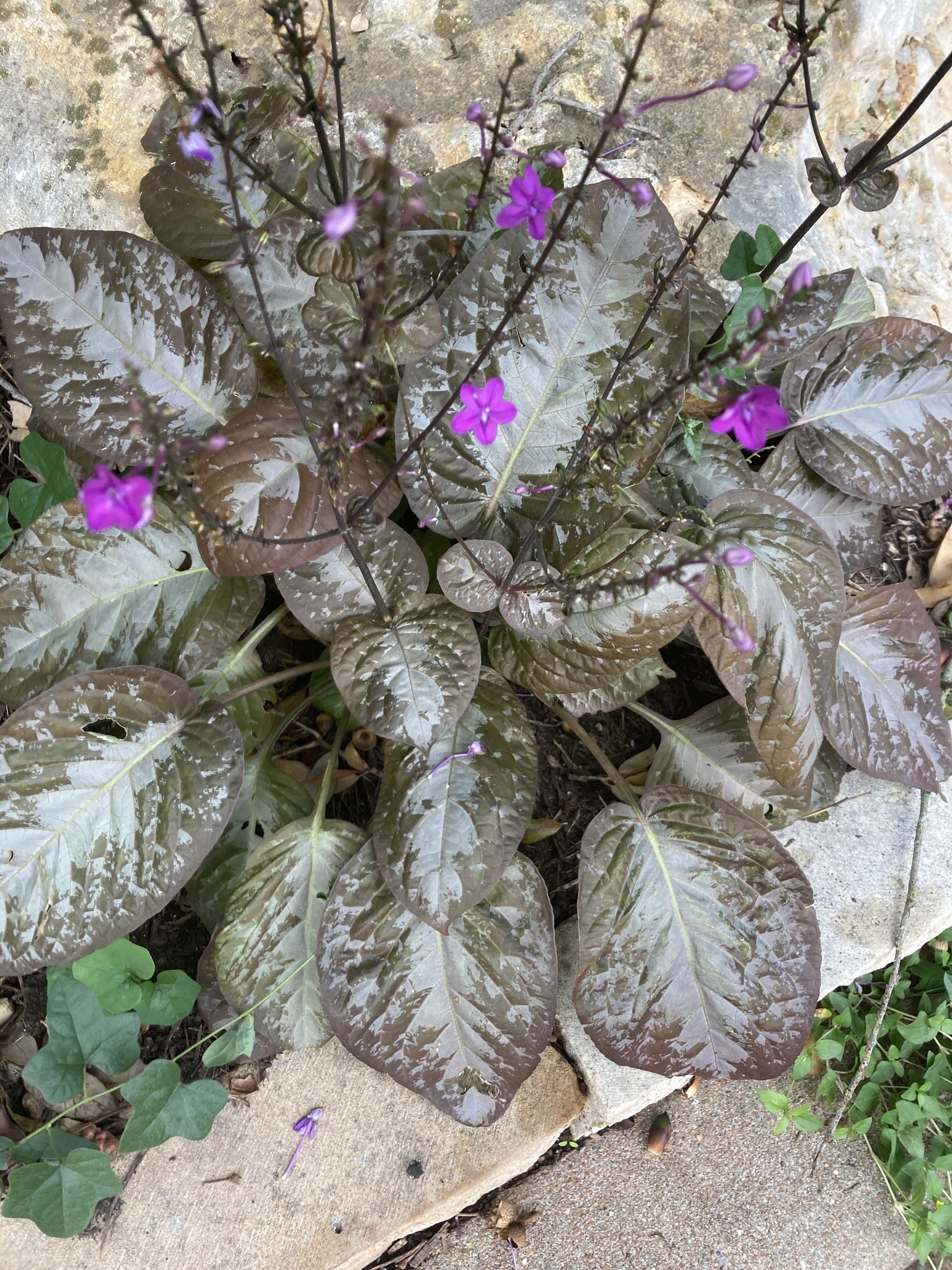
Persian Shield is grown chiefly for its foliage rather than its flowers, prized for leaves in a deep, almost luminous purple with contrasting green veins. It is usually treated as an annual or tender perennial, though it also settles well indoors as a houseplant given enough light.
Source: Epic Gardening
From Burmese Forests
Botanically this plant is Strobilanthes auriculata var. dyeriana, its varietal name honoring botanist William Turner Thiselton-Dyer, a former director of the Royal Botanic Gardens. It is native to Myanmar, once known as Burma, where it grows as a forest subshrub. Kew's own records place the wider species across a broad native range from Pakistan through to China and Peninsular Malaysia, occurring naturally as a subshrub or shrub in wet tropical habitats.
Source: Kew
Light, Water, and Feeding
This plant favors partial shade with roughly four hours of direct sun a day, though it tolerates more sun in cooler climates; too much intense sun or too much deep shade both dull the leaf color. It prefers soil kept consistently and slightly moist, watered around one to two times a week outdoors and more often in containers, especially in summer heat, without letting it become waterlogged. It likes well-draining, slightly acidic, nutrient-rich soil enriched with compost, high humidity, temperatures that stay above 50°F, and only moderate feeding with a nitrogen-leaning fertilizer a few times through the growing season.
Source: Epic Gardening
Rooting from Stem Cuttings
Because flowering is rare and seed is hard to come by, stem cuttings taken in spring are the easiest way to propagate Persian Shield. A healthy four-inch stem is cut just below a node, stripped of its lower leaves, and set into a moist soil or soilless mix such as coconut coir and perlite. Covering the pot with a clear plastic bag to hold humidity, then keeping it warm and bright but out of direct sun, brings roots along in a couple of weeks.
Source: Epic Gardening
Foliage Over Flowers
The leaves carry a striking iridescent purple with a silver sheen and prominent green veining, arranged opposite one another on woody stems. Plants typically reach three to four feet tall and two to three feet wide. Flowering does occur, producing small blue blooms, but it is uncommon outdoors and the flowers are considered secondary to the foliage display.
Source: Epic Gardening
Watch for Common Bugs
Persian Shield is not especially prone to pests, but aphids and whitefly can turn up outdoors, while spider mites and mealybugs are the more likely indoor concern. Regular checks and prompt treatment keep any infestation from spreading through the rest of the garden or plant collection.
Source: Epic Gardening
Legginess, Wilting, Fading Color
Leggy growth tends to follow insufficient sun, heat stress, or simply a season without pruning, and is fixed with a light trim that avoids removing too much at once. Wilting is usually a sign of underwatering and the plant typically perks back up soon after a good soak. Dull foliage points to too much sun, too much shade, cold exposure, or natural aging, and if age is the cause it is worth taking cuttings and letting the older plant go.
Source: Epic Gardening
Pinching, Pruning, Replacing
Young stems benefit from pinching back at around eight inches tall to encourage bushier branching. Ongoing pruning keeps leggy stems in check and removes any damaged or diseased leaves that would otherwise draw energy from new growth. Because the plant's color fades after a couple of years, it is generally better to take fresh cuttings and start again than to keep repotting an aging specimen.
Source: Epic Gardening
Care recipe
The species record — the baseline every cultivar inherits unless it says otherwise.
Care notes are early — not yet verified
- Light
- ai:claude-opus-4-8
- Water
- ai:claude-opus-4-8 (range 5-10d)
- Humidity
- ai:claude-opus-4-8
- Soil
- ai:claude-fable-5
- Care
- ai:claude-fable-5
Bright, indirect
≈ every 10 days
Medium
15–27 °C
Rich, moisture-retentive but well-draining mix
Softwood stem cuttings rooted in moist mix
Balanced feed monthly in spring and summer
Moderate
Blue-purple tubular flowers under bright, indirect light
Not yet documented
This is where toxicity lives — every cultivar of this species inherits it and none can override it.
Reference images
Every image credited. Licenses link to their deeds.
PrimarySources: ai:claude-opus-4-8 · ai:claude-opus-4-8 (range 5-10d) · ai:claude-fable-5
Kept true by its growers
Every fact here carries its source. Grow Persian Shield yourself? What you’ve observed — how it drinks, how it holds its color, a name that’s off — and a clear photo of your plant are exactly what keep this page honest. Contributions are reviewed before anything changes.
Sign in to add what you know →