Species · genus Stephanotis · Apocynaceae
Bridalwreath
Stephanotis floribunda Brongn.
Also known as: Chaplet-flower · Madagascar-jasmine · Waxflower
Cultivars of S. floribunda
The named forms growers keep — each with its own page, each honest about how much we know.
No named cultivars catalogued under S. floribunda yet. When growers document a stable, named form, it earns its own page here.
Guide
The species-level account. Cultivar pages build on this and say where they differ.
A fragrant twining climber
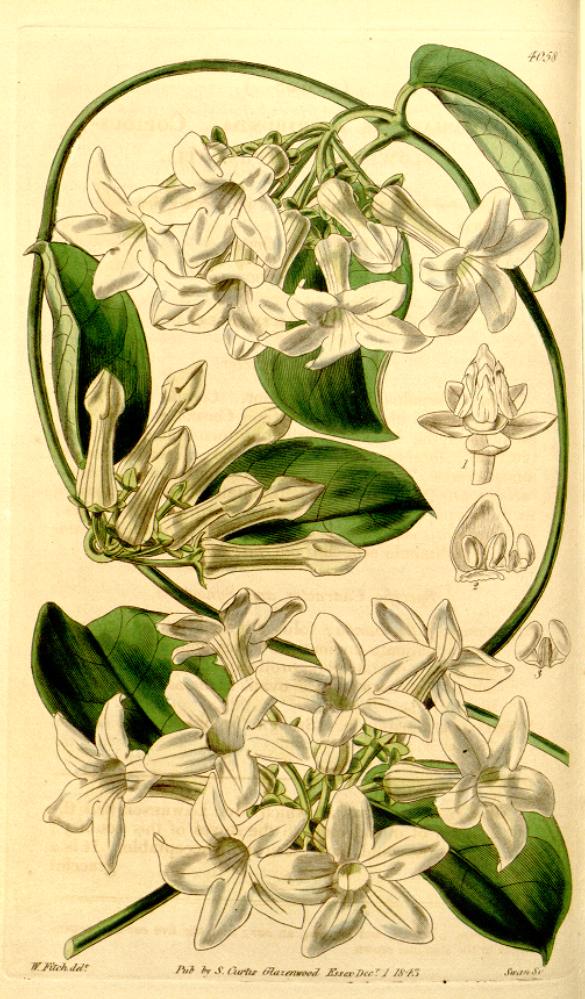
Stephanotis is a woody, twining evergreen vine known for clusters of intensely fragrant white flowers and glossy, leathery dark green foliage. It is grown both as a houseplant trained on a support and, in frost-free climates, as an outdoor perennial vine.
Source: Costa Farms
Madagascar native
This species, Stephanotis floribunda, hails from Madagascar and belongs to the Apocynaceae family. It carries the common names bridal wreath, Madagascar jasmine, and clustered waxflower, and is also known botanically as Marsdenia floribunda or Stephanotis jasminoides.
Source: RHS
Bright light, steady moisture
Give stephanotis a bright spot indoors, since more light means better flowering, and let the top inch or two of potting mix dry before watering again, which may mean anywhere from once a week to once every ten or fourteen days depending on conditions. Fertilize once or twice a year in spring and summer, or more often if faster growth and bloom are wanted. Under glass, water and mist freely during active growth, feed with a balanced liquid fertiliser every two to three weeks, and cut back to sparing water in winter.
Source: Costa Farms
Seed or cuttings
Stephanotis can be propagated from seed sown at 18-21°C in spring, or by taking semi-hardwood cuttings in summer with the help of bottom heat.
Source: RHS
Waxy blooms, twining habit
The genus is defined by twining stems bearing pairs of simple, leathery leaves and waxy, jasmine-scented tubular flowers with five spreading lobes, occasionally followed by egg-shaped green fruit. In this species the flower tubes reach up to about 5cm long, and the vine can climb to 4-8 metres given full sun and a sheltered spot.
Source: RHS
Scale and mites to watch
This vine may be troubled by scale insects, glasshouse red spider mite, mealybugs, and root mealybug, though it is generally free of disease.
Source: RHS
Pruning and support
Prune stephanotis whenever it outgrows its bounds, keeping in mind that as a milkweed-family plant it weeps a milky white sap when cut, so a rag on hand is useful to keep the sap off floors and furniture. As a climber it also needs its twining stems supported, whether on a post, wires, or trained with fishing line.
Source: Costa Farms
Care recipe
The species record — the baseline every cultivar inherits unless it says otherwise.
Care notes are early — not yet verified
- Light
- ai:claude-opus-4-8
- Water
- ai:claude-opus-4-8 (range 7-12d)
- Humidity
- ai:claude-opus-4-8
- Soil
- ai:claude-fable-5
- Care
- ai:claude-fable-5
Bright, indirect
≈ every 12 days
Medium
13–27 °C
Rich, well-draining peat-based mix
Semi-ripe stem cuttings rooted with warmth
Balanced liquid feed every two weeks in the growing season
Moderate
Fragrant white blooms in summer if given bright light and a cool winter rest
Toxic to cats & dogs & humans
Apocynaceae commonly contain toxic cardiac glycosides and milky latex. This is where toxicity lives: every cultivar of this species inherits it and none can override it.
Reference images
Every image credited. Licenses link to their deeds.
Sources: ai:claude-opus-4-8 · ai:claude-opus-4-8 (range 7-12d) · ai:claude-fable-5 · ai:claude-opus-4-8 (family inference)
Kept true by its growers
Every fact here carries its source. Grow Bridalwreath yourself? What you’ve observed — how it drinks, how it holds its color, a name that’s off — and a clear photo of your plant are exactly what keep this page honest. Contributions are reviewed before anything changes.
Sign in to add what you know →