Species · genus Soleirolia · Urticaceae
Mind Your Own Business
Soleirolia soleirolii (Req.) Dandy
Also known as: Mother Of Thousands · Baby's Tears · Corsican Curse · Irish Moss · Japanese Moss
Cultivars of S. soleirolii
The named forms growers keep — each with its own page, each honest about how much we know.
No named cultivars catalogued under S. soleirolii yet. When growers document a stable, named form, it earns its own page here.
Guide
The species-level account. Cultivar pages build on this and say where they differ.
A Mat of Tiny Leaves
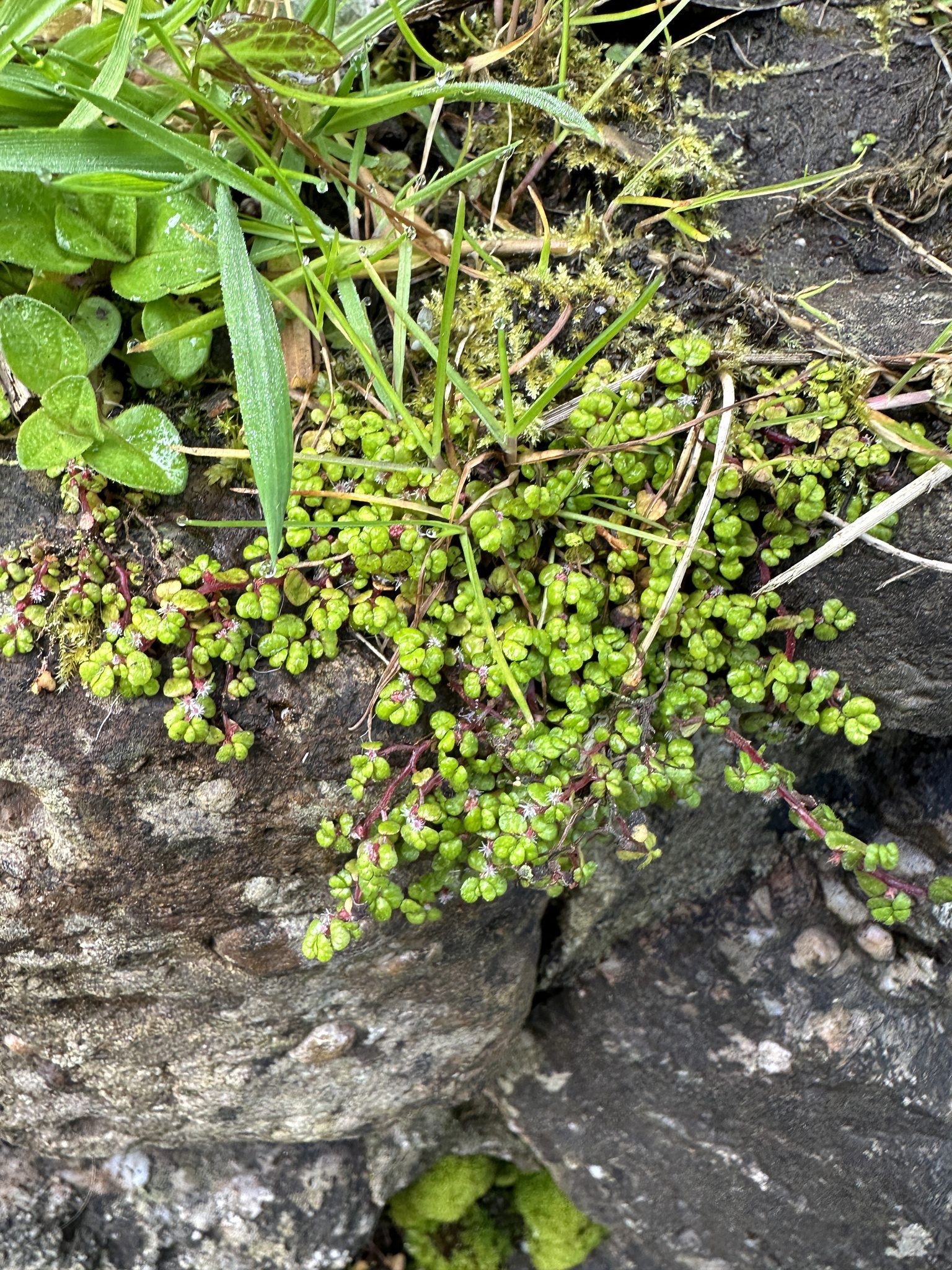
Baby tears, botanically Soleirolia soleirolii, is a creeping evergreen perennial in the nettle family, grown as both a ground cover and a houseplant for its dense carpet of tiny round leaves. It goes by many folk names, including angel's tears, mind-your-own-business, and Corsican curse.
Source: Epic Gardening
Mediterranean Islands
This creeping perennial hails from the western Mediterranean, native to Italy, Sardinia, Corsica, and the Balearic Islands. It has since spread well beyond that range and is regarded as an environmental weed in parts of Western Europe and California.
Source: Epic Gardening
Light, Water, Feed
Give baby tears bright indirect light or partial shade, since direct sun scorches its delicate leaves, and keep the soil consistently moist but never soggy, watering roughly every five to seven days in the growing season. Humidity around 60 percent helps, kept up with daily misting or a pebble tray. Feed with a balanced, water-soluble fertilizer diluted by half every two weeks through spring and summer, easing off once the plant goes dormant in winter.
Source: Epic Gardening
Division Does It
The RHS lists propagation by seed or by division as the routes for this plant. In practice, dividing the root ball and foliage into small clusters and potting them into shallow containers, with a bag or lid over the top to hold humidity, is a straightforward way to multiply your stock.
Source: Epic Gardening
Moss-Like Ground Cover
Baby tears forms a wide, mat-forming carpet of slender, rooting stems set with tiny rounded leaves, reaching only up to about 10 cm tall while spreading half a metre to a metre. In summer it produces minute, inconspicuous pinkish-white flowers without petals. A golden-leaved variety called 'Aurea' exists, with broader, gold foliage growing a bit taller and wider than the species.
Source: RHS
Sap-Suckers to Watch
Aphids, whiteflies, and scale insects are the common visitors, each feeding on sap and weakening the plant. Whiteflies show as tiny white specks on leaf undersides and cause leaf drop, scale appears as small brown slimy bumps leaving sticky honeydew, and aphids form colonies that damage leaves and flowers. Neem oil sprays or wiping scale away with rubbing alcohol are typical responses.
Source: Epic Gardening
Reading the Leaves
Yellowing lower leaves point to overwatering, while curling or browning leaves suggest too much sun or a spot that is too warm. Soggy, waterlogged soil invites root rot, botrytis, southern blight, and powdery mildew, all of which favor foliage sitting in moisture too long. Letting the soil dry out and pruning away affected leaves usually resolves these issues.
Source: Epic Gardening
Repot and Restrain
Baby tears grows vigorously and tends to outgrow its pot, so up-pot by about an inch once crowded, gently separating the root mass into fresh soil. Because it can turn invasive, especially outdoors in climates resembling its Mediterranean home, frequent pruning keeps it from spilling past its bounds. The RHS, by contrast, notes it needs no pruning when grown under its recommended conditions.
Source: Epic Gardening
Care recipe
The species record — the baseline every cultivar inherits unless it says otherwise.
Care notes are early — not yet verified
- Light
- ai:claude-opus-4-8
- Water
- ai:claude-opus-4-8 (range 2-5d)
- Humidity
- ai:claude-opus-4-8
- Soil
- ai:claude-fable-5
- Care
- ai:claude-fable-5
Bright, indirect
≈ every 5 days
High
10–24 °C
Moisture-retentive, well-draining peaty mix
Division of the spreading mat or rooted stem pieces
Balanced liquid feed monthly in the growing season
Fast
Tiny insignificant flowers; grown for its dense foliage mat
Not yet documented
This is where toxicity lives — every cultivar of this species inherits it and none can override it.
Reference images
Every image credited. Licenses link to their deeds.
PrimarySources: ai:claude-opus-4-8 · ai:claude-opus-4-8 (range 2-5d) · ai:claude-fable-5
Kept true by its growers
Every fact here carries its source. Grow Mind Your Own Business yourself? What you’ve observed — how it drinks, how it holds its color, a name that’s off — and a clear photo of your plant are exactly what keep this page honest. Contributions are reviewed before anything changes.
Sign in to add what you know →