Species · genus Sempervivum · Crassulaceae
Cobweb House-leek
Sempervivum arachnoideum L.
Also known as: Cobweb Houseleek
Cultivars of S. arachnoideum
The named forms growers keep — each with its own page, each honest about how much we know.
No named cultivars catalogued under S. arachnoideum yet. When growers document a stable, named form, it earns its own page here.
Guide
The species-level account. Cultivar pages build on this and say where they differ.
The Cobweb Houseleek
Sempervivum arachnoideum, known as the cobweb houseleek, is an evergreen alpine perennial that forms low mats of small, fleshy rosettes. It belongs to the stonecrop family Crassulaceae and is grown chiefly for its tight, textured foliage rather than its flowers.
Source: RHS
From Mountain Screes
This houseleek's natural range runs from the Pyrenees to the Carpathians, where it would have grown on rocky, well-drained ground. It carries the RHS Award of Garden Merit, a mark of its reliability in cultivation.
Source: RHS
Sun, Grit, and Little Else
Grow this houseleek in full sun, in moderately fertile, well-drained soil such as loam or sand, tolerant of acid, neutral, or alkaline conditions. It suits exposed or sheltered spots facing any direction, but excessive winter wet needs guarding against. Left alone, it asks for very little beyond good drainage and light.
Source: RHS
Offsets Do the Work
Propagation is straightforward: sow seed in spring, or simply root the small offset rosettes the plant produces, also in spring.
Source: RHS
Webbed in White
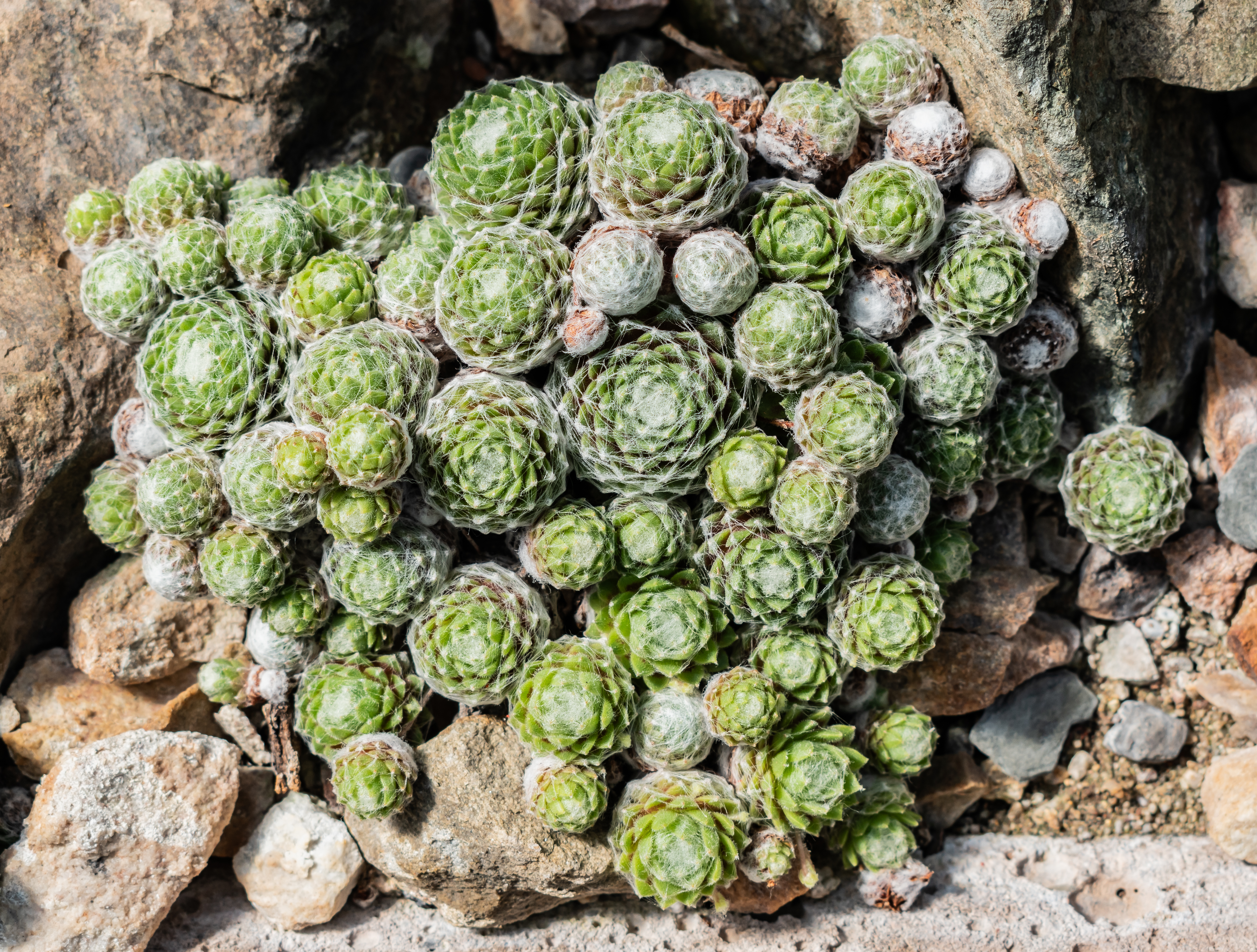
The rosettes are small, only 1 to 3cm across, with leaves in green or reddish tones, and the tips are drawn together by fine white hairs that give the effect of cobwebs. In summer it sends up starry pink flowers about 1cm wide, held in flat clusters on stems reaching up to 12cm. Left to spread, the rosettes knit together into a dense, matforming carpet, eventually up to half a metre wide. A red-leaved selection, 'Rubrum', shows the same cobwebbed rosettes but in mostly dark red foliage.
Source: RHS
Weevils and Leaf Miner
Vine weevil can trouble this houseleek, and the reddish 'Rubrum' selection is also noted as susceptible to sempervivum leaf miner. Watch for the usual early signs of grazing or tunnelling in the fleshy leaves.
Source: RHS
Rust and Wet Feet
The main disease risk noted is a rust, so foliage is worth checking periodically. Beyond that, the chief hazard is excessive winter wet, which the plant needs protection from.
Source: RHS
Little Upkeep Needed
No pruning is required for this houseleek. It suits rock gardens, scree beds, wall crevices, troughs, and alpine houses, and takes some five to ten years to reach full maturity.
Source: RHS
Care recipe
The species record — the baseline every cultivar inherits unless it says otherwise.
Care notes are early — not yet verified
- Light
- ai:claude-opus-4-8
- Water
- ai:claude-opus-4-8 (range 10-21d)
- Humidity
- ai:claude-opus-4-8
- Soil
- ai:claude-fable-5
- Care
- ai:claude-fable-5
Direct sun
≈ every 21 days
Low — average room
4–24 °C
Very gritty, sharply draining alpine succulent mix
Offsets — the cobweb rosettes pup freely and root where they land
Little to none — a weak feed once a year at most
Slow
Rosy-red star flowers once, then that rosette dies after setting offsets
Not yet documented
This is where toxicity lives — every cultivar of this species inherits it and none can override it.
Reference images
Every image credited. Licenses link to their deeds.
PrimarySources: ai:claude-opus-4-8 · ai:claude-opus-4-8 (range 10-21d) · ai:claude-fable-5
Kept true by its growers
Every fact here carries its source. Grow Cobweb House-leek yourself? What you’ve observed — how it drinks, how it holds its color, a name that’s off — and a clear photo of your plant are exactly what keep this page honest. Contributions are reviewed before anything changes.
Sign in to add what you know →