Species · genus Selenicereus · Cactaceae
Nightblooming Cactus
Selenicereus undatus (Haw.) D.R.Hunt
Cultivars of S. undatus
The named forms growers keep — each with its own page, each honest about how much we know.
No named cultivars catalogued under S. undatus yet. When growers document a stable, named form, it earns its own page here.
Guide
The species-level account. Cultivar pages build on this and say where they differ.
A Climbing Cactus Fruit
Dragon fruit, or pitahaya, is a tropical, berry-bearing cactus grown for its sprawling, vining stems, its large night-blooming flowers, and its brightly colored, sweet fruit. It can live for nearly twenty years, making it as much a long-term garden companion as a fruit crop.
Source: Epic Gardening
From Mexico to the World
Kew records this species, Selenicereus undatus, as native to Mexico through Honduras, where it grows as a succulent epiphyte in seasonally dry tropical settings. It has since been introduced widely across the tropics and subtropics, from the Caribbean and Florida to Southeast Asia, southern Africa, and various Pacific and Indian Ocean islands. Beyond the garden, it has served people as food, medicine, and for environmental uses.
Source: Kew
Sun, Water, and Feed
Give dragon fruit as much sun as possible, ideally over six hours a day, though young or heat-stressed plants appreciate some afternoon shade to avoid scorch. Water with a soak-and-dry rhythm, letting the top inch or two of soil dry before watering deeply in the morning, since soggy soil invites root rot while the plant otherwise tolerates dry spells well. It grows best in a light, well-draining mix of roughly two-thirds vegetable potting soil to one-third cactus mix, with a slightly acidic pH, and appreciates a high-nitrogen feed during green growth followed by a higher-potassium formula once flowering begins.
Source: Epic Gardening
Rooting from Stem Cuttings
Like most cacti, dragon fruit propagates readily from stem cuttings taken at a joint, with any deformed or pest-ridden sections discarded. The cut end is trimmed to a triangular point, planted cut-side down, and left to dry and scab over for two to three days before going into soil. Kept lightly moist in shade, cuttings typically root within a couple of weeks, while growing from seed is also possible but takes longer to reach a plantable seedling.
Source: Epic Gardening
Stems, Flowers, and Fruit
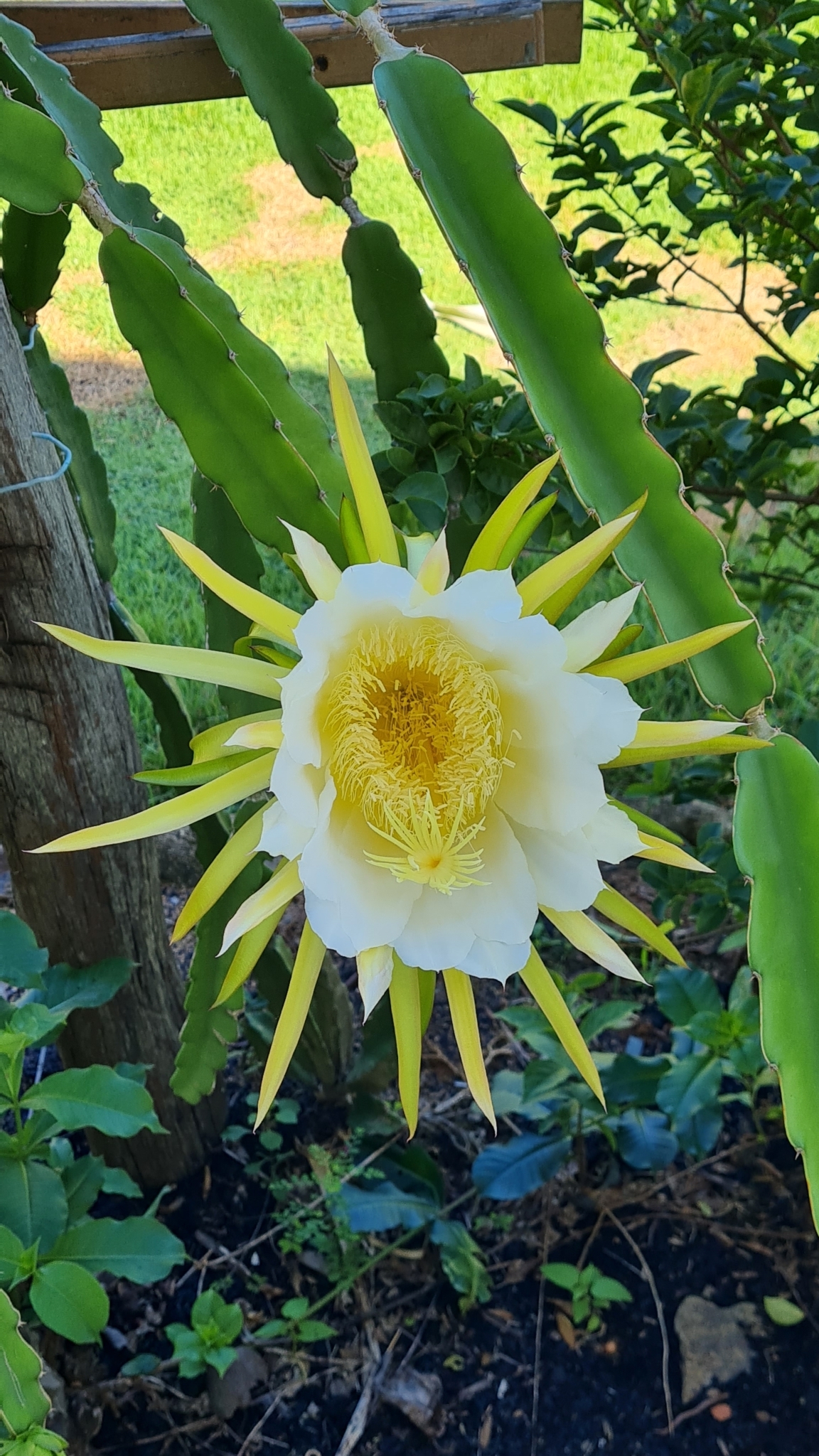
The plant's fleshy, triangular stems sprawl, crawl, and climb, sending out aerial roots as they run since most dragon fruit species are epiphytic or root loosely in soil. Its intensely fragrant flowers open only at night, drawing moths and bats, and can stretch over a foot long before giving way to the thick-skinned, seed-speckled fruit. Depending on species, skin comes in pink, purple, or yellow, with flesh that may be white, red, or magenta and dotted with tiny black seeds.
Source: Epic Gardening
Scale, Ants, and Fruit Flies
Scale insects, including mealybugs, are common culprits, lying flat against the plant to suck its juices and spread disease; horticultural or neem oil smothers them, while heavier infestations may need insecticidal soap or a wipe of rubbing alcohol. Because some scale insects secrete honeydew, ants often show up alongside them and are best treated at the same time, with borax-based traps helping to eliminate the colony. Fruit flies can also settle on the fruit itself, so harvested dragon fruit should always be washed well before eating.
Source: Epic Gardening
Rot, Sunscald, and Poor Fruiting
As a succulent, dragon fruit is especially vulnerable to root rot, most often caused by overwatering, which calls for well-draining soil and a rescue repot into fresh mix if it occurs. Direct sun exposure can also cause irreversible sunscald, though neem oil and removal of rotted tissue can manage the damage while repositioning or shading prevents further harm. Diseases like stem canker and brown fruit rot show up as sunken or water-soaked lesions and spread quickly, so infected material should be removed promptly since cures are unreliable once established.
Source: Epic Gardening
Pruning, Training, and Dormancy
Left alone, dragon fruit grows unruly, so pruning one to three times a year keeps its size and fruiting in check, starting with removal of diseased growth, then out-of-bounds or poorly lit stems. Young plants need a sturdy, textured support tied loosely at the stem joints to train them upright before they arch over and fruit, eventually clinging on their own aerial roots. After harvest, the plant benefits from a dormancy period: topdress with a high-nitrogen amendment, cut back watering to once or twice a month, stop fertilizing, and in cold climates move it under cover or indoors to avoid frost damage.
Source: Epic Gardening
Care recipe
The species record — the baseline every cultivar inherits unless it says otherwise.
Care notes are early — not yet verified
- Light
- ai:claude-opus-4-8
- Water
- ai:claude-opus-4-8 (range 10-21d)
- Humidity
- ai:claude-opus-4-8
- Soil
- ai:claude-fable-5
- Care
- ai:claude-fable-5
Bright, indirect
≈ every 21 days
Medium
13–32 °C
Coarse, fast-draining cactus mix
Stem-segment cuttings callused then rooted; the dragon-fruit cactus
Balanced cactus feed monthly in spring and summer
Fast
Spectacular fragrant white flowers that open for a single night
Non-toxic to cats & dogs
No toxicity concerns on record — NC State lists it as non-toxic for cats, dogs, and horses. This is where toxicity lives: every cultivar of this species inherits it and none can override it.
Reference images
Every image credited. Licenses link to their deeds.
PrimarySources: ai:claude-opus-4-8 · ai:claude-opus-4-8 (range 10-21d) · ai:claude-fable-5 · NC State Extension Plant Toolbox — Selenicereus undatus (species entry; non-toxic for cats, dogs, and horses)
Kept true by its growers
Every fact here carries its source. Grow Nightblooming Cactus yourself? What you’ve observed — how it drinks, how it holds its color, a name that’s off — and a clear photo of your plant are exactly what keep this page honest. Contributions are reviewed before anything changes.
Sign in to add what you know →