Species · genus Selaginella · Selaginellaceae
Krauss's Clubmoss
Selaginella kraussiana (Kunze) A.Braun
Also known as: Krauss' Spikemoss · Garden Selaginella · Kraus's Clubmoss · Krauss's Spike-moss · Krauss's-club-moss
Cultivars of S. kraussiana
The named forms growers keep — each with its own page, each honest about how much we know.
No named cultivars catalogued under S. kraussiana yet. When growers document a stable, named form, it earns its own page here.
Guide
The species-level account. Cultivar pages build on this and say where they differ.
A Mossy Little Clubmoss
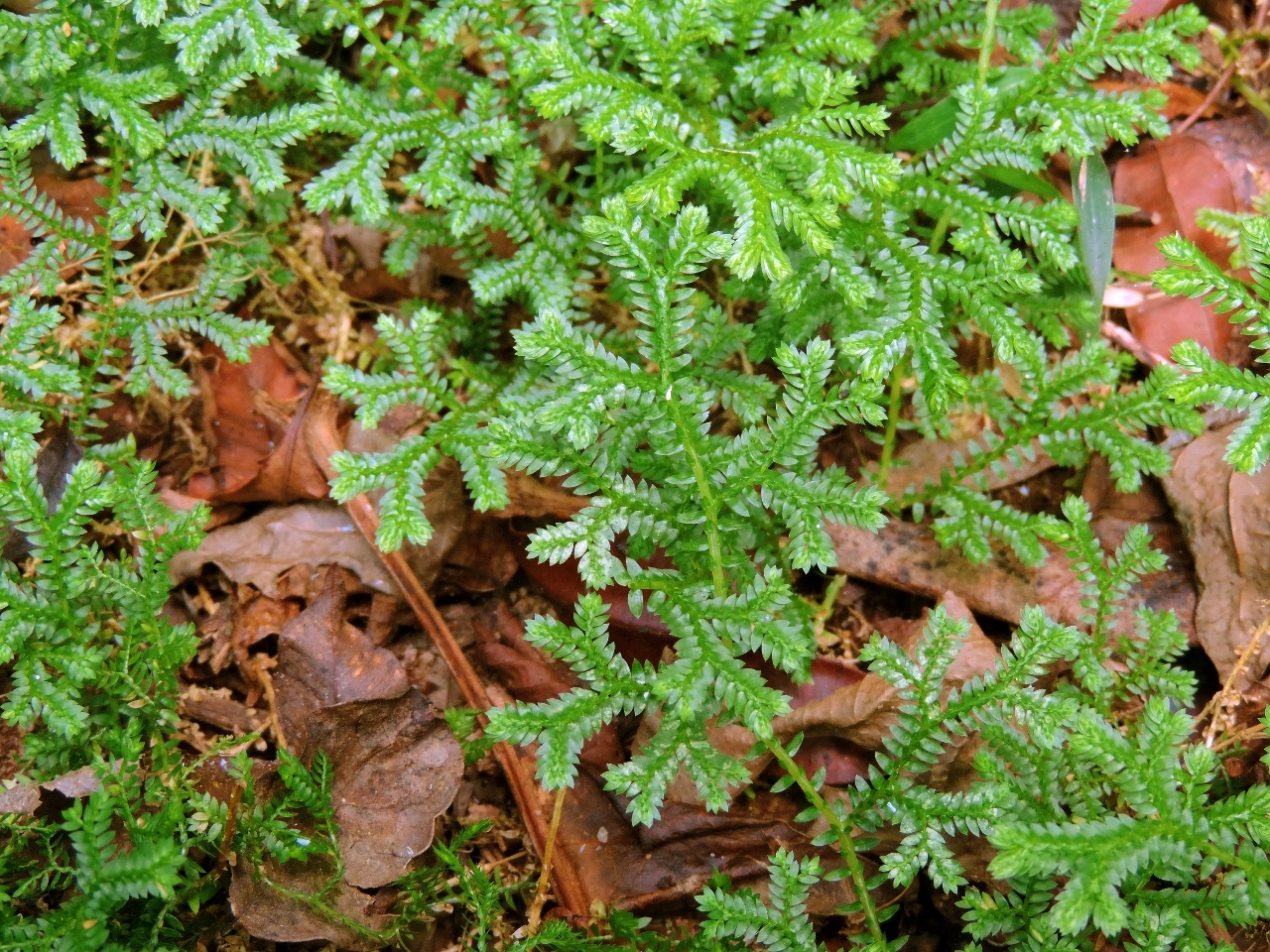
Selaginella kraussiana, known as Kraus's clubmoss, is a mat-forming evergreen perennial with rooting stems and small scale-like leaves that give it a fern-like look. It stays low, reaching only up to about 10cm tall, while spreading widely across the surface it grows on.
Source: RHS
From Macaronesia and Africa
This clubmoss comes originally from Macaronesia and Africa. It belongs to the family Selaginellaceae, a group of evergreen rhizomatous perennials that range from small tufted forms to taller scramblers, all bearing slender stems dressed in tiny scale-like leaves.
Source: RHS
Shade, Moisture, Warmth
This plant prefers full or partial shade rather than bright direct light, and it likes soil that stays moist but well-drained, whether acid or neutral. In frost-prone areas it needs to be grown under glass in a mix of two parts peat-free loam-based compost to one part leafmould, kept in bright but filtered light, and it wants a winter minimum of around 5 to 7°C.
Source: RHS
Spores or Division
Propagation can be done by sowing spores at 21°C as soon as they are ripe, or by dividing rhizomes or rooted stems in spring.
Source: RHS
Mat-Forming, Terrarium-Friendly
Its habit is mat-forming, with rooting stems that spread readily, sometimes to as much as 1 to 1.5 metres across, even though the plant itself stays under 10cm in height. This spreading, fern-like texture makes it especially well suited to terrariums and bottle gardens.
Source: RHS
Safe Around Pets
For households with animals, this is one to worry less about: it is classed as non-toxic to dogs, cats, and horses.
Source: ASPCA
Little Upkeep Needed
No pruning is required for this clubmoss, and it is generally free of both pests and disease, which keeps its care fairly hands-off once conditions are right.
Source: RHS
Care recipe
The species record — the baseline every cultivar inherits unless it says otherwise.
Care notes are early — not yet verified
- Light
- ai:claude-opus-4-8
- Water
- ai:claude-opus-4-8 (range 2-5d)
- Humidity
- ai:claude-opus-4-8
- Soil
- ai:claude-fable-5
- Care
- ai:claude-fable-5
Low light
≈ every 5 days
High
15–24 °C
Peaty, moisture-retentive mix that stays evenly damp
Division or stem cuttings that root at the nodes in moist mix
Weak balanced feed monthly in the growing season
Moderate
Non-flowering — a spore-bearing spikemoss, never blooms
Not yet documented
This is where toxicity lives — every cultivar of this species inherits it and none can override it.
Reference images
Every image credited. Licenses link to their deeds.
PrimarySources: ai:claude-opus-4-8 · ai:claude-opus-4-8 (range 2-5d) · ai:claude-fable-5
Kept true by its growers
Every fact here carries its source. Grow Krauss's Clubmoss yourself? What you’ve observed — how it drinks, how it holds its color, a name that’s off — and a clear photo of your plant are exactly what keep this page honest. Contributions are reviewed before anything changes.
Sign in to add what you know →