Species · genus Sedum · Crassulaceae
Tasteless Stonecrop
Sedum sexangulare L.
Also known as: Hexagon Stonecrop · Six-angled Stonecrop
Cultivars of S. sexangulare
The named forms growers keep — each with its own page, each honest about how much we know.
No named cultivars catalogued under S. sexangulare yet. When growers document a stable, named form, it earns its own page here.
Guide
The species-level account. Cultivar pages build on this and say where they differ.
A tasteless little stonecrop
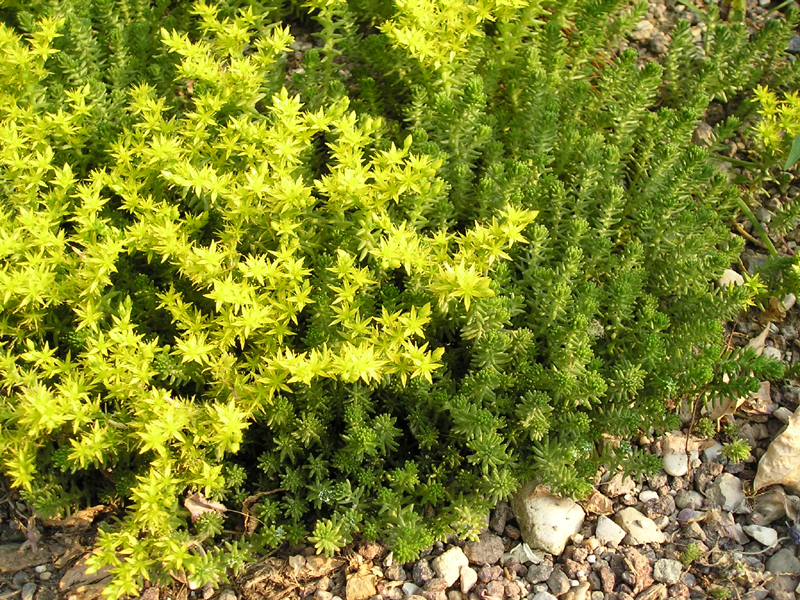
Sedum sexangulare, known as tasteless stonecrop, is a low, vigorous evergreen succulent in the Crassulaceae family. It forms a dense, creeping mat of tiny cylindrical leaves and, in summer, sends up starry yellow flowers above the foliage.
Source: RHS
A European native
This sedum's natural range lies across Europe, and it is not native to Britain or Ireland. It has long been grown in rock gardens and alpine collections for its toughness and ground-covering habit.
Source: RHS
Sun, shelter, sharp drainage
Give it full sun in a sheltered spot, ideally a south- or west-facing aspect, and moderately fertile, well-drained soil that is alkaline to neutral. It tolerates chalk, loam or sand and takes drought well, asking little beyond good drainage and light.
Source: RHS
Rooting from softwood cuttings
New plants are raised from softwood cuttings, taken in the usual way for succulent stonecrops.
Source: RHS
Dense mats, starry blooms
The plant grows to about 10cm tall, with succulent, cylindrical leaves packed tightly along rooting, creeping stems in an evergreen mat. Come summer, masses of small, star-shaped yellow flowers rise on stems above the foliage.
Source: RHS
Watch for vine weevil
Vine weevil larvae are the pest most likely to trouble this sedum.
Source: RHS
Rot in wet conditions
Fungal and bacterial crown and root rots can set in, generally where drainage or shelter is lacking.
Source: RHS
A trim after flowering
Once the flowers fade, trim the mat back to keep its shape tidy.
Source: RHS
Care recipe
The species record — the baseline every cultivar inherits unless it says otherwise.
Care notes are early — not yet verified
- Light
- ai:claude-opus-4-8
- Water
- ai:claude-opus-4-8 (range 10-21d)
- Humidity
- ai:claude-opus-4-8
- Soil
- ai:claude-fable-5
- Care
- ai:claude-fable-5
Direct sun
≈ every 21 days
Low — average room
5–26 °C
Gritty, low-nutrient succulent mix
Division or stem cuttings; spreads by creeping mats
Rarely needed; a very dilute feed at most once a year
Moderate
Yellow flowers in early summer with ample light
Not yet documented
This is where toxicity lives — every cultivar of this species inherits it and none can override it.
Reference images
Every image credited. Licenses link to their deeds.
Sources: ai:claude-opus-4-8 · ai:claude-opus-4-8 (range 10-21d) · ai:claude-fable-5
Kept true by its growers
Every fact here carries its source. Grow Tasteless Stonecrop yourself? What you’ve observed — how it drinks, how it holds its color, a name that’s off — and a clear photo of your plant are exactly what keep this page honest. Contributions are reviewed before anything changes.
Sign in to add what you know →