Species · genus Sedum · Crassulaceae
Burro's-tail
Sedum morganianum Walther
Also known as: Donkey's-tail · Donkeytail
Cultivars of S. morganianum
The named forms growers keep — each with its own page, each honest about how much we know.
No named cultivars catalogued under S. morganianum yet. When growers document a stable, named form, it earns its own page here.
Guide
The species-level account. Cultivar pages build on this and say where they differ.
A Trailing Succulent Favorite
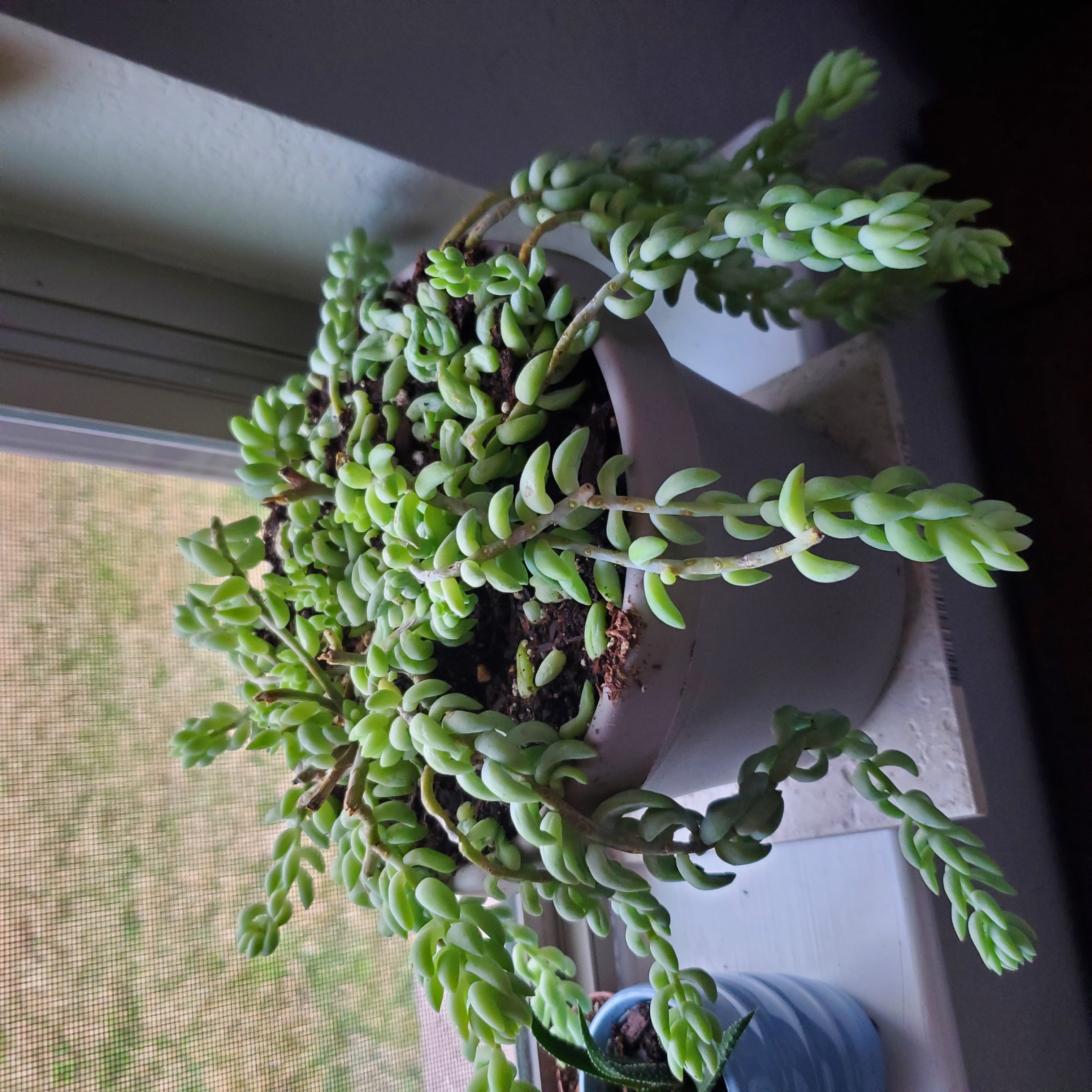
Burro's Tail, Sedum morganianum, is a trailing succulent in the stonecrop family, grown for its long rope-like stems of overlapping fleshy leaves. It has earned the Royal Horticultural Society's Award of Garden Merit and is widely sold as an easy, popular houseplant. Outside of warm zones it is best treated as an indoor plant, kept in a pot or hanging basket where its stems can drape freely.
Source: Epic Gardening
From Mexican Cliffs to Cultivation
The species grows naturally on cliffs in a couple of ravines in southeastern Mexico, where it once had medicinal uses among local people. It reached North America in 1935 when botanist Eric Walther found it for sale in a market in Veracruz and passed it along to Dr. Meredith Morgan, who worked out its genus and gave the plant her name. Today its role has shifted almost entirely to ornamental use.
Source: Epic Gardening
Sun, Drainage, Patience
This succulent wants strong light, ideally direct sun in the morning followed by bright indirect light in the afternoon, and will grow leggy with stems showing between leaves if kept too dim. Its fleshy leaves store water well, so indoor plants generally need watering only about every two weeks, always letting the soil dry between waterings, with slightly more frequent watering outdoors. It prefers temperatures between 65 and 75°F, tolerates average home humidity without complaint, and needs little to no fertilizer beyond an occasional diluted cactus feed during spring and summer growth. Plant it in a well-draining cactus mix and a container with generous drainage holes, since soggy roots are the plant's greatest vulnerability.
Source: Epic Gardening
Grown From a Dropped Leaf
Burro's Tail propagates readily from single leaves, which often break off on their own with handling and will root and sprout new growth within days to a week when laid on soil in bright light. Stem cuttings work as well: strip leaves from one end, let the cut scar over, then set the healed end into potting mix, watering lightly only after a few days and keeping cuttings short since long stems are too heavy to anchor well. Rooting hormone and a humidity-holding plastic cover can speed things along. Seed propagation is possible but slow and rarely used, since indoor plants seldom flower and seeds are hard to come by.
Source: Epic Gardening
Beaded, Braided Stems
The plant's signature trait is its neat, overlapping rosette of small, oblong, blue-green leaves running down stems that can reach one to four feet long. A white waxy bloom coats the leaves at first and rubs off easily under a touch. Given enough sun outdoors, it can produce clusters of star-shaped pink flowers with bright yellow stamens in summer, though indoor plants rarely bloom. There are two forms in cultivation: the true species with longer, more widely spaced, crescent-shaped leaves, and the 'Burrito' variety with shorter, rounder leaves held closer together.
Source: Epic Gardening
Mealybugs, Mostly
This succulent resists pests fairly well, with mealybugs the main concern, showing up as small white, cotton-like insects that feed on sap and leave sticky honeydew behind that can attract ants and sooty mold. The RHS also notes it can be susceptible to vine weevil grubs and scale insects. Isolating an affected plant, wiping off visible pests with alcohol, trimming heavily infested growth, and treating with neem oil or a similar insecticide are the usual responses.
Source: Epic Gardening
Rot, Mold, and Mildew
Root rot is the most serious threat, usually from overwatering or poor drainage, and shows up as yellowing, weakening foliage and roots that turn dark and mushy; catching it early and repotting into drier, better-draining conditions is the best remedy. Botrytis, or grey mold, starts as water-soaked spots on old or dead leaves and spreads if hygiene and airflow are poor. Powdery mildew appears as a white, powdery coating when humidity is high and air circulation is lacking, and can be washed off with a baking soda solution. Southern blight is rarer but more serious, attacking the crown and lower leaves in hot, humid weather and persisting in soil for years, generally requiring the plant be discarded.
Source: Epic Gardening
Light Touch Upkeep
This plant does not require pruning, though trimming away dying or damaged leaves with clean tools keeps it tidy and helps prevent disease or pests from entering open cuts. It tolerates being a little root bound, so repotting every two to three years with fresh soil and a slightly larger pot, ideally in spring before flowering, is generally enough. It is non-toxic to people and animals, making it a safe choice around children and pets.
Source: Epic Gardening
Care recipe
The species record — the baseline every cultivar inherits unless it says otherwise.
Care notes are early — not yet verified
- Light
- ai:claude-opus-4-8
- Water
- ai:claude-opus-4-8 (range 14-28d)
- Humidity
- ai:claude-opus-4-8
- Soil
- ai:claude-fable-5
- Care
- ai:claude-fable-5
Bright, indirect
≈ every 28 days
Low — average room
10–27 °C
Gritty, fast-draining cactus and succulent mix
Individual plump leaves laid on dry mix to root
Dilute succulent feed once or twice in spring and summer
Moderate
Pink to red flowers at trailing stem tips, occasional indoors
Not yet documented
This is where toxicity lives — every cultivar of this species inherits it and none can override it.
Reference images
Every image credited. Licenses link to their deeds.
PrimarySources: ai:claude-opus-4-8 · ai:claude-opus-4-8 (range 14-28d) · ai:claude-fable-5
Kept true by its growers
Every fact here carries its source. Grow Burro's-tail yourself? What you’ve observed — how it drinks, how it holds its color, a name that’s off — and a clear photo of your plant are exactly what keep this page honest. Contributions are reviewed before anything changes.
Sign in to add what you know →