Species · genus Sedum · Crassulaceae
Thick-Leaved Stonecrop
Sedum dasyphyllum L.
Also known as: Thick-leaf Stonecrop
Cultivars of S. dasyphyllum
The named forms growers keep — each with its own page, each honest about how much we know.
No named cultivars catalogued under S. dasyphyllum yet. When growers document a stable, named form, it earns its own page here.
Guide
The species-level account. Cultivar pages build on this and say where they differ.
A tiny stonecrop
Sedum dasyphyllum, known as thick-leaved stonecrop, is a low, creeping evergreen succulent in the Crassulaceae family. It forms a mat barely reaching 10cm tall, dotted with tiny fleshy leaves, and in summer sends up slender stems topped with creamy-white flowers.
Source: RHS
A Mediterranean wanderer
This species is native across central and southern Europe into southwest Türkiye and northwest Africa, with a native range spanning countries from Spain and France to Greece, Albania, Morocco, and Tunisia. It has since been introduced further north, taking hold in Belgium, Denmark, Great Britain, and Ireland. First described by Linnaeus in 1753, it now also counts several accepted subspecies, including granatense and oblongifolium.
Source: Kew
Sun, drainage, shelter
Give this stonecrop full sun and a sheltered spot, in moderately fertile, well-drained soil that leans alkaline to neutral, whether chalk, loam, or sand. It is drought resistant and rated hardy through most of the UK, tolerating cold well once established. No particular feeding routine is called for beyond the ordinary care of hardy succulents.
Source: RHS
Softwood cuttings
Propagation is done by softwood cuttings, taken from the trailing stems.
Source: RHS
Grey leaves, pink stress
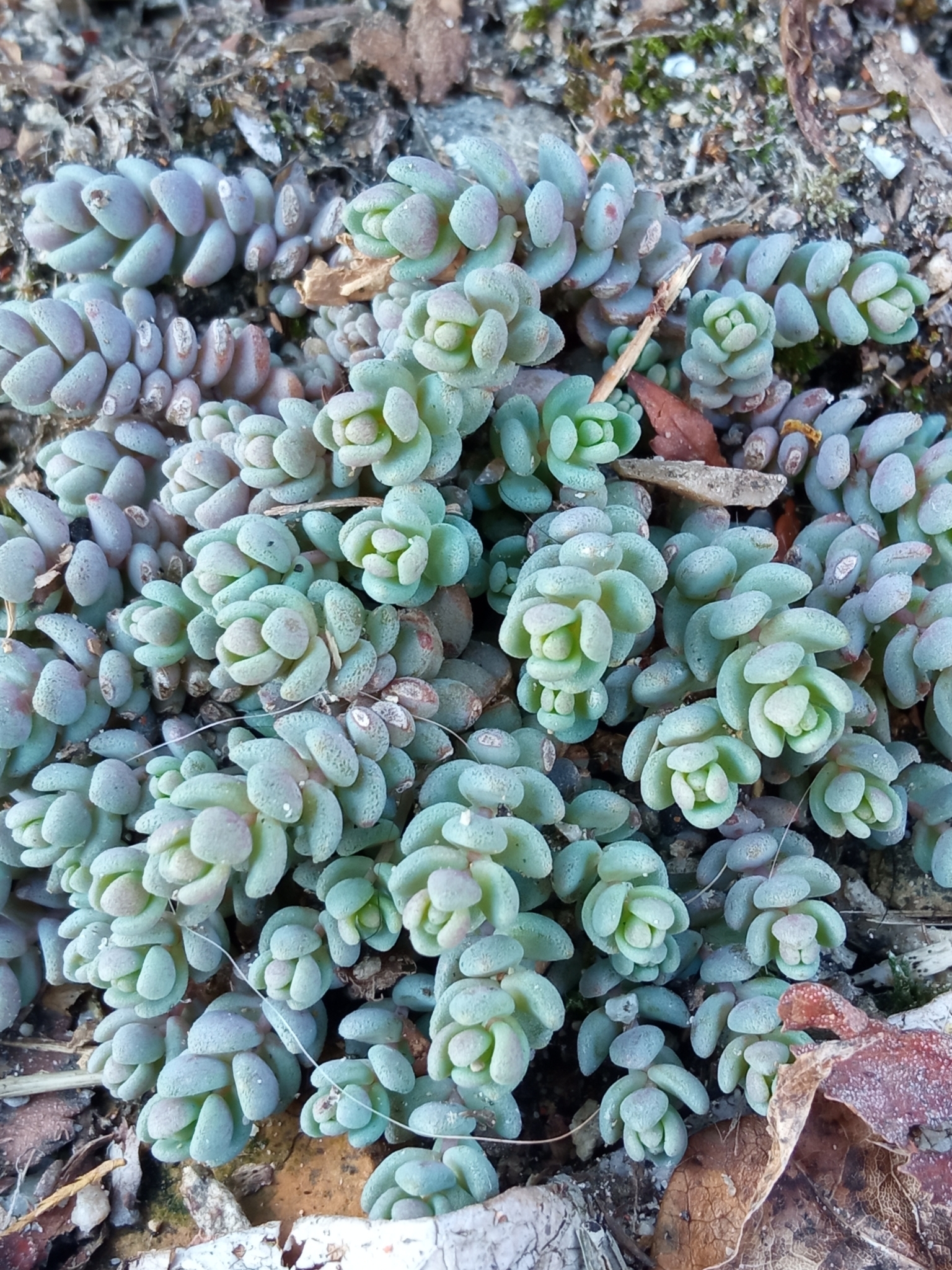
The plant's small, silvery-grey leaves crowd tightly along its trailing stems, giving it a soft, matforming habit. Under drought or cold stress those leaves take on a pink or purple tinge, a useful visual cue to its condition. Its creamy-white summer flowers rise on slender stems above this low foliage.
Source: RHS
Slugs and sap-suckers
Watch for slugs, snails, and vine weevil grubs, which can trouble the foliage and roots, along with scale insects and mealybugs on the stems and leaves.
Source: RHS
Rot in wet conditions
The main problem to guard against is fungal and bacterial crown and root rot, which tends to follow poorly drained or overly wet soil. Sticking to the well-drained, sheltered conditions this plant prefers helps avoid it.
Source: RHS
Little upkeep needed
This is a genuinely low-maintenance plant that requires no pruning. It suits rock gardens, gravel gardens, containers, and even garden edging, where its mat-forming habit can spread undisturbed.
Source: RHS
Care recipe
The species record — the baseline every cultivar inherits unless it says otherwise.
Care notes are early — not yet verified
- Light
- ai:claude-opus-4-8
- Water
- ai:claude-opus-4-8 (range 10-21d)
- Humidity
- ai:claude-opus-4-8
- Soil
- ai:claude-fable-5
- Care
- ai:claude-fable-5
Direct sun
≈ every 21 days
Low — average room
5–27 °C
Gritty, fast-draining cactus and succulent mix
Leaf or stem cuttings rooted on dry mix
Light dilute succulent feed once or twice in the growing season
Slow
Small white flowers in early summer
Not yet documented
This is where toxicity lives — every cultivar of this species inherits it and none can override it.
Reference images
Every image credited. Licenses link to their deeds.
PrimarySources: ai:claude-opus-4-8 · ai:claude-opus-4-8 (range 10-21d) · ai:claude-fable-5
Kept true by its growers
Every fact here carries its source. Grow Thick-Leaved Stonecrop yourself? What you’ve observed — how it drinks, how it holds its color, a name that’s off — and a clear photo of your plant are exactly what keep this page honest. Contributions are reviewed before anything changes.
Sign in to add what you know →