Species · genus Rhipsalis · Cactaceae
Mistletoe Cactus
Rhipsalis baccifera (J.S.Muell.) Stearn
Cultivars of R. baccifera
The named forms growers keep — each with its own page, each honest about how much we know.
No named cultivars catalogued under R. baccifera yet. When growers document a stable, named form, it earns its own page here.
Guide
The species-level account. Cultivar pages build on this and say where they differ.
A trailing epiphytic cactus
Rhipsalis baccifera, the mistletoe cactus, is a variable species of epiphytic cactus grown for its slender, trailing stems rather than any showy bloom. It belongs to the cactus family, but its habit and needs set it apart from the spiny desert kinds most people picture.
Source: RHS
A remarkably wide-ranging native
This species has one of the broadest natural distributions of any cactus, found across tropical and subtropical America, much of Africa, and even Sri Lanka. In the wild it grows as a succulent epiphyte or lithophyte, settling into the seasonally dry tropical biome rather than rooting in open ground.
Source: Kew
Bright, humid, evenly moist
Grow it in an epiphytic cactus compost, under glass if the climate demands it, with bright indirect light and high humidity, misting daily with soft water. Water moderately while the plant is in active growth and feed monthly with a dilute, low-nitrogen fertiliser, then let it rest with just enough moisture to avoid drying out completely over winter.
Source: RHS
Seed or stem cuttings
New plants can be raised from seed sown at 19-24°C, or more simply from stem cuttings taken in spring or summer.
Source: RHS
Slender stems, quiet flowers
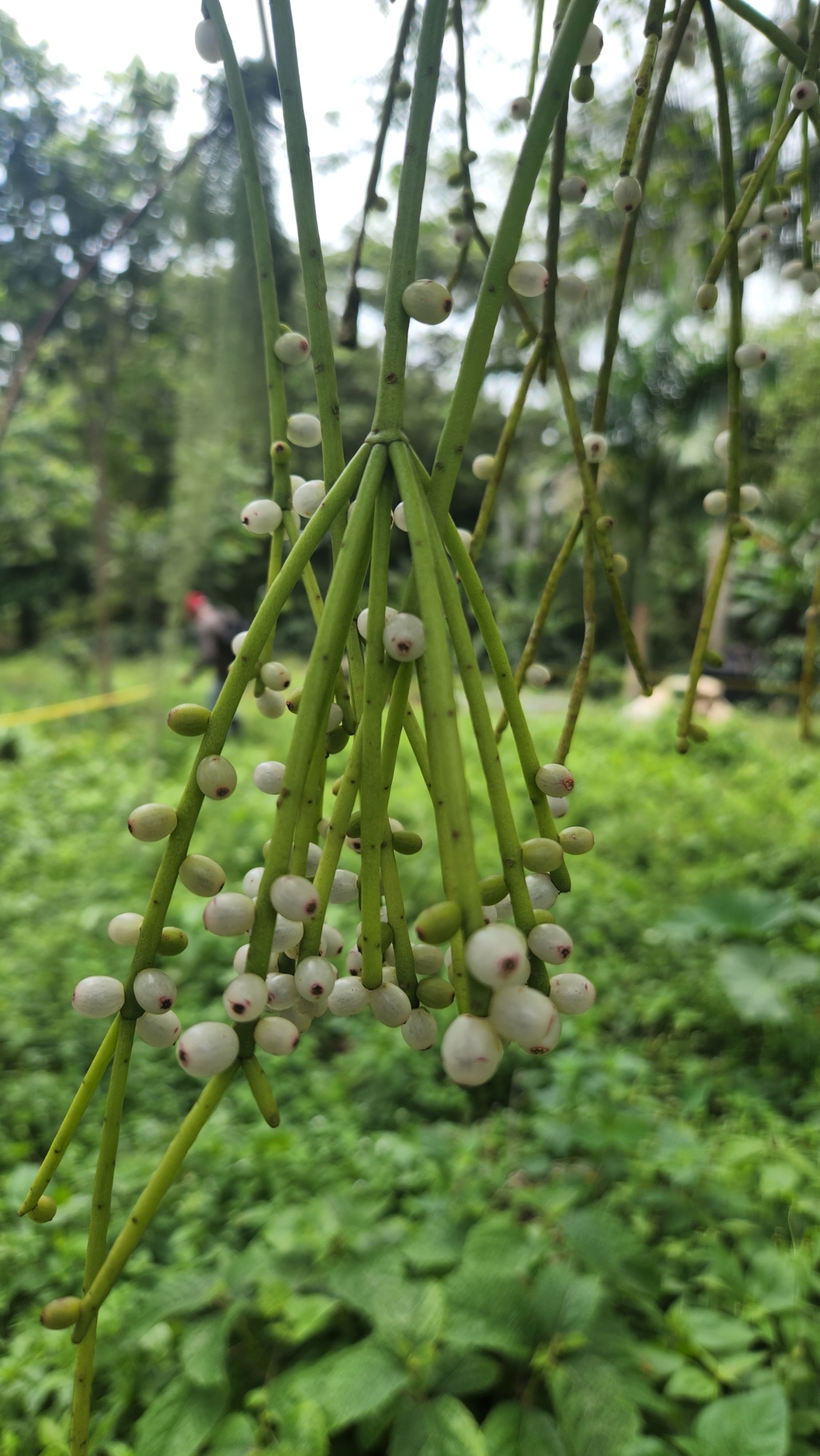
The stems are cylindrical, green to pale blue-green, and trail rather than stand upright, reaching lengths of several metres over time. Young growth carries sparse woolly areoles with a few bristly spines, which tend to vanish as the stems age. Small funnel-shaped white or greenish-white flowers appear along the stems, mostly from winter into spring, followed by small round translucent white or pale pink berries.
Source: RHS
Watch for mealybugs
Mealybugs are the main pest to watch for on this plant.
Source: RHS
Little pruning needed
No routine pruning is required, though the stems can grow to metres in length and may be trimmed back if they outgrow their space. It suits a hanging basket, conservatory, or greenhouse setting where its trailing habit has room to hang.
Source: RHS
Care recipe
The species record — the baseline every cultivar inherits unless it says otherwise.
Care notes are early — not yet verified
- Light
- ai:claude-opus-4-8
- Water
- ai:claude-opus-4-8 (range 7-14d)
- Humidity
- ai:claude-opus-4-8
- Soil
- ai:claude-fable-5
- Care
- ai:claude-fable-5
Bright, indirect
≈ every 14 days
High
13–27 °C
Loose, fast-draining cactus or epiphyte mix
Stem-segment cuttings
Diluted cactus feed monthly in the growing season
Moderate
Small flowers followed by berries in good light
Not yet documented
This is where toxicity lives — every cultivar of this species inherits it and none can override it.
Reference images
Every image credited. Licenses link to their deeds.
PrimarySources: ai:claude-opus-4-8 · ai:claude-opus-4-8 (range 7-14d) · ai:claude-fable-5
Kept true by its growers
Every fact here carries its source. Grow Mistletoe Cactus yourself? What you’ve observed — how it drinks, how it holds its color, a name that’s off — and a clear photo of your plant are exactly what keep this page honest. Contributions are reviewed before anything changes.
Sign in to add what you know →