Species · genus Pteris · Pteridaceae
Slender Brake
Pteris ensiformis Burm.
Also known as: Slender Bracken · Sword Brake
Cultivars of P. ensiformis
The named forms growers keep — each with its own page, each honest about how much we know.
No named cultivars catalogued under P. ensiformis yet. When growers document a stable, named form, it earns its own page here.
Guide
The species-level account. Cultivar pages build on this and say where they differ.
A Variegated Slender Brake
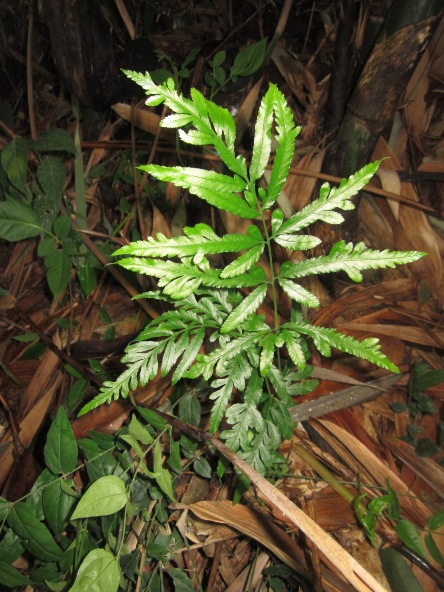
Pteris ensiformis 'Evergemiensis' is a tufted, evergreen fern known as the slender brake, valued for its feathery, silvery-white fronds edged in green. It stays compact, reaching only 0.1 to 0.5 metres in height and spread, which suits it well to close quarters such as a terrarium.
Source: RHS
Shade, Moisture, Shelter
This fern prefers full or partial shade rather than bright exposure, and wants soil or a potting mix that stays moist but well-drained, whether loam, chalk, or sand-based, with a neutral to alkaline pH. Outdoors it does best in moist ground enriched with leaf-mould, while in a container under glass it appreciates added limestone chips and high humidity. It is rated H1C, meaning it can only go outside in the summer in the UK and otherwise needs sheltered, frost-free conditions.
Source: RHS
Spores or Rhizome Division
Increase this fern by sowing spores as soon as they ripen, or by dividing its rhizomes in spring.
Source: RHS
Silvery, Feathery Fronds
What sets this fern apart is its variegation: fronds carry a silvery-white centre bordered with green, giving the whole plant a feathery, luminous look. Its habit is tufted rather than sprawling, and the foliage holds through the year as it is evergreen.
Source: RHS
Mostly Trouble-Free
Outdoors this fern is generally free of pests, but under glass it can attract scale insects and eelworms.
Source: RHS
Watch for Sooty Mould
The main disease concern noted for this fern is sooty mould.
Source: RHS
Light Tidying Only
Maintenance is minimal: simply remove dead or damaged fronds as they appear. Left outdoors it takes some five to ten years to reach full maturity.
Source: RHS
Care recipe
The species record — the baseline every cultivar inherits unless it says otherwise.
Care notes are early — not yet verified
- Light
- ai:claude-opus-4-8
- Water
- ai:claude-opus-4-8 (range 3-7d)
- Humidity
- ai:claude-opus-4-8
- Soil
- ai:claude-fable-5
- Care
- ai:claude-fable-5
Bright, indirect
≈ every 7 days
High
13–24 °C
Moisture-retentive, well-draining peat-based mix
Division of the clump, or spores
Dilute liquid feed monthly in the growing season
Moderate
Never flowers; reproduces by spores
Not yet documented
This is where toxicity lives — every cultivar of this species inherits it and none can override it.
Reference images
Every image credited. Licenses link to their deeds.
PrimarySources: ai:claude-opus-4-8 · ai:claude-opus-4-8 (range 3-7d) · ai:claude-fable-5
Kept true by its growers
Every fact here carries its source. Grow Slender Brake yourself? What you’ve observed — how it drinks, how it holds its color, a name that’s off — and a clear photo of your plant are exactly what keep this page honest. Contributions are reviewed before anything changes.
Sign in to add what you know →