Species · genus Podocarpus · Podocarpaceae
Big-leaf Podocarp
Podocarpus macrophyllus (Thunb.) Sweet
Also known as: Buddhist Pine · Japanese Yew · Yew Plum Pine · Yew
Cultivars of P. macrophyllus
The named forms growers keep — each with its own page, each honest about how much we know.
No named cultivars catalogued under P. macrophyllus yet. When growers document a stable, named form, it earns its own page here.
Guide
The species-level account. Cultivar pages build on this and say where they differ.
A Slow, Steady Conifer
Podocarpus is a genus of woody evergreen conifers, mostly trees and shrubs, grown for dense foliage rather than showy flowers. It belongs to the Podocarpaceae family and covers around 100 species, ranging from three-foot dwarf forms to trees that can reach 80 feet. Gardeners tend to reach for it as a hedge, screen, or backdrop plant rather than a centerpiece.
Source: Epic Gardening
A Southern Hemisphere Family
Podocarpus belongs to Podocarpaceae, a family of nineteen conifer genera native chiefly to the Southern Hemisphere, spanning Australia, New Zealand, South America, Africa, and Asia. Podocarpus itself is the genus that reaches furthest north. One well-known species, Podocarpus macrophyllus, comes from the Far East and is traditionally used in Japanese gardens.
Source: Epic Gardening
Sun, Soil, and Patience
Podocarpus tolerates anything from full sun to fairly deep shade, though full sun brings faster growth and paler foliage while shade slows growth and deepens leaf color. It prefers sandy or loamy soil that stays lightly moist yet drains freely, ideally rich and slightly acidic, and mulching with pine or bark helps maintain that acidity over time. Water deeply about every two weeks during the first year of establishment, then only during extreme drought once mature. Indoors, the plant is happiest between 61 and 68°F with plenty of light, doesn't demand humidity, and needs only a light spring feeding if the soil is already reasonably rich.
Source: Epic Gardening
Cuttings Over Seed
Cuttings are the preferred propagation method since they're far quicker than starting from seed. A 3 to 4 inch cutting of soft new wood, stripped of its lower leaves and dipped in rooting hormone, will typically root in a well-draining, evenly moist pot within about four months. Seed propagation is possible but slow, often taking up to six months to germinate, and is helped along by a two-day salt water soak followed by cold, moist stratification in the refrigerator near 50°F.
Source: Epic Gardening
Yew-Like Foliage, Shifting Green
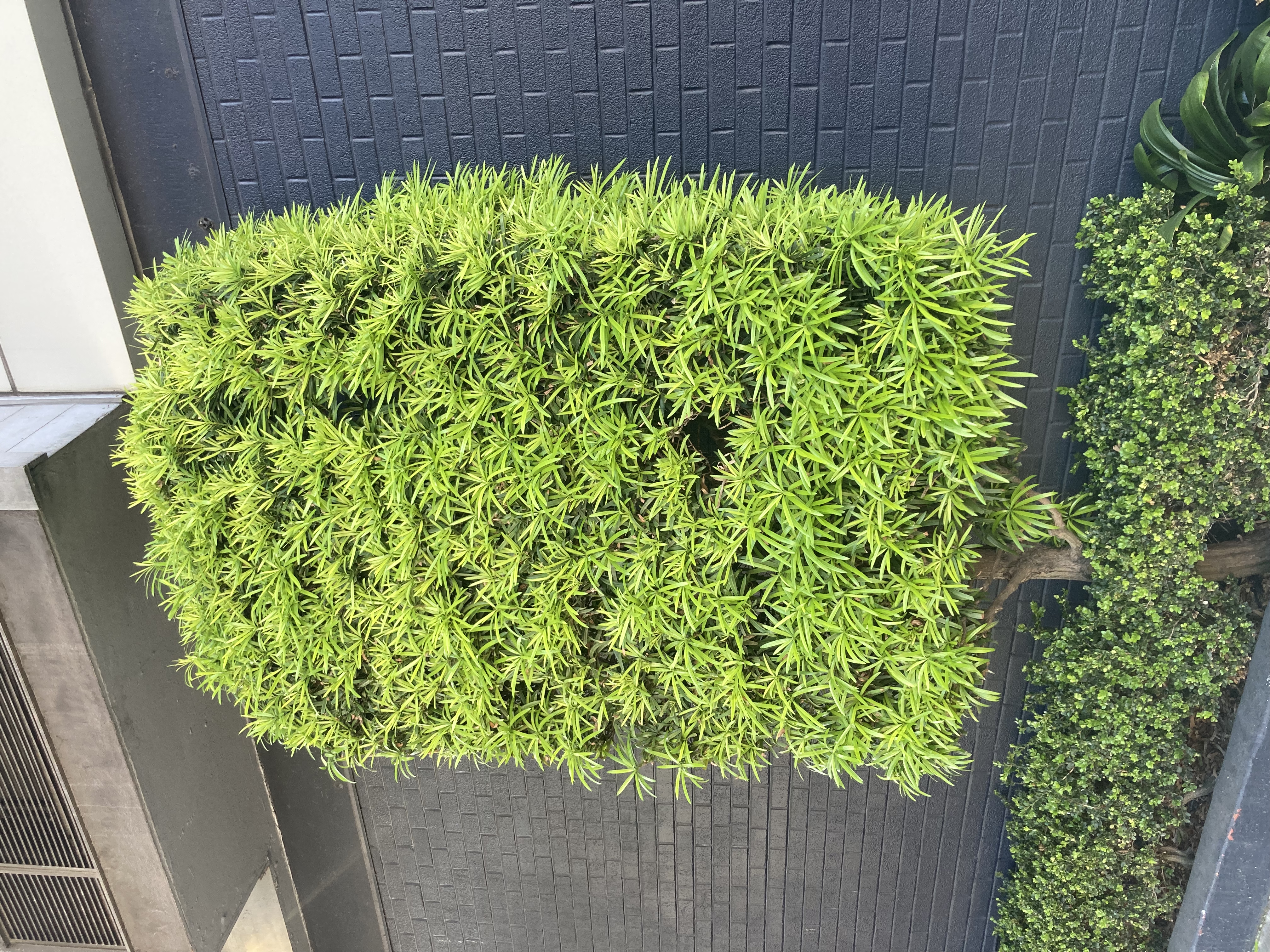
The foliage is dense, with flat, lance-shaped leaves arranged in a spiral along the branches, giving the plant a resemblance to yew. Despite their leathery look, the leaves are soft and shear easily, which is why the plant takes so well to hedge shaping. Leaf color shifts with light: deeper green in shade, lighter green in full sun. Most Podocarpus are dioecious, meaning separate male and female plants, with males bearing pollen cones and females developing seed cones.
Source: Epic Gardening
Aphids, Mites, and Scale
The Podocarpus aphid is the pest of most concern, a small pale purple insect that lives its whole life on the plant and, in large numbers, causes curling leaves, stunted growth, and sticky honeydew that invites sooty mold. Spider mites are sap-suckers that favor hot, dry conditions and give themselves away with fine webbing on leaf undersides. Scale insects pierce leaves to feed on sap and leave a similar sticky residue, and their hard waxy coating is best broken down with horticultural oil. By contrast, the RHS describes Podocarpus macrophyllus as generally pest-free in UK growing conditions.
Source: Epic Gardening
Fungal Troubles from Wet Feet
Several fungal issues can trouble Podocarpus: leaf spot causes brown or yellow spotting and is treated by removing affected foliage and applying a copper or sulfur-based fungicide, while Botrytis blight brings wilting, decay, and browning and calls for removing affected growth and thinning branches for airflow. Root rot and fusarium wilt are both linked to overwatering or poor drainage, showing up as yellowing, wilting, and die-off, and are best prevented by letting soil nearly dry between waterings and ensuring good drainage. The RHS, meanwhile, reports Podocarpus macrophyllus as generally disease-free in UK conditions.
Source: Epic Gardening
Pruning for Shape
A young Podocarpus often grows straight up, so pruning it back hard at the end of its first summer encourages back budding and branching for those who want a bushier shrub rather than a tree form. The plant tolerates hard pruning and shaping well and can generally be cut year-round, but pruning should be avoided within two months of the first expected frost in climates that freeze. The RHS notes that, at least for Podocarpus macrophyllus in UK conditions, no pruning is actually required.
Source: Epic Gardening
Care recipe
The species record — the baseline every cultivar inherits unless it says otherwise.
Care notes are early — not yet verified
- Light
- ai:claude-opus-4-8
- Water
- ai:claude-opus-4-8 (range 7-14d)
- Humidity
- ai:claude-opus-4-8
- Soil
- ai:claude-fable-5
- Care
- ai:claude-fable-5
Bright, indirect
≈ every 14 days
Medium
7–24 °C
Well-draining, slightly acidic loam with grit
Semi-hardwood cuttings in summer, or seed
Balanced liquid feed monthly spring through summer
Slow
Rarely flowers indoors; often shaped as bonsai
Not yet documented
This is where toxicity lives — every cultivar of this species inherits it and none can override it.
Reference images
Every image credited. Licenses link to their deeds.
PrimarySources: ai:claude-opus-4-8 · ai:claude-opus-4-8 (range 7-14d) · ai:claude-fable-5
Kept true by its growers
Every fact here carries its source. Grow Big-leaf Podocarp yourself? What you’ve observed — how it drinks, how it holds its color, a name that’s off — and a clear photo of your plant are exactly what keep this page honest. Contributions are reviewed before anything changes.
Sign in to add what you know →