Species · genus Platycerium · Polypodiaceae
Staghorn Fern
Platycerium superbum de Jonch. & Hennipman
Also known as: Regal Elkhorn
Cultivars of P. superbum
The named forms growers keep — each with its own page, each honest about how much we know.
No named cultivars catalogued under P. superbum yet. When growers document a stable, named form, it earns its own page here.
Guide
The species-level account. Cultivar pages build on this and say where they differ.
An Australian staghorn
Platycerium superbum, the staghorn fern, is a tender evergreen epiphyte grown for its bold sculptural fronds rather than any flower. It carries the common name staghorn fern and is sometimes still sold under the old name Platycerium grande.
Source: RHS
Out of Queensland's canopy
This fern's natural range lies in Australia, in Queensland and New South Wales, where it grows as an epiphyte rather than rooted in soil. Its clumping habit and grey-green shield fronds reflect a life spent clinging to tree bark in that setting.
Source: RHS
Warmth, filtered light, humidity
Grown as it would be on a tree, this fern wants a heated greenhouse or conservatory setting out of direct sun, mounted on bark or wood in a mix of coarse leaf mould, loam and charcoal, with bright filtered light and high humidity. Through the growing season water freely and mist daily, occasionally dunking the whole root ball for a few minutes before draining it, and feed monthly; in winter, water is best given sparingly and roots should never be allowed to dry out completely.
Source: RHS
Pups or spores
New plants can be raised by replanting the plantlets, or pups, that form at the base, or by growing on from spores.
Source: RHS
Two fronds, two jobs
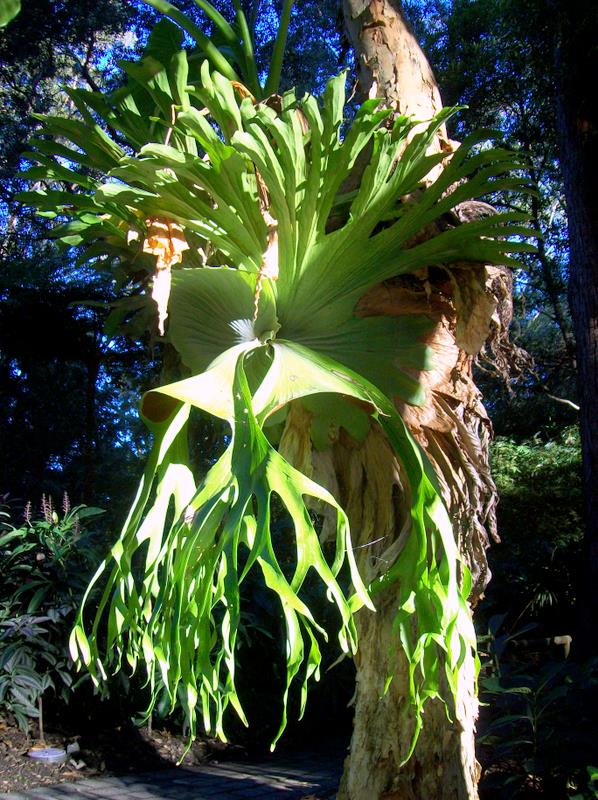
The plant carries a large, upright, kidney-shaped grey-green nest frond that catches falling leaves and insects, which it uses as a slow-release feed. From this base grow the long, pendent, forked, leathery fertile fronds, bright green and wedge-shaped, which are the ones that carry spores.
Source: Epic Gardening
Largely trouble-free
By the RHS's account this fern is generally free of both pests and disease, which is one reason it suits low-maintenance growing.
Source: RHS
Little pruning needed
This is a low-maintenance houseplant that asks for no routine pruning. It is suited to being grown indoors much as it would live in the wild, on a mount rather than in a conventional pot.
Source: RHS
Care recipe
The species record — the baseline every cultivar inherits unless it says otherwise.
Care notes are early — not yet verified
- Light
- ai:claude-opus-4-8
- Water
- ai:claude-opus-4-8 (range 7-14d)
- Humidity
- ai:claude-opus-4-8
- Soil
- ai:claude-fable-5
- Care
- ai:claude-fable-5
Bright, indirect
≈ every 14 days
High
15–27 °C
Mounted epiphyte or very open bark and sphagnum mix
Spores; rarely produces offsets, usually solitary
Dilute feed monthly in warm months; avoid the shield frond
Slow
Non-flowering fern; reproduces by spores
Not yet documented
This is where toxicity lives — every cultivar of this species inherits it and none can override it.
Reference images
Every image credited. Licenses link to their deeds.
PrimarySources: ai:claude-opus-4-8 · ai:claude-opus-4-8 (range 7-14d) · ai:claude-fable-5
Kept true by its growers
Every fact here carries its source. Grow Staghorn Fern yourself? What you’ve observed — how it drinks, how it holds its color, a name that’s off — and a clear photo of your plant are exactly what keep this page honest. Contributions are reviewed before anything changes.
Sign in to add what you know →