Species · genus Pilea · Urticaceae
Chinese Money Plant
Pilea peperomioides Diels
Cultivars of P. peperomioides
The named forms growers keep — each with its own page, each honest about how much we know.
No named cultivars catalogued under P. peperomioides yet. When growers document a stable, named form, it earns its own page here.
Guide
The species-level account. Cultivar pages build on this and say where they differ.
A Foliage Favourite
Pilea is a genus of foliage houseplants grown for their varied leaf shapes and textures rather than for flowers. The best known member, the Chinese money plant, has become a firm favourite thanks to its unusual disc-shaped leaves and easygoing nature. Across the genus you will find both upright bushy forms and trailing types suited to shelves and hanging planters.
Source: RHS
Roots in Southwest China
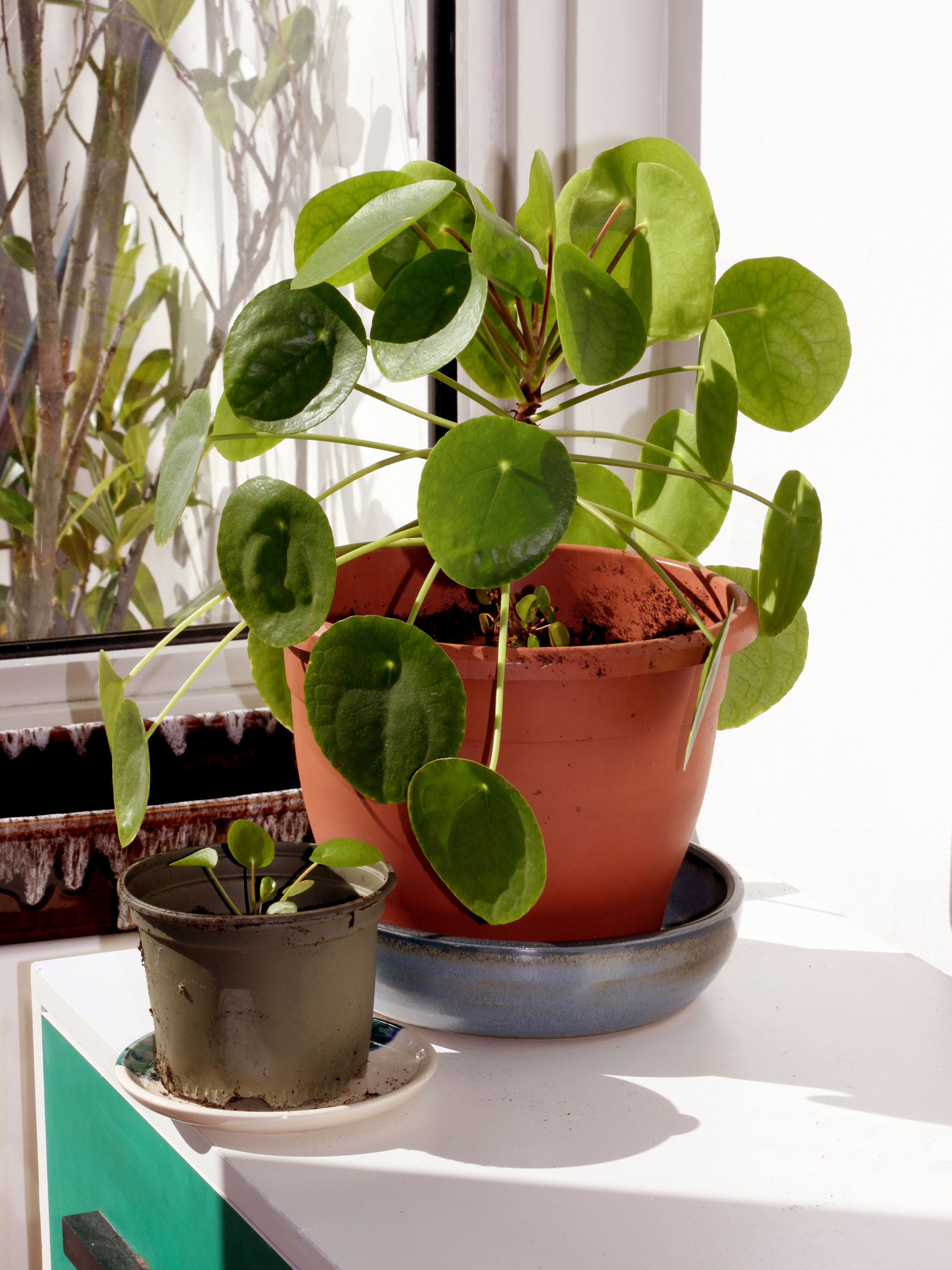
Pilea peperomioides, the Chinese money plant, is native to southwest China, where it grows as a bushy evergreen perennial. In cultivation it stays fairly compact, reaching only 10 to 50 centimetres or so over five to ten years. Its stalked, rounded leaves and small pale green flowers, sometimes tinged pink, are typical of the wider Pilea genus, which belongs to the nettle family.
Source: RHS
A Simple Rhythm
Give pileas bright but indirect light, keeping them back from direct summer sun in south-facing rooms, and hold the room above 10°C with no cold draughts. Water once the top few centimetres of compost have dried out, checking by touch or by the weight of the pot, and let plants rest a little drier through winter. Most pileas cope with ordinary indoor humidity, though thinner-leaved kinds appreciate a pebble tray or terrarium, and a monthly to bi-monthly balanced liquid feed from April to September keeps growth steady without pushing it too hard.
Source: RHS
Easy To Multiply
Pileas are among the easiest houseplants to increase, and there are four routes in. The Chinese money plant produces offsets around its base that can simply be detached and potted on, while its individual leaves will also root in water or moist compost. Other species can be grown from softwood stem-tip cuttings taken in spring and summer under high humidity, or from division of clump-forming plants.
Source: RHS
Disc-Shaped and Distinctive
The Chinese money plant is instantly recognisable for its flattened, disc-like leaves held on long stalks that radiate out from a central point, sometimes in a variegated form. Elsewhere in the genus the diversity runs wide: the aluminium plant carries pointed dark-green leaves brushed with silver, the friendship plant has deeply crinkled, nettle-like foliage often flushed purple-bronze, and trailing species offer small rounded or veined leaves on long stems suited to cascading displays.
Source: RHS
Sap-Suckers To Watch
Pileas are generally healthy plants, but it is worth checking them regularly for sap-sucking insects such as mealybugs, red spider mites, scale insects and thrips. Fluffy white deposits on the leaves are usually a giveaway sign of mealybug activity rather than harmless mineral spotting.
Source: RHS
Reading The Leaves
Most Chinese money plant troubles trace back to watering. Leaves that curl inward into a cup usually point to underwatering, low humidity, or too much light, while downward curling, sudden drooping, yellowing, or leaf drop are more often signs of overwatering and the root rot it can bring. Brown, crispy patches tend to come from direct sun exposure, dark almost-black patches from excess water sitting on or around the leaves, and stretched, leggy growth from insufficient light.
Source: Epic Gardening
Care recipe
The species record — the baseline every cultivar inherits unless it says otherwise.
Care notes are early — not yet verified
- Light
- ai:claude-opus-4-8
- Water
- ai:claude-opus-4-8 (range 7-12d)
- Humidity
- ai:claude-opus-4-8
- Soil
- ai:claude-fable-5
- Care
- ai:claude-fable-5
Bright, indirect
≈ every 12 days
Medium
15–24 °C
Well-draining potting mix with added perlite
Offsets — the pups that ring the base, ready to share
Half-strength balanced feed monthly in the growing season
Moderate
Tiny pinkish flowers, usually after a cool winter rest
Not yet documented
This is where toxicity lives — every cultivar of this species inherits it and none can override it.
Reference images
Every image credited. Licenses link to their deeds.
PrimarySources: ai:claude-opus-4-8 · ai:claude-opus-4-8 (range 7-12d) · ai:claude-fable-5
Kept true by its growers
Every fact here carries its source. Grow Chinese Money Plant yourself? What you’ve observed — how it drinks, how it holds its color, a name that’s off — and a clear photo of your plant are exactly what keep this page honest. Contributions are reviewed before anything changes.
Sign in to add what you know →