Species · genus Philodendron · Araceae
Split Leaf Climber
Philodendron radiatum Schott
Cultivars of P. radiatum
The named forms growers keep — each with its own page, each honest about how much we know.
No named cultivars catalogued under P. radiatum yet. When growers document a stable, named form, it earns its own page here.
Guide
The species-level account. Cultivar pages build on this and say where they differ.
A Climbing Aroid
Philodendron radiatum is an accepted species in the arum family, Araceae, growing as a climber. It is used medicinally in parts of its native range, alongside its role as an ornamental foliage plant.
Source: Kew
From Mexico to Colombia
This species was first described by Schott and published in 1853. Its native range stretches from Mexico south through Belize, Guatemala, Honduras, Nicaragua, Costa Rica and Panama, into northern Colombia, where it grows within the wet tropical biome.
Source: Kew
Deeply Lobed Foliage
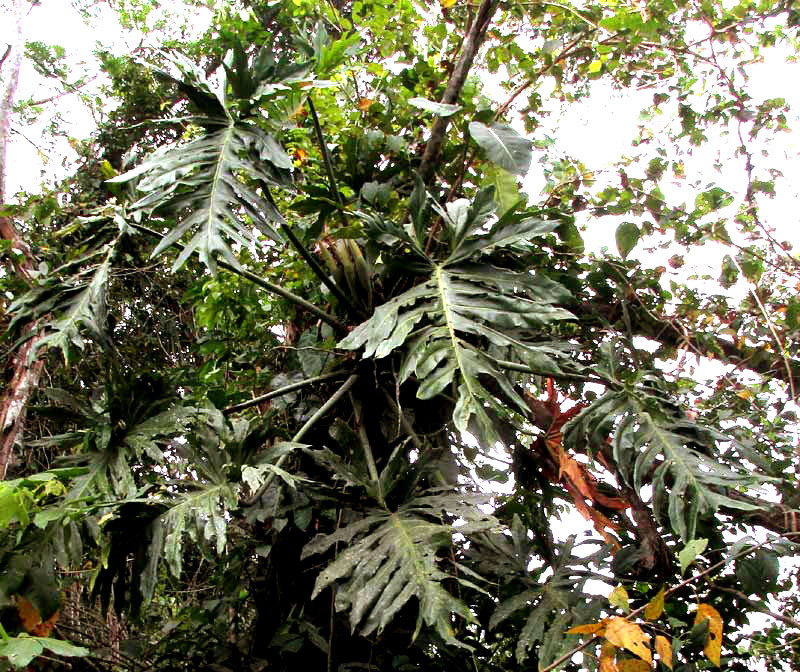
The variety radiatum carries long petioles, from roughly 33 to 108 centimetres, supporting blades that are deeply lobed almost to the midrib, sometimes reaching over a metre long. Its inflorescences appear one to a few per leaf axil, with a spathe up to 25 centimetres long wrapped around a shorter spadix. Flowering has been recorded chiefly in February, August and September, with mature fruit seen only in February and May.
Source: Kew
Care recipe
The species record — the baseline every cultivar inherits unless it says otherwise.
Care notes are early — not yet verified
- Light
- ai:claude-opus-4-8
- Water
- ai:claude-opus-4-8 (range 7-12d)
- Humidity
- ai:claude-opus-4-8
- Soil
- ai:claude-fable-5
- Care
- ai:claude-fable-5
Bright, indirect
≈ every 12 days
High
16–29 °C
Chunky, well-draining aroid mix with bark and perlite
Stem cuttings with a node rooted in water or mix
Balanced liquid feed monthly in the growing season
Moderate
Rarely flowers indoors
Toxic to cats & dogs & humans
Araceae contain insoluble calcium oxalate crystals, which irritate mouth and digestive tissues if chewed. This is where toxicity lives: every cultivar of this species inherits it and none can override it.
Reference images
Every image credited. Licenses link to their deeds.
PrimarySources: ai:claude-opus-4-8 · ai:claude-opus-4-8 (range 7-12d) · ai:claude-fable-5 · ai:claude-opus-4-8 (family inference)
Kept true by its growers
Every fact here carries its source. Grow Split Leaf Climber yourself? What you’ve observed — how it drinks, how it holds its color, a name that’s off — and a clear photo of your plant are exactly what keep this page honest. Contributions are reviewed before anything changes.
Sign in to add what you know →