Species · genus Peperomia · Piperaceae
String of Turtles
Peperomia prostrata B.S.Williams ex Mast. & T.Moore
Also known as: Turtle Vine
Cultivars of P. prostrata
The named forms growers keep — each with its own page, each honest about how much we know.
No named cultivars catalogued under P. prostrata yet. When growers document a stable, named form, it earns its own page here.
Guide
The species-level account. Cultivar pages build on this and say where they differ.
A Turtle-Shelled Trailer
String of turtles is the common name for Peperomia prostrata, a small vining member of the Peperomia genus grown for its cascading strings of rounded, patterned leaves. It is a semi-succulent, storing some moisture in its foliage while still behaving, in most other respects, like a tropical houseplant. Left to its own devices it forms a thick mat in the pot before spilling over the edges.
Source: Epic Gardening
Out of Ecuador's Forests
This plant was first found in Ecuador and described by the English orchidologist Benjamin Samuel Williams, who published it in 1879. In the wild it belongs to the wet forest floor of tropical Central and South America, growing low in the shade of trees and shrubs. Peperomia as a genus is vast, with over a thousand species spread through tropical and subtropical regions, and this one has travelled from that forest floor to become a houseplant collector's favourite.
Source: Epic Gardening
Bright Light, Sparing Water
String of turtles wants bright, indirect light rather than direct sun, and does best positioned at head height or lower so the whole trail, not just the top, receives enough brightness. Water only once the top couple of inches of soil are dry, which in good conditions may mean as little as every two to three weeks, and always let excess water drain away rather than let the pot sit wet. It appreciates warmth and humidity above 40 percent, and a feed with a diluted liquid or succulent fertiliser every few weeks through spring and summer keeps the markings bright, though feeding should stop over autumn and winter.
Source: Epic Gardening
Rooting Broken Strings
Because the stems are delicate and snap easily, any broken piece can usually be turned into a new plant. Cuttings taken at the start of the growing season, in spring, root fastest, and can be started either in water, held in place under plastic wrap over a glass, or pressed into a damp mix of coco peat and perlite. Dipping a cutting in rooting hormone before potting improves the odds, and once new growth appears the young plant can move into its own small pot.
Source: Epic Gardening
Leaves Like Little Shells
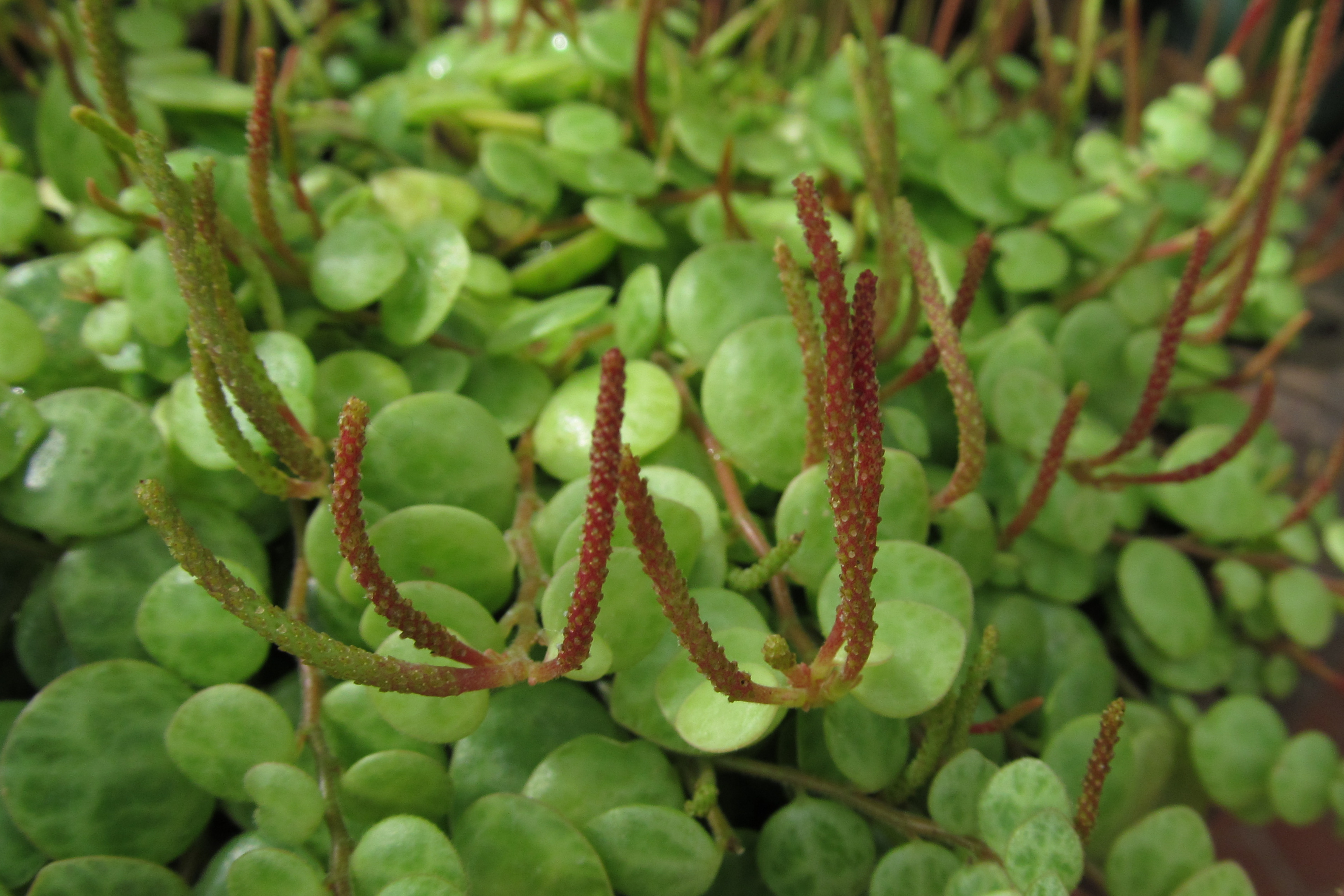
The leaves are small, round, and only about half an inch across, borne on thin fleshy strings with a reddish tinge. Their purple patterning and white veining, arranged in symmetrical markings, is what gives the plant its turtle-shell resemblance. Reddish-brown flower stalks with tiny cream flowers appear year-round, though they are modest beside the foliage and carry no scent. Growth is notably slow, so a trail reaching a foot in length may take several years to achieve.
Source: Epic Gardening
Mites, Mealybugs, Whitefly
Spider mites show up as faint dust or webbing on the undersides of leaves and can be rinsed off before treating with neem oil or insecticidal soap. Mealybugs announce themselves with a white, powdery secretion and are best dealt with by rinsing the plant and following up with neem oil or spot treatments of rubbing alcohol. Whiteflies, small white moth-like insects on leaf undersides, are trickier since the adults fly off, so repeated neem oil treatments are usually needed to break the cycle.
Source: Epic Gardening
Reading the Leaves
Overwatering is the most common trouble: soil kept too wet leads to bumpy, wilting leaves and eventually root rot, so the fix is to let the plant dry out fully and always drain thoroughly after watering. Underwatering shows itself differently, with leaves curling and taking on a raisin-like texture, resolved by watering promptly and adjusting the routine going forward. Too much direct sun causes the leaves to fade, lose their markings, or turn red, and calls for moving the plant into filtered or indirect light.
Source: Epic Gardening
Light Pruning, Occasional Repotting
This plant asks for very little upkeep, needing only an occasional trim with clean, sharp secateurs to remove damaged growth or to tighten up a leggy trail, and no more than a third of the plant should be cut at once. Repotting in spring, into the same pot size or just one size up, refreshes the soil and gives it a nutrient boost, since its small root system rarely demands more room.
Source: Epic Gardening
Care recipe
The species record — the baseline every cultivar inherits unless it says otherwise.
Care notes are early — not yet verified
- Light
- ai:claude-opus-4-8
- Water
- ai:claude-opus-4-8 (range 7-14d)
- Humidity
- ai:claude-opus-4-8
- Soil
- ai:claude-fable-5
- Care
- ai:claude-fable-5
Bright, indirect
≈ every 14 days
Medium
16–26 °C
Light, airy mix with perlite; shallow container
Stem strands laid on or pinned to moist mix
Weak balanced feed every 4–6 weeks in growing season
Slow
Rarely flowers indoors; trailing 'string of turtles' foliage is the draw
Non-toxic to cats & dogs
Peperomia (Piperaceae) — ASPCA lists multiple Peperomia non-toxic (e.g. watermelon peperomia, P. argyreia); genus-wide safe. This is where toxicity lives: every cultivar of this species inherits it and none can override it.
Reference images
Every image credited. Licenses link to their deeds.
PrimarySources: ai:claude-opus-4-8 · ai:claude-opus-4-8 (range 7-14d) · ai:claude-fable-5 · ASPCA
Kept true by its growers
Every fact here carries its source. Grow String of Turtles yourself? What you’ve observed — how it drinks, how it holds its color, a name that’s off — and a clear photo of your plant are exactly what keep this page honest. Contributions are reviewed before anything changes.
Sign in to add what you know →