Species · genus Peperomia · Piperaceae
Emerald-Ripple Peperomia
Peperomia caperata Ruiz & Pav. ex Yunck.
Also known as: Emerald-ripple Pepper · Green-ripple Pepper · Little Fantasy Pepper
Cultivars of P. caperata
The named forms growers keep — each with its own page, each honest about how much we know.
No named cultivars catalogued under P. caperata yet. When growers document a stable, named form, it earns its own page here.
Guide
The species-level account. Cultivar pages build on this and say where they differ.
The Emerald Ripple Pepper
Peperomia caperata, sometimes called emerald ripple or little fantasy pepper, is a small evergreen perennial grown mainly as a houseplant. It forms a tidy mound of puckered, heart-shaped leaves and, from spring to autumn, sends up slender spikes of tiny greenish-white flowers. Its compact size and tolerance of enclosed conditions make it a natural choice for terrariums and bottle gardens.
Source: RHS
A Brazilian Understory Native
This species comes originally from Brazil, part of a genus of evergreen perennials with simple, often succulent leaves and small greenish-white flowers carried in slender spikes. Selections such as 'Lillian' and the reddish-purple Schumi Red have since been raised from it, keeping the same mounding habit and puckered foliage but varying the leaf colour.
Source: RHS
Light, Water, and Feeding Rhythm
Give this plant bright indirect light while it is actively growing, allowing fuller light in winter, and keep the soil moist but well-drained, watering moderately in summer and sparingly in winter with tepid, soft water. From spring to summer, daily misting helps maintain the moderate to high humidity it appreciates, and a balanced liquid fertiliser applied monthly supports steady growth. Coloured forms such as Schumi Red tolerate lower light and can dry out a little between waterings, since they store some moisture in their fleshy stems, but they colour up best with medium to bright, indirect light and hold up fine at average household humidity.
Source: RHS
From Leaf and Seed
New plants can be raised by sowing seed at 19-24°C as soon as it is ripe, or by taking leaf stalk or leaf blade cuttings during spring and summer.
Source: RHS
Puckered Leaves, Modest Habit
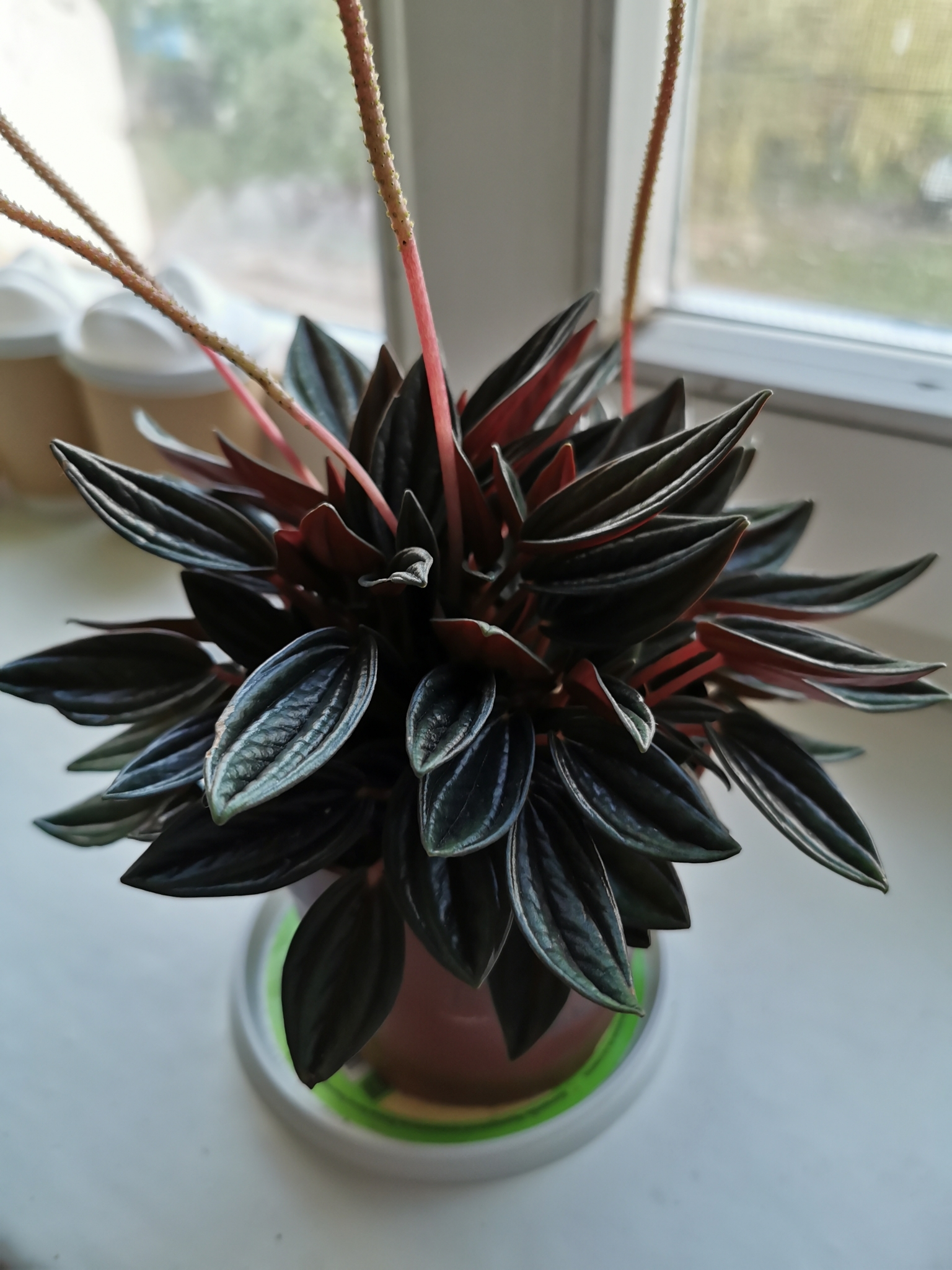
The plant stays low, reaching only around 20cm, with thick, puckered, heart-shaped leaves to about 5cm across held on long succulent stalks. In darker forms like Schumi Red, that same rippled, almost corrugated texture appears in a rich reddish-purple, often deeper on the leaf underside, and can look faintly sparkly or metallic under bright light. Whatever the leaf colour, the habit is a neat, tufted mound rather than a trailing or climbing one.
Source: Costa Farms
Largely Trouble-Free
This plant is generally pest-free, though it may be susceptible to grey moulds.
Source: RHS
Light Upkeep Only
No routine pruning is required; simply pull off spent flower spikes as they finish. For coloured varieties, an occasional leaf can be clipped off to tidy the shape, and any dead or yellowing leaves should be removed.
Source: RHS
Care recipe
The species record — the baseline every cultivar inherits unless it says otherwise.
Care notes are early — not yet verified
- Light
- ai:claude-opus-4-8
- Water
- ai:claude-opus-4-8 (range 7-14d)
- Humidity
- ai:claude-opus-4-8
- Soil
- ai:claude-fable-5
- Care
- ai:claude-fable-5
Bright, indirect
≈ every 14 days
Medium
16–26 °C
Well-draining peat-based mix with perlite
Leaf-petiole cuttings in moist mix
Dilute balanced feed monthly in spring and summer
Slow
Distinctive slender reddish-white flower spikes above rippled leaves
Non-toxic to cats & dogs
Peperomia (Piperaceae) — ASPCA lists multiple Peperomia non-toxic (e.g. watermelon peperomia, P. argyreia); genus-wide safe. This is where toxicity lives: every cultivar of this species inherits it and none can override it.
Reference images
Every image credited. Licenses link to their deeds.
Sources: ai:claude-opus-4-8 · ai:claude-opus-4-8 (range 7-14d) · ai:claude-fable-5 · ASPCA
Kept true by its growers
Every fact here carries its source. Grow Emerald-Ripple Peperomia yourself? What you’ve observed — how it drinks, how it holds its color, a name that’s off — and a clear photo of your plant are exactly what keep this page honest. Contributions are reviewed before anything changes.
Sign in to add what you know →