Species · genus Musa · Musaceae
Edible Banana
Musa acuminata Colla
Also known as: Banana · Cavendish Banana · Chinese Banana · Dwarf Banana · Wild Banana
Cultivars of M. acuminata
The named forms growers keep — each with its own page, each honest about how much we know.
No named cultivars catalogued under M. acuminata yet. When growers document a stable, named form, it earns its own page here.
Guide
The species-level account. Cultivar pages build on this and say where they differ.
A Tropical Foliage Giant
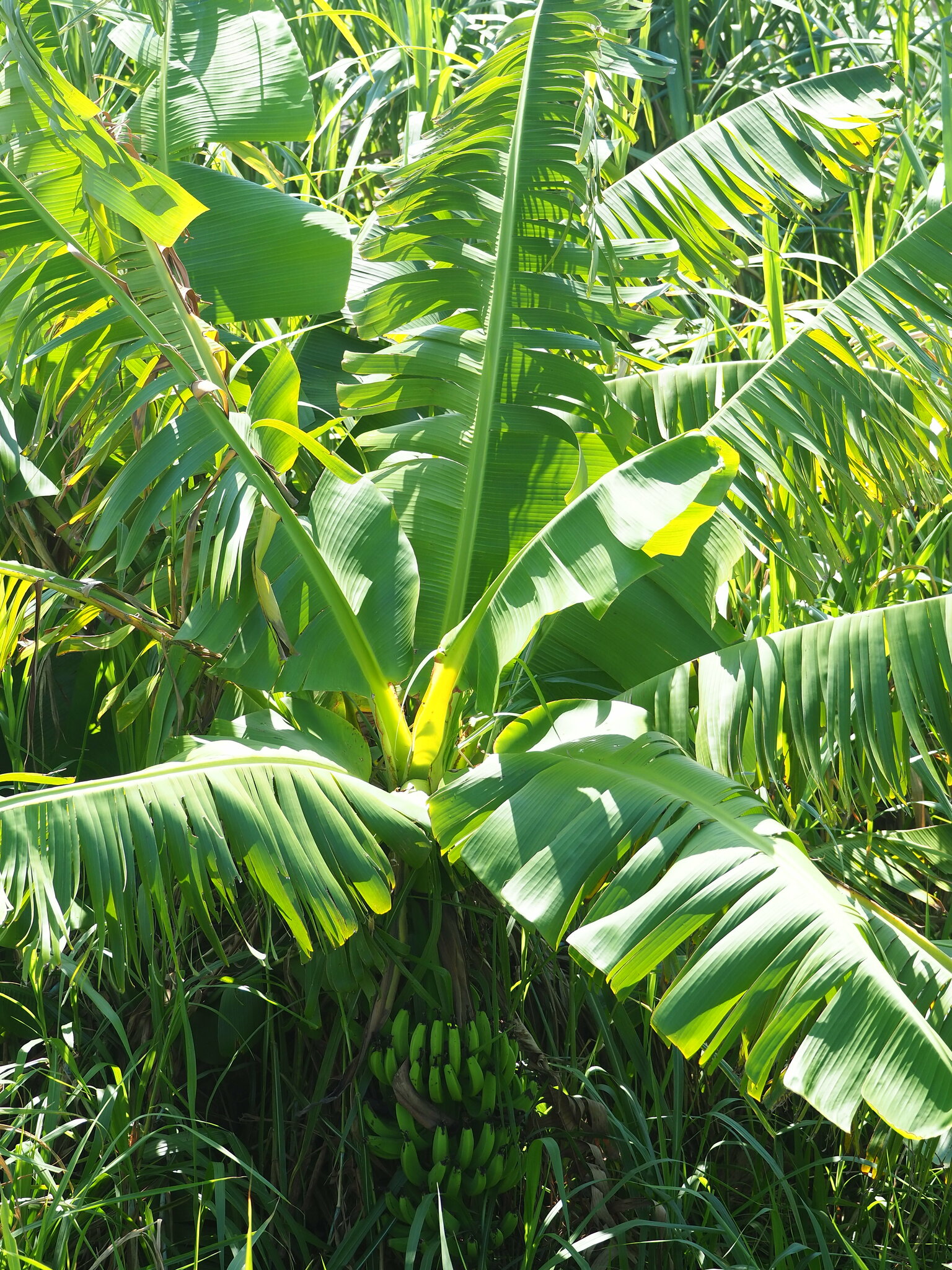
Musa acuminata is the wild banana behind most of the ornamental and edible bananas found in cultivation, grown chiefly for its huge paddle-shaped leaves rather than its fruit. In the tropics it is a fast-growing, evergreen, suckering herbaceous perennial, though in cooler climates it is more often kept as a container or houseplant, with dwarf selections such as 'Dwarf Cavendish' bred to suit that role.
Source: Missouri Botanical Garden
From Southeast Asia and Beyond
This species is native to Southeast Asia, Australia, and eastern Africa. Its genus name honors Antonia Musa, a Roman physician of the first century B.C., while the species name simply refers to leaves that taper into a long, narrow point.
Source: Missouri Botanical Garden
Light, Moisture, and Feeding
Give this banana full sun to light shade, with some protection from harsh midday sun and from strong winds that can tear its broad leaves. Soil or potting mix should be organically rich and well-drained but kept consistently moist, never allowed to dry out fully, and plants respond well to regular feeding through the growing season. The RHS notes a similar rhythm for container specimens: peat-free potting mix and a monthly balanced liquid feed, with watering cut back to just keeping the soil barely moist over winter.
Source: Missouri Botanical Garden
Suckers, Division, or Seed
New pseudostems arise naturally from suckers pushed out by the roots after the parent stem flowers and fruits and then dies. For deliberate propagation, separate suckers in early spring and remove their older leaves, or divide an established clump roughly every five years. Seed can also be sown as soon as it is ripe at 21–24°C, with spring-sown seed pre-soaked for 24 hours first.
Source: RHS
Pseudostem and Paddle Leaves
What looks like a trunk is really a pseudostem, formed by tightly overlapping leaf sheaths, topped by huge paddle-shaped leaves that can reach 6 to 10 feet long in mature plants. Mature specimens may produce cream to yellow flowers in summer, followed by edible yellow bananas, though younger plants often wait until their second or third year to flower, and container plants cut back hard each autumn may never flower at all. Once a pseudostem has fruited it dies back, but the root system keeps sending up new suckers to replace it.
Source: Missouri Botanical Garden
Watch for Sap Suckers
Houseplant specimens are mainly bothered by aphids, spider mites, mealybugs, and scale. The RHS likewise flags glasshouse red spider mite, mealybugs, and aphids as the main troublemakers, particularly on plants grown under glass.
Source: Missouri Botanical Garden
Seasonal Overwintering Routine
Outdoors in marginal climates this banana must be brought through winter indoors, whether kept as a houseplant with reduced water and feeding, cut back to 6–8 inches and stored dormant in a cool dark spot, or lifted with roots wrapped and stored the same way. In milder container culture, the RHS suggests potting up to overwinter under cover, or protecting plants in place with straw and chicken wire, keeping the soil just moist through winter. At season's end, older leaves can simply be removed, since little other pruning is needed.
Source: Missouri Botanical Garden
Care recipe
The species record — the baseline every cultivar inherits unless it says otherwise.
Care notes are early — not yet verified
- Light
- ai:claude-opus-4-8
- Water
- ai:claude-opus-4-8 (range 4-9d)
- Humidity
- ai:claude-opus-4-8
- Soil
- ai:claude-fable-5
- Care
- ai:claude-fable-5
Bright, indirect
≈ every 9 days
High
18–30 °C
Rich, moisture-retentive loamy mix that drains freely
Division of pups from the base
Feed generously every 2 to 4 weeks in the growing season
Fast
Rarely flowers or fruits indoors
Non-toxic to cats & dogs
Banana (Musa) — ASPCA non-toxic to cats, dogs, horses. This is where toxicity lives: every cultivar of this species inherits it and none can override it.
Reference images
Every image credited. Licenses link to their deeds.
PrimarySources: ai:claude-opus-4-8 · ai:claude-opus-4-8 (range 4-9d) · ai:claude-fable-5 · ASPCA
Kept true by its growers
Every fact here carries its source. Grow Edible Banana yourself? What you’ve observed — how it drinks, how it holds its color, a name that’s off — and a clear photo of your plant are exactly what keep this page honest. Contributions are reviewed before anything changes.
Sign in to add what you know →