Species · genus Microcitrus · Rutaceae
Finger Lime
Citrus australasica F.Muell.
Also known as: Australian Finger Lime · Caviar Lime · Australian Caviar Lime · Lime Caviar · Citrus Caviar
Cultivars of C. australasica
The named forms growers keep — each with its own page, each honest about how much we know.
No named cultivars catalogued under C. australasica yet. When growers document a stable, named form, it earns its own page here.
Guide
The species-level account. Cultivar pages build on this and say where they differ.
Citrus, Reimagined as Caviar
The finger lime, Citrus australasica, is a spiny evergreen citrus known for fruit whose pulp breaks into tiny juice-filled pearls, earning it the nickname citrus caviar. It sits in the same family as lemons, oranges, and mandarins, but its unusual texture has made it a favourite among chefs rather than a supermarket staple.
Source: Epic Gardening
An Australian Rainforest Native
This is one of six citrus species native to Australia, where it grows wild as an understory shrub or small tree in rainforest conditions. Mature plants in the wild can range from six to twenty-five feet tall, and the RHS lists its home range as eastern Australia.
Source: Epic Gardening
Sun, Steady Water, Light Feeding
This plant wants partial to full sun, at least six hours of direct light a day, and well-draining soil that leans loamy and slightly acidic to neutral. Water in the morning once or twice a week, keeping the soil moist but never soggy, and water more attentively during flowering and fruit set since underwatering in warm months can bring on leaf drop. Feed in spring and summer with a citrus-formulated fertilizer, applied sparingly compared to other citrus, and hold off feeding during bloom and early fruiting to avoid pushing flowers and fruit to drop.
Source: Epic Gardening
Grafting Over Seed
Grafting and rooted cuttings are the reliable routes here, since seed is hard to source and germinates poorly. Chip budding onto seedling rootstock is the standard grafting method and is preferred for trees destined for the ground, while two-to-four-inch cuttings treated with rooting hormone and kept humid out of direct light suit container growing, typically rooting in about two weeks.
Source: Epic Gardening
Thorns, Pink Flowers, Finger Fruit
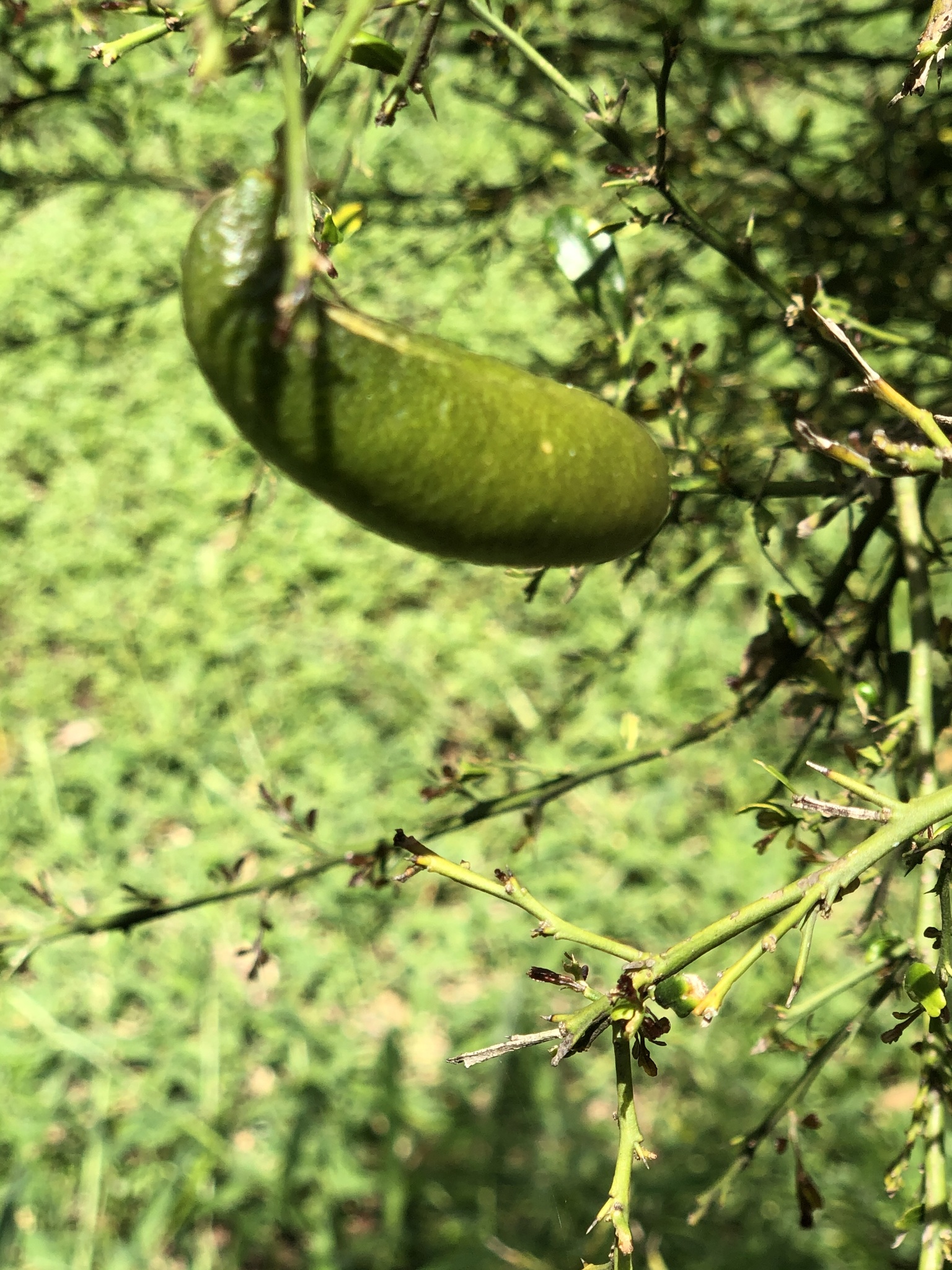
The tree carries small evergreen leaves with a thorn at each leaf axil, and flowers that open bright pink before fading to pale pink or white. Its fruit is long, cylindrical, often curved, and usually seedless, ranging from one to six inches and coming in red, yellow, green, purple, or brown depending on variety. The RHS describes the same fruit more plainly as cylindrical, to about seven centimetres, green to bronze-flushed, ripening in late autumn and best opened by cutting through the middle and gently squeezing out the pearls.
Source: RHS
Mites, Scale, and Leaf Miners
Mites cause stippling on leaves and tend to target trees already under stress, while soft and armored scale insects excrete honeydew that invites sooty mold and can lead to leaf drop; both are often kept in check by natural predators, with horticultural oils as backup. Aphids and lepidopteran larvae, including leaf rollers and citrus leaf miner, round out the common troublemakers, and small infestations can often just be removed by hand. The RHS separately notes scale insects, mealybugs, and glasshouse red spider mite as the pests to watch for under glass.
Source: Epic Gardening
Shade, Wind, and Overfeeding
Too much shade won't kill the plant but will sharply cut fruiting. Flower and fruit drop beyond the normal amount usually traces back to extreme weather or fertilizing during bloom and early fruit set, and wind is its own hazard since thorns can puncture developing fruit and open the door to rot. On the disease side, Phytophthora root disease shows as yellow or pale leaves and, in advanced cases, gumming on the trunk, and is best headed off with good drainage and by keeping the graft union above soil level.
Source: Epic Gardening
Prune After Harvest, Mind the Thorns
Pruning is best done after harvest, roughly March through May, so flowers and developing fruit are not lost, though it can technically happen anytime. Because the plant is densely thorned, heavy-duty puncture-resistant gloves are essential; the work is mainly about maintaining size, removing dead shoots, and clearing old fruit that hasn't dropped on its own.
Source: Epic Gardening
Care recipe
The species record — the baseline every cultivar inherits unless it says otherwise.
Care notes are early — not yet verified
- Light
- ai:claude-opus-4-8
- Water
- ai:claude-opus-4-8 (range 5-10d)
- Humidity
- ai:claude-opus-4-8
- Soil
- ai:claude-fable-5
- Care
- ai:claude-fable-5
Direct sun
≈ every 10 days
Medium
10–30 °C
Well-draining, slightly acidic citrus mix
Semi-hardwood cuttings or grafting
Regular citrus feed through spring and summer
Slow
Small pink-tinged white flowers in bright light
Toxic to cats & dogs
Citrus — essential oils + psoralens; vomiting, diarrhoea, photosensitivity, dermatitis. This is where toxicity lives: every cultivar of this species inherits it and none can override it.
Reference images
Every image credited. Licenses link to their deeds.
PrimarySources: ai:claude-opus-4-8 · ai:claude-opus-4-8 (range 5-10d) · ai:claude-fable-5 · ASPCA
Kept true by its growers
Every fact here carries its source. Grow Finger Lime yourself? What you’ve observed — how it drinks, how it holds its color, a name that’s off — and a clear photo of your plant are exactly what keep this page honest. Contributions are reviewed before anything changes.
Sign in to add what you know →