Species · genus Mammillaria · Cactaceae
Golden Star Cactus
Mammillaria elongata DC.
Also known as: Lace Cactus · Ladyfinger Cactus · Gold Lace Cactus
Cultivars of M. elongata
The named forms growers keep — each with its own page, each honest about how much we know.
No named cultivars catalogued under M. elongata yet. When growers document a stable, named form, it earns its own page here.
Guide
The species-level account. Cultivar pages build on this and say where they differ.
The Ladyfinger Cactus
Mammillaria elongata, known as the ladyfinger cactus, is a clump-forming member of the Cactaceae grown for its clustered, finger-like stems. It carries small pale yellow flowers, sometimes tinged pink, and has earned the RHS Award of Garden Merit as a houseplant and conservatory subject.
Source: RHS
A Mexican Native
This species comes from central Mexico, where it grows as a spiny, clump-forming cactus. The genus Mammillaria as a whole is defined by spherical or columnar stems, often clustered, covered in prominent tubercles and topped with a ring of funnel-shaped flowers near the stem apex.
Source: RHS
Sun, Water, Rest
Give this cactus full sun and grow it in a standard cactus compost with sharp drainage, ideally under glass with low humidity. Water moderately while it is actively growing and feed every two or three weeks with a balanced liquid feed, then hold back to almost dry through winter dormancy.
Source: RHS
Seed or Offsets
New plants can be raised from seed sown at 19–24°C in early spring, or more simply by removing the offsets that cluster around the parent stems.
Source: RHS
Slender Clustered Stems
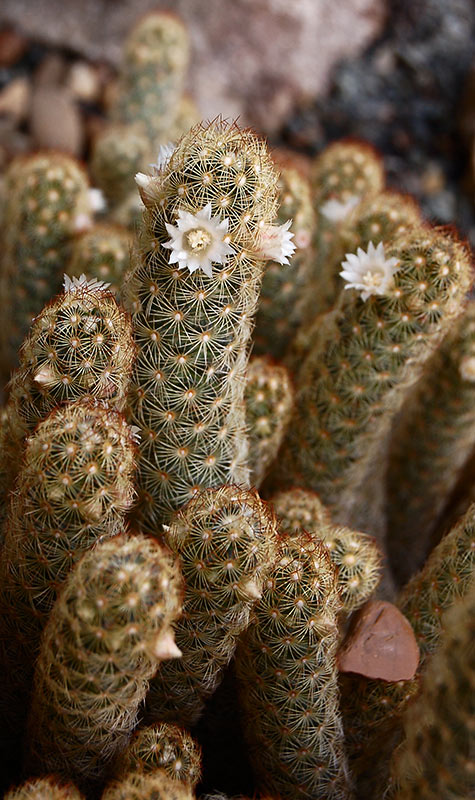
The stems are cylindrical, reaching up to about 15cm, and cluster together to form a low, spreading mound rarely taller than half a metre. Spines run creamy-yellow to brown along the stems, and the small flowers, only about 1.5cm long, appear pale yellow or faintly pink. It stays evergreen and clump-forming year round.
Source: RHS
Watch for Mealybugs
Mealybugs are the pest most likely to trouble this cactus, so it is worth checking stem crevices and tubercles now and then.
Source: RHS
Little Intervention Needed
No pruning is required for this species, and it is generally free of disease, so maintenance mainly comes down to keeping the winter rest dry and the summer feeding schedule steady.
Source: RHS
Care recipe
The species record — the baseline every cultivar inherits unless it says otherwise.
Care notes are early — not yet verified
- Light
- ai:claude-opus-4-8
- Water
- ai:claude-opus-4-8 (range 14-28d)
- Humidity
- ai:claude-opus-4-8
- Soil
- ai:claude-fable-5
- Care
- ai:claude-fable-5
Direct sun
≈ every 28 days
Low — average room
7–32 °C
Gritty, fast-draining cactus mix
Offsets separated and rooted after callusing
Dilute low-nitrogen cactus feed in spring and summer
Moderate
Small cream to yellow flowers in spring
Not yet documented
This is where toxicity lives — every cultivar of this species inherits it and none can override it.
Reference images
Every image credited. Licenses link to their deeds.
Sources: ai:claude-opus-4-8 · ai:claude-opus-4-8 (range 14-28d) · ai:claude-fable-5
Kept true by its growers
Every fact here carries its source. Grow Golden Star Cactus yourself? What you’ve observed — how it drinks, how it holds its color, a name that’s off — and a clear photo of your plant are exactly what keep this page honest. Contributions are reviewed before anything changes.
Sign in to add what you know →