Species · genus Ludisia · Orchidaceae
Jewel Orchid
Ludisia discolor (Ker Gawl.) Blume
Cultivars of L. discolor
The named forms growers keep — each with its own page, each honest about how much we know.
No named cultivars catalogued under L. discolor yet. When growers document a stable, named form, it earns its own page here.
Guide
The species-level account. Cultivar pages build on this and say where they differ.
A Foliage Orchid
Ludisia is a small orchid genus, really just two species, grown chiefly for its foliage rather than its flowers. It is a jewel orchid, prized for leaves rather than blooms, and while it does flower, those blooms are modest compared with most orchids. What makes it notable in cultivation is that it grows quite differently from the orchids most people know.
Source: Epic Gardening
From Asian Forest Floors
Ludisia discolor was first described in 1818 and, through an early mix-up, was thought to hail from Brazil before its true home in Asia was confirmed. It grows across southern China, Vietnam, Malaysia, Indonesia, Myanmar, the Philippines, Thailand, and northern India, and is especially common in Malaysia. For a long time the genus held only this one species, until Ludisia ravanii was recognized in 2013, found solely in the Philippines. The RHS gives its range simply as the Himalaya to Java.
Source: Epic Gardening
A Different Kind of Orchid
Because Ludisia grows in the ground rather than on bark, its care departs from typical orchid wisdom. Epic Gardening recommends low to medium, diffused or indirect light, since direct sun will scorch the leaves into white, eventually rotting patches. Water weekly, letting only the top inch of soil dry rather than the whole pot, in a custom mix of equal parts peat moss, perlite, and potting soil. It prefers warmth between 70-80°F, humidity around 70 percent, and a light feeding roughly every two months with diluted orchid or all-purpose fertilizer. The RHS, by contrast, suggests houseplant compost or a bark-and-sphagnum mix, allowing the compost to dry between waterings, in an airy, humid spot with partial shade and feeding frequently with orchid fertiliser.
Source: Epic Gardening
Easy Stem Division
Ludisia is unusually easy to propagate by division, more so than most orchids. Epic Gardening advises cutting an outer section of stem with about three inches of growth and potting it separately, covering the cutting with a plastic bag to hold moisture while roots form. The RHS offers a similar route: place broken-off fleshy stem sections in sphagnum moss, where roots typically form within about six weeks, and pot the cuttings into houseplant compost after roughly six months.
Source: RHS
Velvet Leaves, Modest Flowers
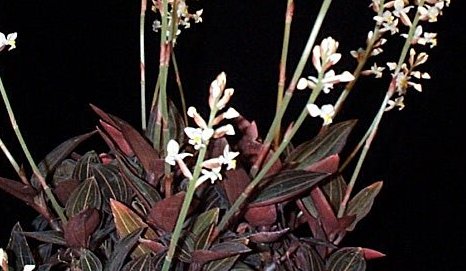
Unlike most orchids, which perch on trees or rocks, Ludisia grows on the ground, spreading horizontally along a rhizome and sending up short pseudobulbs. The RHS describes the leaves as velvety, dark purple-brown, four to seven centimetres long, marked with red or gold veins, an evergreen plant with an upright, columnar habit. Epic Gardening adds that the leaf tops carry a shimmering texture, with red undersides and bold contrasting veining being the plant's signature. Flowers are small, white with a yellow lip, carried on a slender stem, and appear once a year, usually as the weather cools.
Source: RHS
Sap-Sucking Visitors
Aphids, spider mites, thrips, and mealybugs are the usual suspects, piercing foliage to feed on sap and weakening the plant as colonies build. Epic Gardening notes these pests also leave behind sticky honeydew, which invites black sooty mold that interferes with photosynthesis. The RHS lists aphids, glasshouse red spider mite, and mealybugs as the main concerns, though it notes the plant is otherwise generally disease-free.
Source: Epic Gardening
Rot, Sunburn, and Silence
Direct sun burns the leaves into white patches that soften and rot, and since orchids are prone to fungal trouble, any rotting tissue should not be left in place. Losing only the oldest leaves is a normal part of aging, but losing more than that points to fungal issues in the root, rhizome, or crown, usually from overwatering. If the plant will not bloom, the likely cause is a lack of the cooler temperature shift it needs indoors to trigger flowering, along with insufficient feeding.
Source: Epic Gardening
Light Pruning, Occasional Repotting
Ludisia needs little pruning beyond removing dead or diseased foliage and, after flowering, cutting the spent flower spike back to just above the lowest node so the plant redirects energy into new growth. The RHS agrees, advising that flower stems be cut back once the blooms have died. As the plant spreads, it will eventually need repotting into a wide, shallow container that suits its shallow, horizontal root system.
Source: Epic Gardening
Care recipe
The species record — the baseline every cultivar inherits unless it says otherwise.
Care notes are early — not yet verified
- Light
- ai:claude-opus-4-8
- Water
- ai:claude-opus-4-8 (range 5-10d)
- Humidity
- ai:claude-opus-4-8
- Soil
- ai:claude-fable-5
- Care
- ai:claude-fable-5
Low light
≈ every 10 days
High
16–29 °C
Humus-rich, moisture-retentive terrestrial-orchid mix
Stem cuttings laid on damp moss
Dilute balanced feed monthly while in growth
Moderate
Small white blooms on tall spikes in winter
Not yet documented
This is where toxicity lives — every cultivar of this species inherits it and none can override it.
Reference images
Every image credited. Licenses link to their deeds.
Sources: ai:claude-opus-4-8 · ai:claude-opus-4-8 (range 5-10d) · ai:claude-fable-5
Kept true by its growers
Every fact here carries its source. Grow Jewel Orchid yourself? What you’ve observed — how it drinks, how it holds its color, a name that’s off — and a clear photo of your plant are exactly what keep this page honest. Contributions are reviewed before anything changes.
Sign in to add what you know →