Species · genus Kalanchoe · Crassulaceae
Flour-dust Plant
Kalanchoe pumila Baker
Cultivars of K. pumila
The named forms growers keep — each with its own page, each honest about how much we know.
No named cultivars catalogued under K. pumila yet. When growers document a stable, named form, it earns its own page here.
Guide
The species-level account. Cultivar pages build on this and say where they differ.
Dwarf kalanchoe, in brief
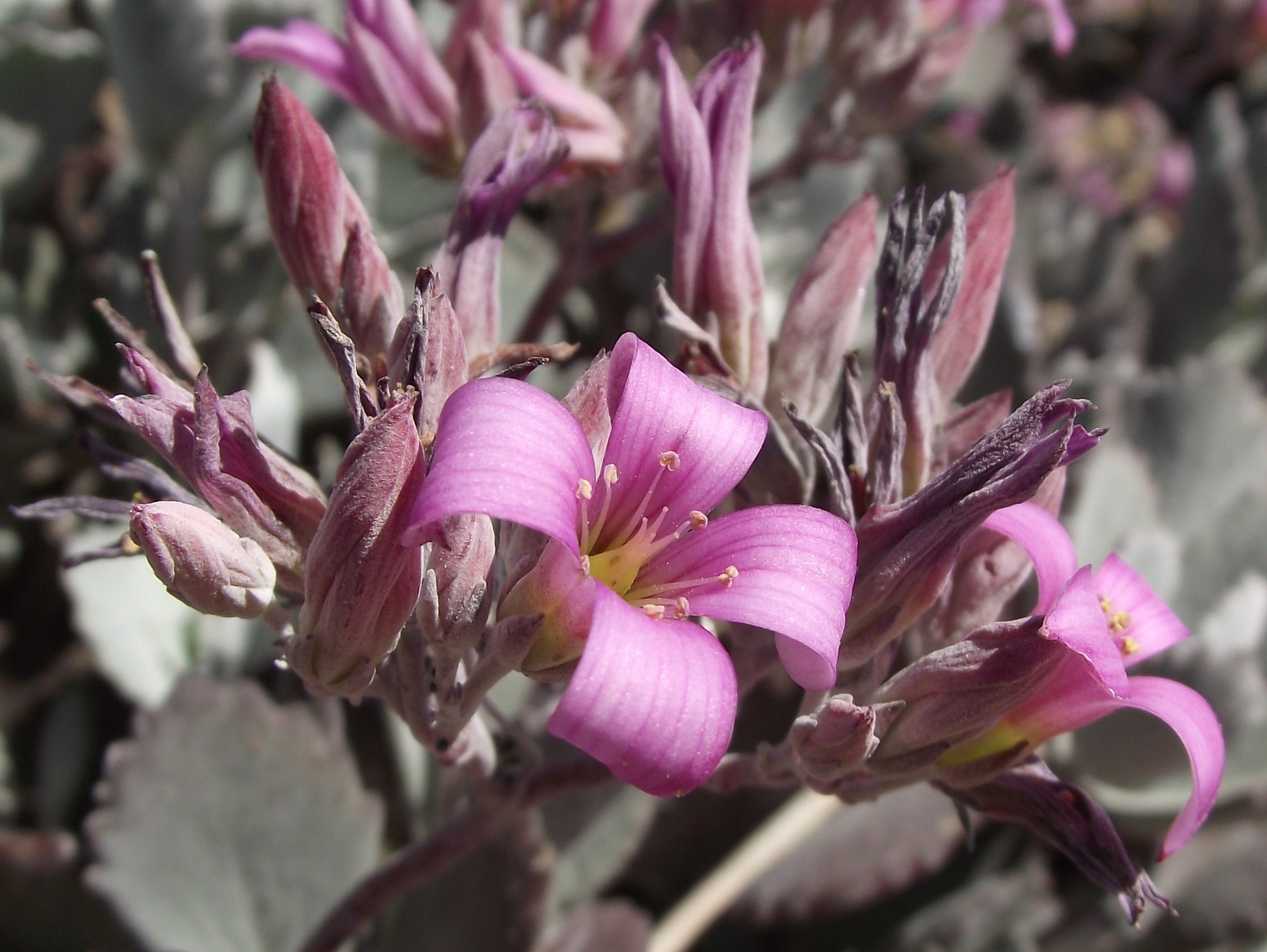
Kalanchoe pumila is an evergreen succulent sub-shrub reaching only around 20cm in height, its arching stems set with powdery-white, obovate leaves. In season it carries clusters of small, urn-shaped pink flowers lined with purple, each about 1cm long.
Source: RHS
A Madagascan native
This kalanchoe comes from east-central Madagascar, where it grows as an epiphyte within a seasonally dry tropical landscape. It was first described by Baker and published in 1883.
Source: Kew
Light, water, feeding rhythm
Grow it under glass in full light with good ventilation, in a peat-free, loam-based compost sharpened with extra sand or grit. Water moderately through the year but hold back in winter, and during the growing season give a balanced liquid feed two or three times. It favours a sheltered, south- or east-facing spot and well-drained soil that can run from acid to alkaline.
Source: RHS
By seed or offset
Propagate this kalanchoe from seed sown at 19–21°C in early spring, or simply take offsets from the parent plant.
Source: RHS
Arching stems, powdery leaves
The plant's bushy, evergreen habit shows off arching stems lined with pale, powdery-white leaves, a texture typical of its succulent nature. Its small pink, purple-lined flowers cluster in an urn shape, offering a modest but distinctive bloom against the foliage.
Source: RHS
Watch for mealybugs, aphids
Mealybugs and aphids are the pests most likely to trouble this kalanchoe, so it is worth checking stems and leaf joints for their early signs.
Source: RHS
Mildew and rust risks
Powdery mildews and a rust disease are the problems most associated with this plant, so good ventilation and careful watering help keep both at bay.
Source: RHS
Little upkeep needed
No pruning is required for this compact sub-shrub, making it a genuinely low-maintenance choice for a container or conservatory position. It reaches maturity over roughly two to five years.
Source: RHS
Care recipe
The species record — the baseline every cultivar inherits unless it says otherwise.
Care notes are early — not yet verified
- Light
- ai:claude-opus-4-8
- Water
- ai:claude-opus-4-8 (range 10-18d)
- Humidity
- ai:claude-opus-4-8
- Soil
- ai:claude-fable-5
- Care
- ai:claude-fable-5
Bright, indirect
≈ every 18 days
Medium
13–27 °C
Gritty, fast-draining cactus and succulent mix
Stem or leaf cuttings root easily in dry mix
Light succulent feed monthly in spring and summer
Moderate
Pink flowers in spring; powdery frosted foliage is the draw
Toxic to cats & dogs
Kalanchoe (Crassulaceae) contain cardiac bufadienolide glycosides known to be toxic to pets. This is where toxicity lives: every cultivar of this species inherits it and none can override it.
Reference images
Every image credited. Licenses link to their deeds.
PrimarySources: ai:claude-opus-4-8 · ai:claude-opus-4-8 (range 10-18d) · ai:claude-fable-5 · ai:claude-opus-4-8 (family inference)
Kept true by its growers
Every fact here carries its source. Grow Flour-dust Plant yourself? What you’ve observed — how it drinks, how it holds its color, a name that’s off — and a clear photo of your plant are exactly what keep this page honest. Contributions are reviewed before anything changes.
Sign in to add what you know →