Species · genus Kalanchoe · Crassulaceae
Penwiper
Kalanchoe marmorata Baker
Cultivars of K. marmorata
The named forms growers keep — each with its own page, each honest about how much we know.
No named cultivars catalogued under K. marmorata yet. When growers document a stable, named form, it earns its own page here.
Guide
The species-level account. Cultivar pages build on this and say where they differ.
A marbled succulent
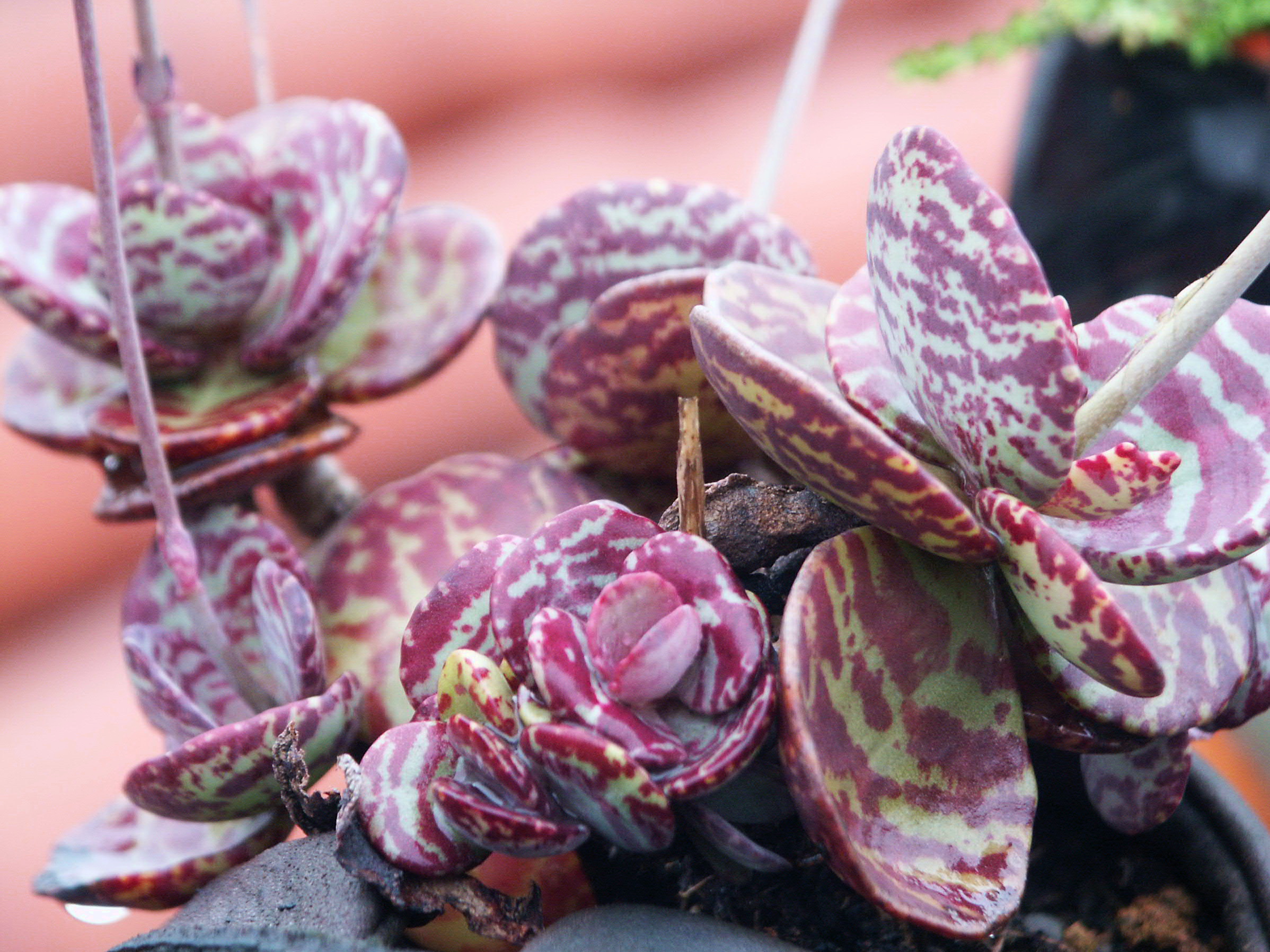
Kalanchoe marmorata, sometimes called penwiper, is a succulent perennial in the Crassulaceae family. It carries broad, toothed, glaucous leaves marked with purple mottling, and in season sends up loose sprays of white or pinkish tubular flowers.
Source: RHS
Roots in East Africa
This species was first described by Baker in 1892 and comes from a wide swathe of Africa, native from Eritrea and Ethiopia down through Kenya, Uganda, Rwanda and Tanzania, with outposts in Somalia, Sudan and DR Congo. It grows there as a succulent subshrub in seasonally dry tropical habitats, and has long been used locally as a medicine.
Source: Kew
Sun, sparing water, feeding
Give it full light with good ventilation, ideally under glass, in a peat-free, loam-based mix sharpened with grit or sand. Water moderately through the growing season and cut right back in winter, since it is far more likely to suffer from excess moisture than from drought. During spring and summer a balanced liquid feed two or three times supports steady growth.
Source: RHS
Cuttings, offsets, or seed
The RHS notes this species can be raised from seed sown at 19–21°C in early spring or from offsets. More broadly for kalanchoe, stem cuttings and offsets root readily, usually within fifteen to twenty days, once the cut end is left to callous over for a day or so before going into a free-draining succulent mix. Bright indirect light and light watering help the new roots establish before the cutting is treated like a mature plant.
Source: Epic Gardening
Marbled, textured foliage
The obovate leaves are toothed along their edges, glaucous in tone, and marbled with purple, reaching up to 20cm long. Flowers appear as panicles of slender white or pink tubes opening into spreading lobes up to 25mm across, and the plant keeps a bushy, evergreen habit staying under half a metre in height and spread.
Source: RHS
Watch for sap feeders
Mealybugs and aphids are the pests most likely to trouble this plant, generally showing up as small clusters on stems and leaf joints.
Source: RHS
Mildew and rust risk
Powdery mildews and a rust disease are the main problems flagged for this species, so good airflow and avoiding overly damp, still conditions are worth keeping in mind.
Source: RHS
Low upkeep, no pruning
This is a low-maintenance plant suited to pots and patios, and it needs no routine pruning. Its main cultivation demands are the right light, a gritty well-drained mix, and restrained winter watering.
Source: RHS
Care recipe
The species record — the baseline every cultivar inherits unless it says otherwise.
Care notes are early — not yet verified
- Light
- ai:claude-opus-4-8
- Water
- ai:claude-opus-4-8 (range 10-21d)
- Humidity
- ai:claude-opus-4-8
- Soil
- ai:claude-fable-5
- Care
- ai:claude-fable-5
Bright, indirect
≈ every 21 days
Low — average room
13–27 °C
Gritty, fast-draining cactus and succulent mix
Leaf or stem cuttings rooted in dry mix
Dilute succulent feed monthly in the growing season
Moderate
White to pale tubular flowers in winter on mature plants
Toxic to cats & dogs
Kalanchoe (Crassulaceae) contains cardiac bufadienolide glycosides toxic to animals. This is where toxicity lives: every cultivar of this species inherits it and none can override it.
Reference images
Every image credited. Licenses link to their deeds.
PrimarySources: ai:claude-opus-4-8 · ai:claude-opus-4-8 (range 10-21d) · ai:claude-fable-5 · ai:claude-opus-4-8 (family inference)
Kept true by its growers
Every fact here carries its source. Grow Penwiper yourself? What you’ve observed — how it drinks, how it holds its color, a name that’s off — and a clear photo of your plant are exactly what keep this page honest. Contributions are reviewed before anything changes.
Sign in to add what you know →