Species · genus Kalanchoe · Crassulaceae
Palm Beachbells
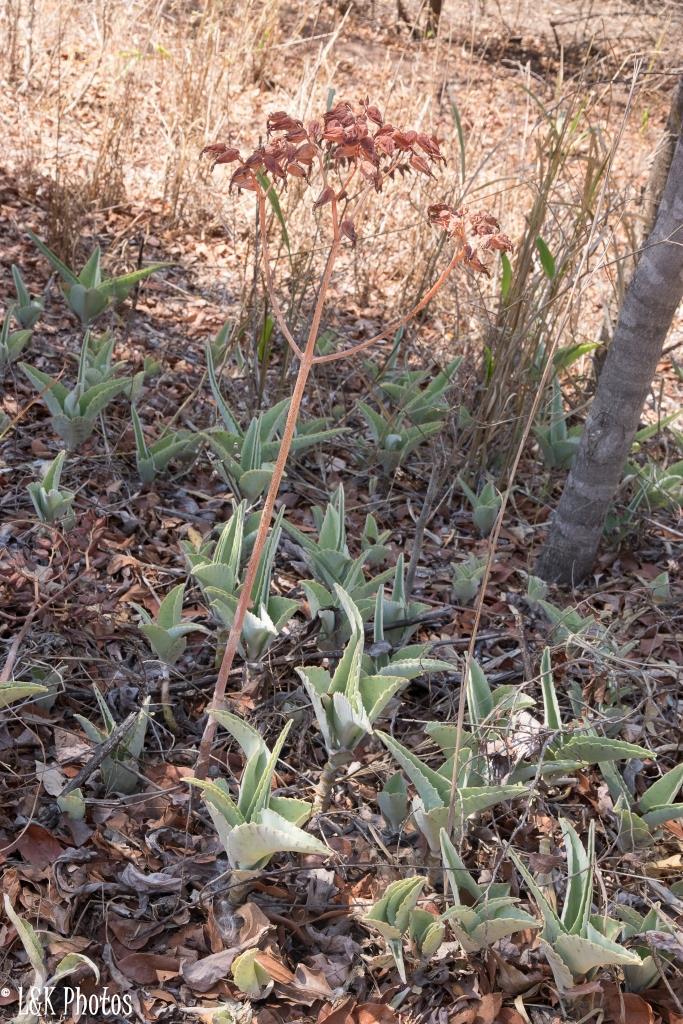
Kalanchoe gastonis-bonnieri Raym.-Hamet & H.Perrier
Also known as: Donkey Ears
Cultivars of K. gastonis-bonnieri
The named forms growers keep — each with its own page, each honest about how much we know.
No named cultivars catalogued under K. gastonis-bonnieri yet. When growers document a stable, named form, it earns its own page here.
Guide
The species-level account. Cultivar pages build on this and say where they differ.
A Madagascan Succulent
Kalanchoe gastonis-bonnieri is a succulent plant in the Crassulaceae family, growing as a biennial or subshrub. It belongs to a genus that ranges from annuals to shrubs and trees, generally marked by fleshy foliage and tubular, four-lobed flowers.
Source: RHS
Native to Madagascar
This species comes from northwestern and central Madagascar, where it grows in the seasonally dry tropical biome. It was first described in 1912 by Raymond-Hamet and Henri Perrier. Beyond its native range it has since been introduced to a scattering of places including Florida, Kenya, Senegal, Spain, Cameroon, El Salvador, and Zimbabwe.
Source: Kew
Habit and Classification
As a member of Crassulaceae, this kalanchoe carries the succulent, water-storing tissue typical of the family. Kew notes it has recognised environmental uses and includes two accepted botanical varieties, gastonis-bonnieri and adolphi-engleri.
Source: Kew
Care recipe
The species record — the baseline every cultivar inherits unless it says otherwise.
Care notes are early — not yet verified
- Light
- ai:claude-opus-4-8
- Water
- ai:claude-opus-4-8 (range 10-21d)
- Humidity
- ai:claude-opus-4-8
- Soil
- ai:claude-fable-5
- Care
- ai:claude-fable-5
Bright, indirect
≈ every 21 days
Low — average room
13–27 °C
Gritty, fast-draining cactus and succulent mix
Plantlets that form along leaf margins, simply potted up
Dilute succulent feed monthly in spring and summer
Fast
Occasionally sends up tubular bell flowers indoors
Toxic to cats & dogs
Kalanchoe (Crassulaceae) contain cardiac glycosides (bufadienolides) that are toxic to pets. This is where toxicity lives: every cultivar of this species inherits it and none can override it.
Reference images
Every image credited. Licenses link to their deeds.
PrimarySources: ai:claude-opus-4-8 · ai:claude-opus-4-8 (range 10-21d) · ai:claude-fable-5 · ai:claude-opus-4-8 (family inference)
Kept true by its growers
Every fact here carries its source. Grow Palm Beachbells yourself? What you’ve observed — how it drinks, how it holds its color, a name that’s off — and a clear photo of your plant are exactly what keep this page honest. Contributions are reviewed before anything changes.
Sign in to add what you know →