Species · genus Kalanchoe · Crassulaceae
Chandelier Plant
Kalanchoe delagoensis Eckl. & Zeyh.
Also known as: Mother Of Millions · Mother Of Thousands · Lizard Plant
Cultivars of K. delagoensis
The named forms growers keep — each with its own page, each honest about how much we know.
No named cultivars catalogued under K. delagoensis yet. When growers document a stable, named form, it earns its own page here.
Guide
The species-level account. Cultivar pages build on this and say where they differ.
The Chandelier Plant
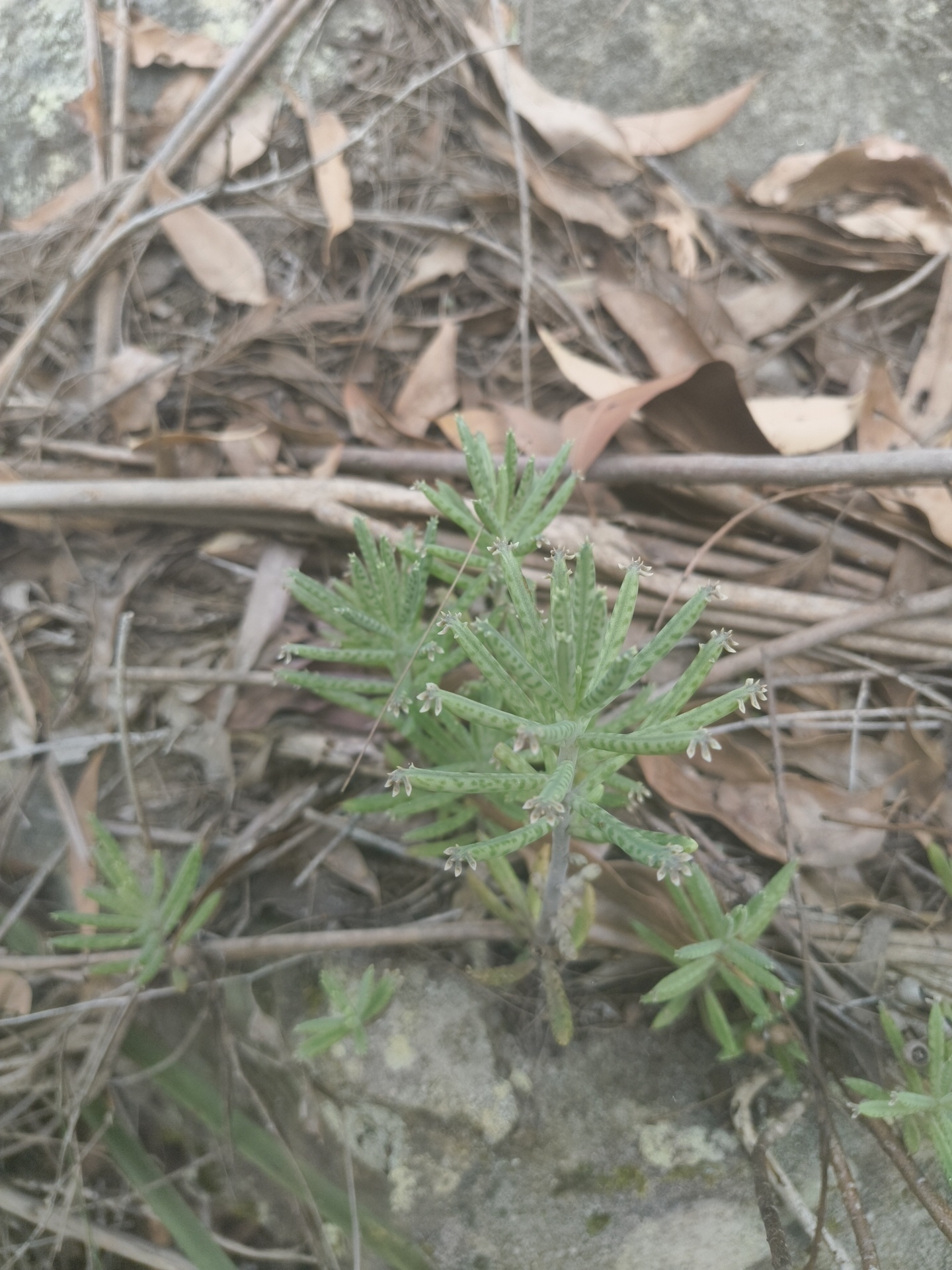
Kalanchoe delagoensis, commonly called the chandelier plant, is an upright succulent perennial in the Crassulaceae family, growing to about a metre tall. It carries almost cylindrical, grey-green leaves mottled with red-brown, and in late winter and early spring produces panicles of tubular to bell-shaped flowers ranging from purple-grey to pale orange-yellow.
Source: RHS
A Madagascan Native
This species is native to south-central and southern Madagascar, where it grows as a succulent subshrub in desert and dry shrubland. It has since spread widely beyond its homeland, becoming established across parts of Africa, the Americas, Asia, Australia, and various islands, and it carries a history of use both as an environmental plant and, notably, as a poison.
Source: Kew
Light, Water, and Feed
Grow it under glass in a peat-free, loam-based compost with added grit, set in full light with good ventilation. Water moderately through the growing season, cutting back to a sparing hand in winter, and feed with a liquid fertiliser two or three times while it is actively growing. In the home, bright indirect light suits it well, with a deep watering followed by a proper drying-out period between drinks, since this succulent is more likely to suffer from too much water than too little.
Source: Epic Gardening
Plantlets, Cuttings, or Seed
The easiest route is simply removing the plantlets that form at the leaf tips, though it can also be grown from softwood cuttings taken in spring or summer, or from seed sown at around 21°C in early spring. In practice, cuttings or offsets typically root within fifteen to twenty days once given time to callous over, dipped in rooting hormone, and set into a fast-draining succulent mix under bright, indirect light.
Source: RHS
Plantlets Along The Leaves
The defining trait of this plant is its habit of producing tiny plantlets at the tips of its narrow, near-cylindrical leaves, a trick that gives the species its common name and its knack for self-propagation. Its spreading, branched habit and grey-green, red-spotted foliage stay evergreen year-round, punctuated seasonally by clusters of pendant tubular flowers.
Source: RHS
Watch For Mealybugs
This plant may be susceptible to mealybugs and aphids, so it is worth checking leaf joints and the undersides of foliage for the telltale sticky residue or clustering insects.
Source: RHS
Mildew and Leaf Spot
Beyond pests, the chandelier plant can be affected by downy mildews and a leaf spot disease, worth ruling out if foliage develops discoloured patches or a dusty coating.
Source: RHS
Little Pruning Needed
No pruning is required for this species, making it a fittingly low-maintenance choice for a patio, conservatory, or greenhouse container.
Source: RHS
Care recipe
The species record — the baseline every cultivar inherits unless it says otherwise.
Care notes are early — not yet verified
- Light
- ai:claude-opus-4-8
- Water
- ai:claude-opus-4-8 (range 14-28d)
- Humidity
- ai:claude-opus-4-8
- Soil
- ai:claude-fable-5
- Care
- ai:claude-fable-5
Direct sun
≈ every 28 days
Low — average room
10–32 °C
Gritty, fast-draining succulent mix
Tip plantlets on cylindrical leaves root readily
Dilute succulent feed sparingly in the growing season
Fast
Orange-red drooping bells in winter
Toxic to cats & dogs & humans
Crassulaceae of this group contain bufadienolide cardiac glycosides, which are toxic if ingested. This is where toxicity lives: every cultivar of this species inherits it and none can override it.
Reference images
Every image credited. Licenses link to their deeds.
PrimarySources: ai:claude-opus-4-8 · ai:claude-opus-4-8 (range 14-28d) · ai:claude-fable-5 · ai:claude-opus-4-8 (family inference)
Kept true by its growers
Every fact here carries its source. Grow Chandelier Plant yourself? What you’ve observed — how it drinks, how it holds its color, a name that’s off — and a clear photo of your plant are exactly what keep this page honest. Contributions are reviewed before anything changes.
Sign in to add what you know →